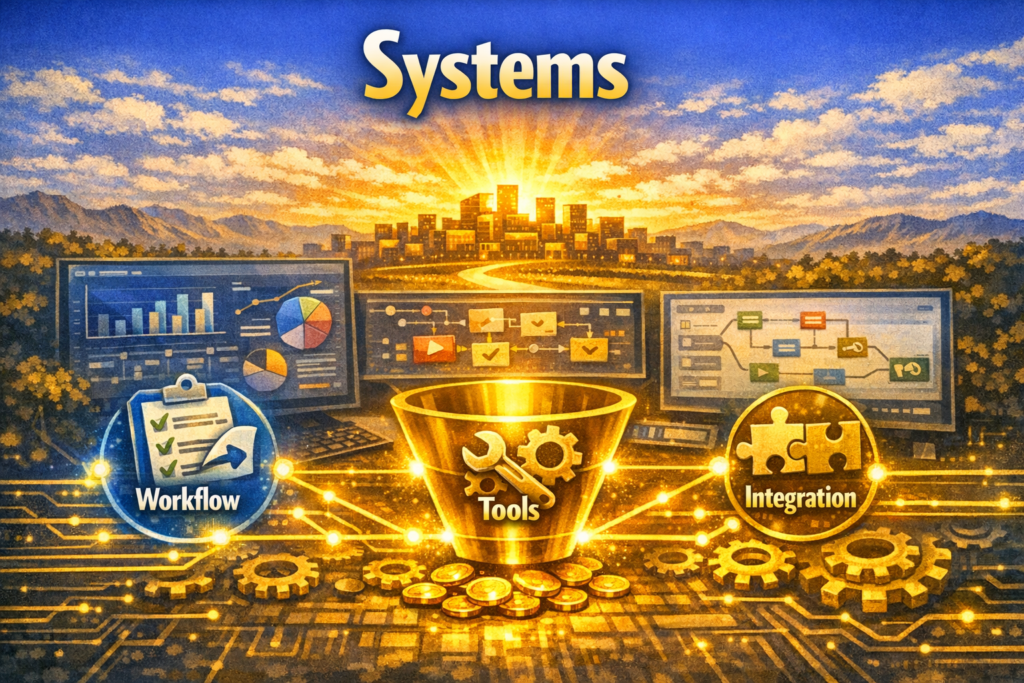
Most affiliates rebuild from scratch with every new offer, traffic source, or “strategy”. Systems change that. This page shows how to use simple systems and tracking to make your affiliate business predictable and easier to scale.
What “Systems” Mean For Affiliates
In this context, systems are repeatable ways of doing things that don’t depend on you guessing or starting over every time.
They cover how you track performance, publish content, run promotions, and optimize funnels so your results improve over time, not at random.
With basic systems in place you:
- Know what’s working and what isn’t.
- Spend less time firefighting and more time on high‑leverage work.
- Can scale traffic and offers without losing control.
The Core Affiliate System Stack
You do not need a huge tech stack. You do need a few simple, reliable systems that talk to each other.
Key pieces:
- Tracking & Analytics – link tracking, conversions, EPCs, and funnel metrics.
- Content & Publishing – how you ideate, create, and ship content consistently.
- Email & Follow‑Up – automated sequences and regular broadcasts.
- Testing & Optimization – a routine for improving pages, emails, and offers.
Think of these as the “engine room” of your Strategic Affiliate Empire.
Tracking & Analytics: Know Your Numbers
Without tracking you’re flying blind. With it, you can make confident decisions about where to put your time and money.
At minimum, track:
- Clicks on your affiliate links (by source and campaign).
- Opt‑ins (by page and traffic source).
- Sales, commissions, and earnings per click (EPC) for each offer.
Use:
- Analytics tools (e.g. Google Analytics, tracking platforms, or network dashboards) to see traffic and behaviour.
- Affiliate tracking tools/networks with clear reporting so you can see which campaigns, creatives, and pages actually produce results.
Set up simple UTM parameters or link IDs so you know exactly which content and funnels are driving sales, then double down on those.
Content & Publishing Systems: Consistency Without Burnout
A content system ensures you’re not waking up thinking “What should I post today?” every single day.
Instead, you build a pipeline that turns your strategy into a regular output of traffic‑generating assets.
Basic elements:
- An editorial calendar aligned with your pillars (strategy, niches/offers, traffic, systems).
- A repeatable creation workflow: research → outline → draft → edit → publish → promote.
- A reuse plan: turning one core piece (article, video, training) into multiple snippets for email and social.
The goal is not volume for its own sake; it’s steady, strategic publishing that continually feeds your funnels.
Email & Follow‑Up Systems: Automated Value And Sales
Email systems are where a lot of your long‑term revenue will come from.
Instead of manually writing every message from scratch, you build reusable sequences and a simple broadcast rhythm.
Key components:
- Welcome/indoctrination sequence for new subscribers.
- Offer sequences for your main products and affiliate recommendations.
- Ongoing broadcast rhythm (e.g. 1–3 emails per week) with tips, stories, and occasional promotions.
Use tags or segments so you can identify:
- Buyers vs non‑buyers.
- Interest segments (by topic, niche, or offer clicked).
This lets you send more relevant messages, improve engagement, and increase revenue per subscriber over time.
Testing & Optimization: Continuous Improvement
A system for optimization means you always know what you’re testing next instead of randomly changing things when you get frustrated.
Simple optimization loop:
- Pick one part of the funnel (headline, opt‑in page, email subject line, CTA, bonus).
- Create a clear alternative to test.
- Run the test for a set period or sample size.
- Keep the winner and document what you learned.
Use your tracking tools to monitor:
- Conversion rates at each step (opt‑in, click‑through, purchase).
- Revenue per visitor and EPC by traffic source and offer.
Small, consistent improvements here have compounding effects across your whole system.
Tooling: Keep It Simple, But Robust
There are many tools on the market; focus on ones that give you clear data and fit your current level.
Look for:
- Reliable link and conversion tracking (including options like server‑to‑server or postback where available).
- Real‑time or near real‑time reporting so you can spot issues quickly.
- Basic A/B testing capabilities or easy integration with testing tools.
The right tools support your systems; they don’t replace the need for strategy.
Turning Systems Into Your Strategic Advantage
Most affiliates compete on “what offer” or “what traffic source”. Few compete on systems.
By building simple systems for tracking, publishing, email, and optimization, you create a strategic advantage that is hard to copy and gets stronger over time.
The Strategic Affiliate Empire system is designed to help you:
- Decide what to track and how.
- Set up practical workflows.
- Turn your business into something you can measure, improve, and scale.
Your Next Step
If you’re ready to stop guessing and start running your affiliate business like a real, data‑driven operation:
- Get the Strategic Affiliate Empire book to understand how systems fit into the bigger picture.
- Join the Strategic Affiliate training to set up your own tracking, content, email, and optimization systems step‑by‑step.
- If you want help actually implementing what you’ve just read — with feedback, examples, and accountability — come join The Strategic Affiliate Lab on Skool. That’s where I break this down with the community, answer questions, and help you turn ideas into a working affiliate system.
Use this “Systems” page as the hub for deeper guides on tracking setup, dashboards, email automation, and optimization playbooks as you build them out.