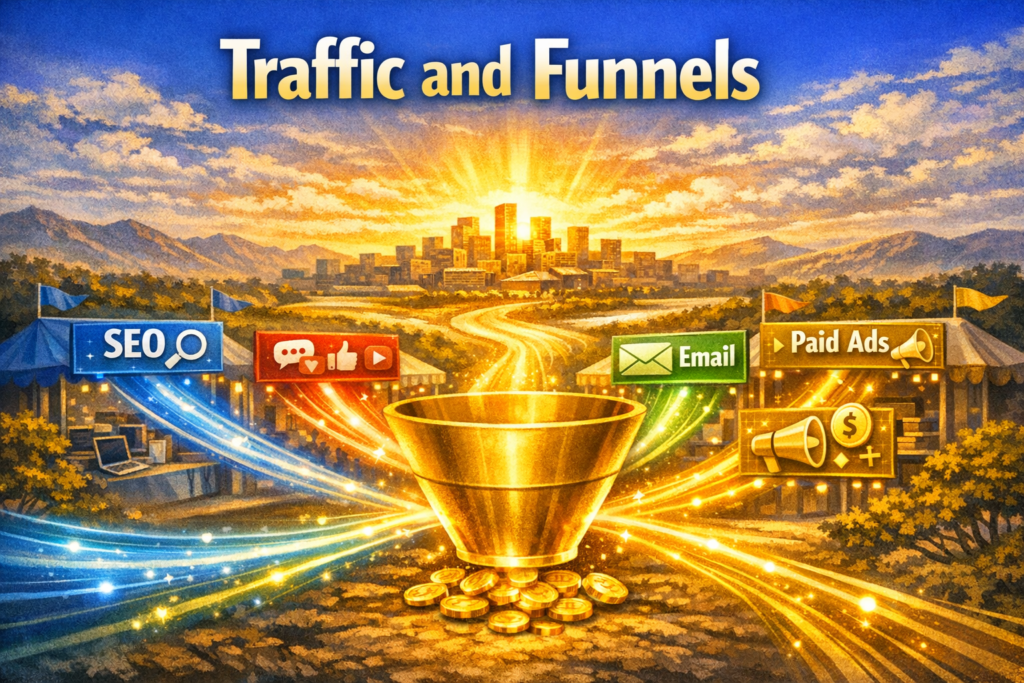
Most affiliates obsess over “more traffic” and then send it straight to a random offer link. The result: spikes of clicks, a few commissions, and no real asset being built.
This page shows how to design simple, strategic funnels so every visitor has a clear path from stranger to subscriber to buyer.
Why Traffic Without A Funnel Fails
Traffic is attention. A funnel is the structured journey that turns that attention into revenue.
Without a funnel, you rely on one‑click conversions; with a funnel, you build relationships and promote multiple aligned offers over time.
A good affiliate funnel helps you:
- Capture leads instead of losing them after one click.
- Educate and warm people before asking for a sale.
- Monetize through a stack of offers instead of a single link.
The Core Affiliate Funnel Framework
At a high level, a solid affiliate funnel has four stages:
- Attract: Bring in the right people with targeted content or ads.
- Capture: Turn visitors into email subscribers or community members.
- Nurture: Deliver value, build trust, and present offers.
- Convert & Ascend: Generate initial sales and then move buyers into complementary offers.
Your strategy is to design each stage deliberately instead of hoping a single blog post or video does everything.
Stage 1: Attract – Choosing Your Primary Traffic Channels
Strategic affiliates don’t try to be everywhere. They choose one or two main traffic channels and get very good at them.
Common high‑leverage channels:
- Search (SEO / blogs): Great for long‑term, compounding traffic from problem and solution‑aware searches.
- YouTube: Ideal for tutorials, comparisons, and review content.
- Email referrals and newsletters: Traffic from your own list and partner lists.
- Paid traffic: When you can track and afford it with a clear funnel and EPCs.
Pick:
- One long‑term channel (like SEO or YouTube).
- One “speed” channel (like social or collaborations) you can use to test offers and ideas quickly.
All of that traffic should point into intentional entry points in your funnel, not scattered links.
Stage 2: Capture – Turn Visitors Into Subscribers
Instead of sending traffic straight to affiliate links, send it to:
- Lead magnets: checklists, cheat sheets, templates, or short trainings that solve a specific problem for your niche.
- Content upgrades: niche‑specific extras offered within a blog post or video.
- Waitlists or mini‑workshops: time‑bound opt‑ins that collect warm leads.
Good capture offers are:
- Specific to your ideal customer.
- Closely tied to the offers you promote.
- Easy to consume quickly so people feel they got value.
Once they opt in, they move into your email funnel where you can build a real relationship.
Stage 3: Nurture – Emails That Build Trust And Set Up Offers
Nurture is where most affiliates drop the ball.
The goal is to deliver useful content while moving subscribers towards decisions on your offers, using a mix of education, stories, and direct recommendations.
A simple starting sequence:
- Email 1–2: Welcome, your story, and what they can expect from you.
- Email 3–4: Valuable how‑to content or quick wins aligned with your core promise.
- Email 5–7: Bridge into your main offers – why they matter, who they’re for, and how they help solve specific problems.
After the initial sequence, continue with:
- Regular tips and mini‑case studies.
- Occasional focused promotions of key offers.
- Links back to pillar pages and deeper content.
You’re aiming for a list that knows, likes, and trusts you enough that your recommendations carry real weight.
Stage 4: Convert & Ascend – From First Sale To Strategic Stack
Your funnel should be designed to:
- Generate an initial sale (often a lower‑ticket or entry‑level offer).
- Then ascend buyers into more complete, higher‑value solutions over time.
As an affiliate, this can look like:
- First promoting an accessible, high‑value product that solves an urgent problem.
- Later recommending complementary tools, advanced trainings, or services.
- Using segmentation (tags, links, surveys) to tailor which offers people see.
You’re not trying to squeeze everything into one email; you’re building a sequence of logical next steps that align with your audience’s progress.
Example: A Simple Strategic Affiliate Funnel
Here’s a streamlined example you can adapt to nearly any niche:
- Someone searches or clicks on content about a specific problem in your niche.
- Your blog post or video teaches something useful and offers a lead magnet for a deeper solution.
- They opt in and receive a 5–7 email sequence that gives value and introduces your main recommended solution(s).
- Those who buy are tagged and later shown additional, complementary offers.
- Those who don’t buy continue to receive useful content and periodic promotions.
This one funnel can run 24/7 once it’s built, with all your main traffic sources pointing into it.
Traffic Without Strategy vs Traffic With Funnels
| Aspect | Traffic Only (Tactical) | Traffic With Funnels (Strategic) |
|---|---|---|
| Goal | Get as many clicks as possible | Turn the right visitors into long‑term subscribers and buyers |
| Destination | Direct to affiliate links | Opt‑in pages, pre‑sell content, segmented funnels |
| Data you track | Clicks, maybe sales | Opt‑ins, open rates, EPCs, funnel step conversions |
| Revenue pattern | Spiky, unpredictable | More stable, compounding over time |
| Asset you’re building | None – traffic disappears after one click | Email list, content library, tested funnels |
Common Traffic And Funnel Mistakes
Most affiliates never fully benefit from their traffic because they:
- Treat every post or video as a standalone piece with no clear next step.
- Send cold traffic straight to offers that require trust.
- Don’t follow up with people who clicked but didn’t buy.
- Avoid email because it feels “complicated” – and then live launch‑to‑launch forever.
Fixing these often means more revenue from the traffic you already have, before you chase more.
Turning Your Traffic Into A Strategic Affiliate Empire
Traffic and funnels are where strategy becomes tangible: real people visiting, subscribing, buying, and staying in your world over time.
The Strategic Affiliate Empire system is built to help you design and implement simple funnels that fit your niche, offers, and positioning – without needing complex tech or agency‑level setups.
On this site you’ll find:
- The Strategic Affiliate Empire book – covering how to choose your channels, design your funnels, and align them with your offer stack.
- The Strategic Affiliate training – where you build these funnels step‑by‑step with guidance, examples, and templates.
Your Next Step
If you’re ready to stop chasing “more traffic” and start building funnels that turn attention into predictable affiliate income:
- Get the Strategic Affiliate Empire book to map out your traffic and funnel strategy.
- Join the Strategic Affiliate training to implement the exact funnel(s) that make sense for your niche and offers.
- If you want help actually implementing what you’ve just read — with feedback, examples, and accountability — come join The Strategic Affiliate Lab on Skool. That’s where I break this down with the community, answer questions, and help you turn ideas into a working affiliate system.
Use this page as your hub for all traffic and funnel content, and link out to deeper guides on SEO, YouTube, email sequences, and specific funnel templates as you create them.