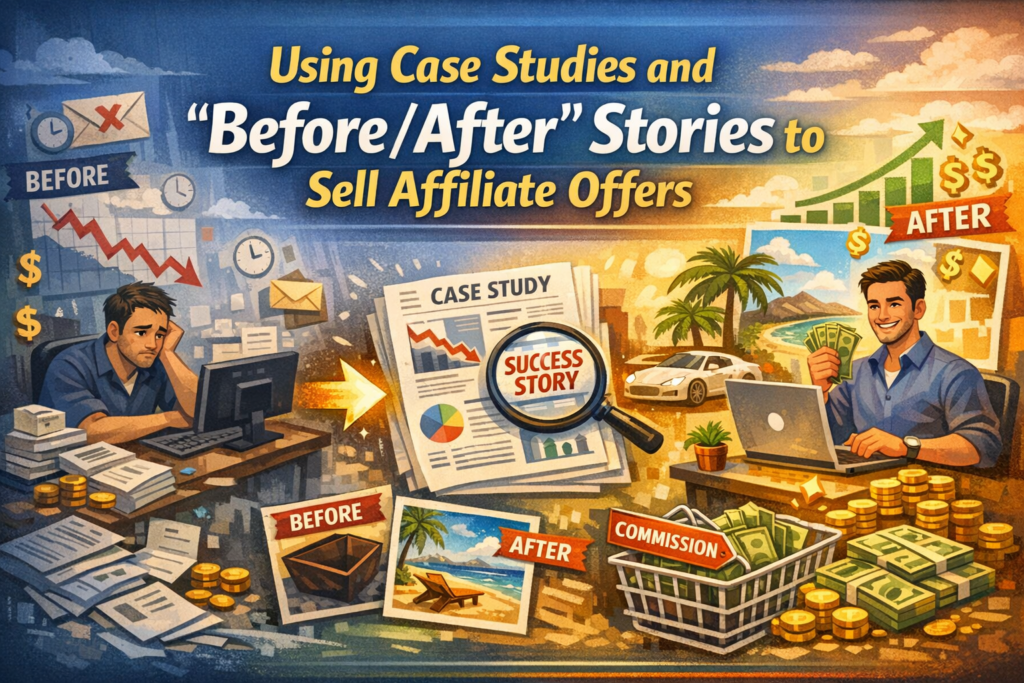
Using Case Studies and “Before/After” Stories to Sell Affiliate Offers
If you’ve ever stared at your stats thinking, “People are seeing my content, but they’re not buying,” there’s a good chance you have an evidence problem, not a traffic problem.
You’re telling people what tools do.
You might even be explaining why they’re useful.
But you’re not showing what happens when a real person actually uses them.
That’s where case studies and before/after stories come in.
In 2026, buyers are taking longer to research but making decisions in shorter windows once they hit that “I get it, this will work for me” moment. Story‑driven proof is one of the fastest ways to create that moment. Campaigns that use storytelling and real success stories consistently see higher engagement and conversions compared to dry, product‑only messaging.
In this post, I’ll show you how to use simple case studies and before/after stories to sell affiliate offers — without fabricating results or turning into an infomercial.
Why Stories Sell Better Than Specs
Humans don’t make decisions based on specs alone. We decide based on how we feel about what those specs mean for our life or business.
That’s why:
- Brands that introduced real customer success stories on their product pages saw conversion lifts of 15–35%.
- Campaigns using storytelling report up to 20% higher engagement and significantly higher conversion rates than purely promotional messaging.
In affiliate marketing, the same principle applies:
- A bullet point saying “Saves 5 hours per week” is abstract.
- A story saying “I went from drowning in manual follow‑ups to having my client reminders go out automatically while I’m offline” is real.
Case studies and before/after stories:
- Make your recommendations feel believable.
- Show the process, not just the outcome.
- Help people see themselves in the story — “If they can do it, I probably can too.”
That’s what moves someone from “interesting” to “I’m ready to click.”
The Difference Between a Case Study and a Before/After Story
You don’t need a 20‑page PDF to call something a case study. For our purposes:
- Case study: A structured breakdown of how a specific person (you, a client, or a subscriber) used a product or strategy to get a result.
- Before/after story: A shorter, more narrative version that highlights the shift from “then” to “now.”
Think of it as a spectrum:
- Case study = more detail, numbers, steps.
- Before/after = more emotion, contrast, and relatability.
Both can sell affiliate offers very effectively — especially when you’re the one in the story (or you have permission to share someone else’s).
Anatomy of a Simple Affiliate Case Study
Let’s build a case study structure you can reuse.
1. Who It’s About (and Why We Should Care)
Start with a quick snapshot:
- Who is this person (or business)?
- What situation were they in?
- Why is their situation relevant to your reader?
Example:
“This is Sam, a freelance designer who was spending 6–8 hours a week chasing late invoices and trying to keep track of client projects in spreadsheets.”
Immediately, readers who resemble “Sam” lean in.
2. The “Before” – Problem and Pain
Describe the starting point in clear, concrete terms:
- What was frustrating them?
- What was it costing them (time, money, stress, missed opportunities)?
- What had they already tried that didn’t work?
Don’t be afraid to get specific:
- “He’d tried using a basic to‑do app, but tasks kept slipping through the cracks and clients were chasing him for updates.”
- “She had 500+ subscribers sitting cold on a list and no idea what to send next.”
The more tangible the pain, the more meaningful the transformation.
3. The Turning Point – Why This Tool/Approach?
Next, show how the product or strategy you recommend entered the picture:
- How did they discover it?
- Why did they decide to try it?
- What made it different from what they’d tried before?
You can weave in your affiliate angle naturally:
“I suggested he try [Tool] because I’d used it myself to automate client onboarding — and it took me less than an afternoon to set up.”
You’re positioning the product as a logical response to a real problem, not as a random promo.
4. The “During” – What They Actually Did
Now, walk through the process at a high level:
- 3–7 key steps they took.
- How they set things up.
- Any important decisions or shortcuts.
This is where your case study doubles as a mini tutorial, which adds a ton of value.
Example:
- “We started by moving all active projects into [Tool] and setting up basic Kanban boards.”
- “Then we created three simple automations: new client onboarding, invoice reminders, and project status updates.”
- “Finally, we connected it to his calendar so he could see deadlines in one place.”
You can link to a full tutorial or checklist for readers who want to replicate it.
5. The “After” – Results and Change
Now the payoff:
- What changed, specifically?
- Time saved, revenue generated, stress reduced, consistency improved.
- Where possible, use numbers and timeframes.
You don’t need insane wins. Modest, believable improvements are more trustworthy.
Examples:
- “Within 3 weeks, Sam had cut his admin time from 6–8 hours down to 2 hours per week.”
- “Over 60 days, her open rates went from 12% to 28% and she made £430 in affiliate commissions from a list that had been ‘dead’ for months.”
6. Lessons Learned (and Who This Is For)
Wrap up with:
- 2–3 key lessons your reader can apply.
- A quick note on who this approach is best suited for.
This turns the story from “nice for them” into “useful for me.”
7. Call‑to‑Action (CTA)
Finally, connect the dots:
- “If you see yourself in Sam’s story and you’re juggling clients and chaos, here’s the exact tool we used and my walkthrough: [link].”
You’re not shouting “buy now.” You’re saying, “If this sounds like you, here’s what to do next.”
Quick Before/After Story Template (Perfect for Blog Intros and Emails)
Not every story needs the full case‑study treatment. For shorter content, use this simple template:
- Before: “I used to…” (describe the struggle)
- Trigger: “Then I tried…” (the tool/approach)
- After: “Now…” (specific improvement)
- Bridge: “In this post/email, I’ll show you how I did it and how you can do it too.”
Example:
“I used to spend Sunday nights rewriting the same ‘welcome’ emails for new subscribers from scratch. Then I finally set up a proper 7‑email sequence with [Email Tool]. Now my new subscribers get a full introduction to my world automatically, and I regularly wake up to affiliate clicks from emails I wrote once. In this post, I’ll show you exactly how I set that up.”
This works brilliantly as:
- Blog post intros
- Email hooks
- Short‑form video scripts
- Social posts that link to deeper content
Where to Use Case Studies and Before/After Stories in Your Affiliate Ecosystem
You don’t need separate “case study” pages (although those can be powerful). You can bake stories into places you’re already publishing.
1. In Review Posts
Instead of just listing features, drop in a story:
- A section called “How I Actually Use [Tool] Each Week.”
- A mini case study showing a real result.
This breaks up the review and makes it feel grounded instead of theoretical.
2. In Comparison Posts
When you’re writing “Tool A vs Tool B,” real usage stories are gold:
- “I used Tool A for 2 years, then switched to Tool B. Here’s what changed.”
- Short before/after around time saved, usability, or results.
Comparisons are already decision‑focused; stories help people pick a side.
3. In Email Sequences
Case studies fit perfectly in nurturing sequences:
- One email that’s “Here’s what happened when I finally did X.”
- Another that’s “How a reader went from [before] to [after] using this approach/tool.”
These emails often get higher click‑through rates because people love stories over pure info.
4. On Sales Pages and Resources Pages
If you have a “Tools I Use” or Resources page, consider adding one‑paragraph before/after blurbs under each tool instead of generic copy.
- “I used this to go from [pain] to [result] in [timeframe].”
That’s far more persuasive than “Great for productivity!”
Ethical Guardrails: How to Keep Stories Honest
Just like reviews, case studies need to be ethical and believable.
A few rules:
- Never fabricate results. If you don’t have a dramatic outcome, use a smaller but real one.
- Don’t cherry‑pick without context. If results required significant effort or other factors, mention that.
- Get permission if you’re sharing someone else’s story with identifying details.
- Avoid “typical results” claims unless you genuinely have data to back that up.
You’re aiming for “inspiring but realistic,” not “too good to be true.”
Remember: people are 22 times more likely to remember facts when they’re embedded in stories. That’s power — use it responsibly.
A Simple Workflow for Collecting Stories (Even if You’re New)
You might be thinking, “This is great, but I don’t have dozens of client stories yet.”
Start here:
- Document your own journey.
- Every time you implement a tool or tactic, jot down your before/after.
- Take screenshots of dashboards, timelines, or small wins.
- Ask your audience.
- When someone replies with a win, ask if you can anonymise and share it.
- Use simple prompts: “Hit reply and tell me what changed for you after you tried this.”
- Turn one story into multiple assets.
- Long case study on your blog.
- Short version in an email.
- 30–60 second before/after story as a Reel or Short.
- 1–2 lines on your Resources page.
Over time, you’ll build a library of proof that keeps working for you across platforms.
Final Thought: Tell the Story, Then Share the Link
Most affiliates start with the link and then look for a story to justify it.
Flip that.
Start with the story:
- Who did you help (including yourself)?
- What was their real‑world “before”?
- What changed after they used your recommended tool or approach?
Then share the link as the natural next step for anyone who sees themselves in that journey.
When you do that consistently, your affiliate marketing stops feeling like “selling” and starts feeling like what it actually is when done well:
Helping people go from where they are to where they want to be — and getting paid for pointing them to tools that genuinely help.
Next Step
If you want help turning your own results (or your audience’s wins) into clean, compelling case studies and before/after stories, join The Strategic Affiliate Lab Community. Share one situation you’re proud of — even a small win — and I’ll help you shape it into a story you can use across your blog, emails, and social content to sell your affiliate offers more effectively.