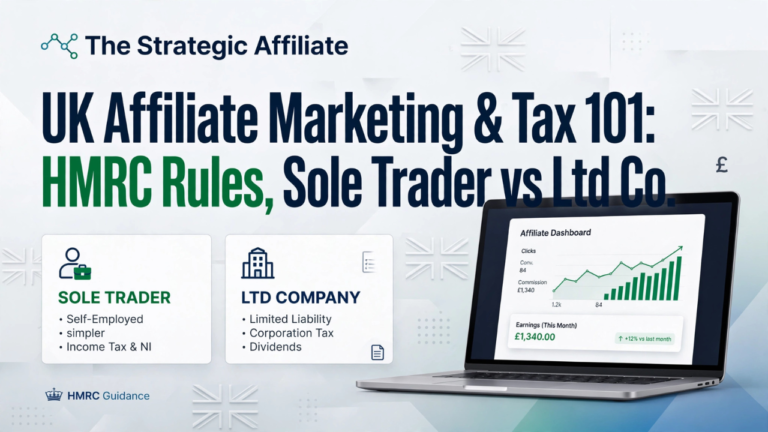
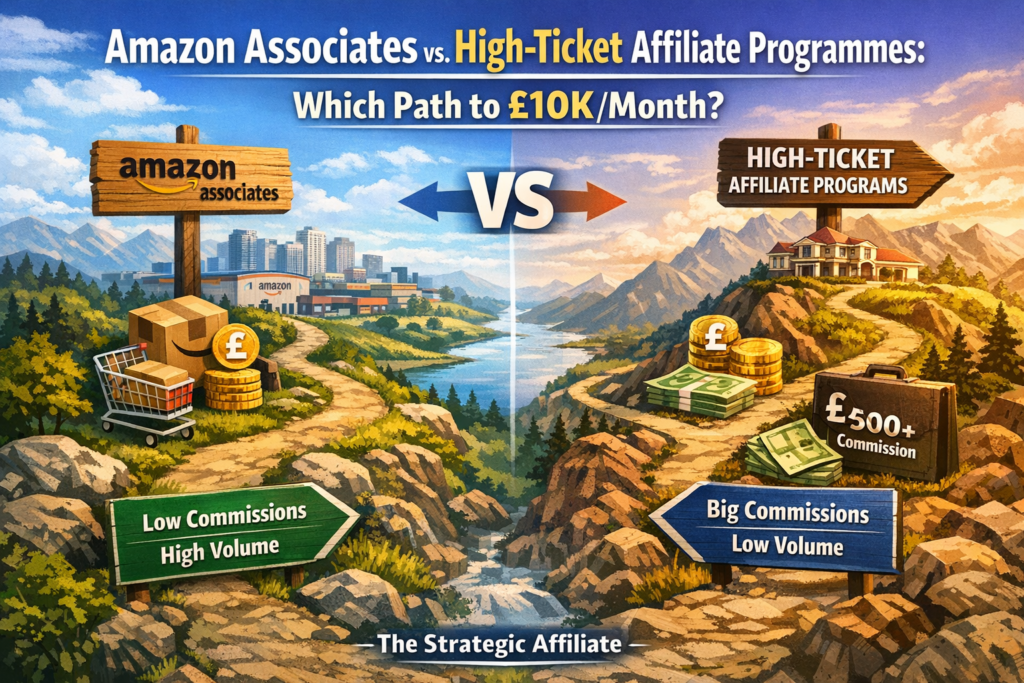
Amazon Associates vs. High-Ticket Affiliate Programmes: Which Path to £10K/Month?
I’ll never forget the moment I realized I’d been leaving money on the table for three solid years.
It was 2009. I was running an affiliate site reviewing outdoor gear—backpacks, tents, hiking boots, the works. My traffic was solid: 30,000 monthly visitors. My content was ranking. People were clicking my Amazon links and buying products I recommended. I was making sales every single day.
My monthly income? A whopping £47.
Then I discovered a direct affiliate programme for a premium outdoor brand that paid 12% commissions instead of Amazon’s 4%. Same products. Same audience. Same traffic. I simply switched my links on my top-performing articles.
My income tripled within 60 days.
That painful lesson taught me what I’m going to share with you today: the affiliate programmes you choose matter far more than your traffic numbers. You can work three times as hard to get triple the traffic, or you can choose better programmes and triple your income with the same effort.
This comprehensive comparison of Amazon Associates vs. high-ticket affiliate programmes will show you exactly when to use each, how to combine them strategically, and which approach makes sense for your current business stage. After 19 years of building affiliate sites across multiple niches, I’ve tested both approaches extensively—and made plenty of expensive mistakes so you don’t have to.
By the end of this guide, you’ll understand which affiliate model fits your goals, how to transition from low-commission to high-paying programmes without tanking your income, and the specific numbers that determine when to make the switch.
Let’s talk about money—specifically, how to make more of it with less traffic.
Understanding the Fundamental Difference
The core distinction between Amazon Associates and high-ticket affiliate programmes boils down to a simple trade-off: volume versus value.
Amazon Associates operates on a high-volume, low-commission model. You promote millions of products, earn 1-4.5% per sale (occasionally up to 10% in specific categories), and benefit from Amazon’s ridiculous conversion rate. When someone clicks your link, they’re already an Amazon customer with saved payment info and Prime shipping expectations. They buy. You get paid a small slice.
High-ticket programs flip this equation entirely. You promote fewer, more expensive products or services, earn 15-50% commissions (sometimes more), but work harder to drive each individual sale. You’re asking people to spend £500, £2,000, or £10,000 instead of £29.99. The conversion rates are lower, but the payouts are massive.
Here’s the math that changed everything for me: To earn £3,000 monthly from Amazon at an average 3% commission rate, you need roughly £100,000 in product sales. At a £50 average order value, that’s 2,000 purchases. With a 3% conversion rate, you need about 67,000 clicks. At a 2% CTR from search, you need 3.3 million monthly pageviews.
To earn £3,000 monthly from a high-ticket programme paying £200 per sale, you need 15 sales. At a 2% conversion rate, that’s 750 clicks. At the same 2% CTR, you need just 37,500 monthly pageviews—roughly 1/100th the traffic.
Both models work. But they work very differently.
Why I Started With Amazon (And You Probably Should Too)
When you’re just starting with affiliate marketing, Amazon Associates offers advantages that high-ticket programmes can’t match:
Instant approval: Amazon accepts virtually anyone with a basic website. High-ticket programmes often require an application, traffic proof, and sometimes even a phone interview with their affiliate manager.
Everything in one place: You can promote literally millions of products through one affiliate account. No hunting down individual programmes, managing multiple dashboards, or juggling different payment schedules.
Conversion machine: Amazon converts like crazy. People trust the platform, they’re already members, and the buying friction is nearly zero. Your job is simply getting them to click—Amazon handles the rest.
Learn the fundamentals: Amazon lets you learn affiliate basics—link placement, disclosure language, conversion optimization—without the pressure of needing each sale to count. When you’re earning £0.80 per sale, a bad article isn’t devastating. When you’re trying to close £500 sales, every piece of content matters.
I recommend every beginner start with Amazon for their first 3-6 months while simultaneously researching higher-paying alternatives. Get your systems working, understand your audience, and figure out what converts before you swing for the bigger commissions.
But here’s the critical part: don’t get comfortable there. Amazon should be your training ground, not your destination.
💡 New to affiliate marketing? Check out my complete guide on how to start affiliate marketing to understand the fundamentals before choosing your programmes.
Amazon Associates: The Complete Reality Check
Let me give you the unfiltered truth about Amazon’s affiliate programme based on running multiple Amazon-heavy sites over 15+ years.
The Commission Structure (And Why It’s Frustrating)
Amazon’s commission rates range from 1% to 10% depending on product category. Here’s what you’ll actually earn in the most common niches:
- Physical books, music, video: 4.5%
- Kitchen, automotive, beauty: 4%
- Toys, furniture, home improvement: 3%
- Outdoors, tools: 3%
- Sports products: 4.5%
- Video games, consoles: 1%
- Luxury beauty, Amazon coins: 10%
- Digital products (Kindle, music downloads): 5-10%
Most affiliate marketers average between 2.5-4% across their entire Amazon income because people buy multiple categories. You might send someone to buy a £200 tent (3% = £6), but they also buy groceries, a book, and replacement batteries during the same session. You earn commissions on everything in their cart—which is Amazon’s saving grace.
The 24-hour cookie window is both shorter and longer than it seems. If someone clicks your link but doesn’t buy immediately, you’ve got 24 hours for them to complete the purchase. However, if they add items to their cart within those 24 hours, you have 90 days for them to actually check out and you still earn the commission.
I’ve earned commissions on purchases made 89 days after the initial click because the customer added my recommended product to their cart, then forgot about it for three months. This extended cart window is one of Amazon’s underrated advantages.
What Actually Works With Amazon
After promoting thousands of Amazon products over the years, here’s what I’ve learned actually drives income:
Gift guides and resource pages: These evergreen collections of 10-20 curated products in a specific category (best camping gear for beginners, essential kitchen tools under £50) generate passive income year-round. My “Budget Travel Gear” guide written in 2015 still earns £200-400 monthly despite zero updates.
Comparison posts with decision matrices: When you compare 3-5 products in the same category and help readers choose based on specific criteria (budget, use case, experience level), conversion rates jump significantly. My “Best Hiking Backpacks for Women” comparison converts at 8-12% versus 3-4% for general informational content.
Seasonal and holiday content: Black Friday guides, Christmas gift lists, and back-to-school roundups drive massive short-term traffic spikes. These require annual updates, but one well-ranked holiday gift guide can earn more in November-December than your entire site earns the rest of the year.
Review roundups, not individual reviews: Instead of reviewing one blender, review the five best blenders for different needs. This captures more buyer-intent keywords and gives readers options, increasing the chances someone finds their match.
The Hidden Amazon Advantages Nobody Talks About
Beyond the obvious benefits, Amazon offers some sneaky advantages:
Cart additions count: When someone clicks your link for a £30 item but buys a £2,000 laptop instead, you earn commission on the laptop. I’ve had £80-150 commission days from single purchases that had nothing to do with my recommended product. This random cart arbitrage can represent 30-40% of your Amazon income.
International programmes: Amazon operates separate affiliate programmes in UK, Canada, Germany, France, Italy, Spain, and other countries. Using plugins like Lasso or AAWP, you can automatically localize links based on visitor location. My US-focused outdoor site earns an additional 15% from international Amazon programs.
Amazon influencer programme: Once you’re approved for Amazon Associates, you can apply for the influencer program which gives you a custom Amazon storefront and additional tools for promoting products through social media and video.
Physical product credibility: When you’re reviewing software or courses, some skepticism exists—did you really test it or just grab the affiliate link? With physical Amazon products, readers assume you’ve tried them because, well, Amazon makes returns easy and products are accessible. This perceived credibility can actually increase click-through rates.
The Brutal Amazon Limitations
Now for the frustrating parts I wish someone had explained clearly when I started:
Race to the bottom on pricing: Amazon encourages a “cheapest option” mentality. When readers are trained to find the lowest price, affiliate sites compete by recommending progressively cheaper products. You make less per sale, and the quality of products degraded. I fought this for years before realizing I was training my audience to buy cheap junk.
Algorithm and policy volatility: Amazon changes commission rates, program policies, and category structures with minimal notice. In 2020, they slashed commission rates across multiple categories during COVID. Affiliates who’d built entire businesses around 8% commissions suddenly earned 3%. There was no recourse and no warning.
The £100 payment threshold trap: You need to hit £100 in commissions before Amazon pays out. For new affiliates earning £15-40 monthly, this means waiting 3-5 months for your first payment. It’s discouraging and creates cash flow problems.
Cookie stuffing and override risk: If someone clicks your link but then clicks another affiliate’s link before purchasing, the other affiliate gets the commission. In competitive niches, some affiliates use aggressive retargeting and cookie-stuffing tactics. You do the work of the recommendation; someone else gets paid.
Account termination risk: Amazon’s terms of service are strict and sometimes arbitrarily enforced. I’ve seen affiliates lose accounts (and unpaid commissions) for technical violations they didn’t even know they’d committed. Once you’re banned, getting reinstated is nearly impossible.
The biggest limitation? Amazon actively discourages building a brand. When you send traffic to Amazon, you’re building their brand, their customer relationships, their email list. You’re the middleman who gets a small finder’s fee, not a business owner building equity.
This realization pushed me to explore high-ticket alternatives—and it changed everything.
High-Ticket Affiliate Programmes: Where Real Money Gets Made
High-ticket affiliate marketing is a completely different game. Instead of earning £2.40 on a £80 purchase, you’re earning £200 on a £1,000 purchase—or £500 on a £2,000 purchase.
The math transforms your business model entirely.
What Qualifies as “High-Ticket”?
The definition varies, but generally:
- Mid-ticket: £50-200 commission per sale (software, digital products, premium services)
- High-ticket: £200-1,000 commission per sale (comprehensive courses, enterprise software, coaching programs)
- Ultra-high-ticket: £1,000+ commission per sale (business consulting, high-end software, luxury travel)
I focus primarily on mid to high-ticket programs earning $100-500 per conversion. These hit the sweet spot of meaningful payouts without requiring enterprise sales skills.
The Categories Where High-Ticket Thrives
Not every niche supports high-ticket affiliate programs. Here’s where they work best:
Business and marketing software: SEMrush (£200 per trial), Shopify (up to £2,000 based on merchant revenue), ClickFunnels (£100-200 per signup), ConvertKit (30% recurring commissions), Kajabi (£200-2,000 based on plan).
Web hosting and infrastructure: WP Engine (£200 per sale), Kinsta (£50-500 depending on plan), Hostinger (I use these) (£200 per signup), Cloudways (£50-125 per sale plus 7% lifetime recurring).
Online courses and education: High-end courses in business, marketing, investing, and personal development often pay 30-50% commissions on £500-3,000 products. Individual programs vary wildly, but six-figure course creators typically offer generous affiliate terms.
B2B services and tools: Email verification services, accounting software, project management tools, and business automation platforms targeting companies (not individuals) tend to have higher prices and better commission structures.
Financial products and services: Credit card offers (£50-200 per approval), investment platforms (varies), accounting software for businesses (£50-150 per sale). These require careful compliance with regulations but pay well.
Premium physical products: High-end mattresses (£200-400 per sale), luxury furniture, designer fashion, and premium outdoor gear often have direct programs paying 8-15% on $£,000+ products.
Real Examples From My Portfolio
Let me share actual numbers from programmes I actively promote:
Mangools: Pays 25% for each person who joins free and becomes a paying customer. I publish SEO tutorials showing the tool in action. One tutorial-style review generates 3-5 sales monthly = £200-5,000 from a single article.
Hostinger: Pays £200 per sale with a 180-day cookie. My WordPress security guide recommends premium hosting as step one. That article earns $800-1,400 monthly from hosting commissions alone—roughly equivalent to what an Amazon-only site needs 50,000 pageviews to generate.
ConvertKit: Pays 30% recurring commissions for 24 months on a £29-79/month product. One customer can generate £210-570 over two years. I have 40 active referrals generating roughly £1,600 monthly in passive recurring income.
High-end online course (keeping specific brand private): Pays 75% on £600 product = £450 per sale. I promote this through email sequences to my list. Three sales per month = £2,400, which is more than many Amazon affiliates earn with 100× the traffic.
The combined revenue from these four programs represents about 70% of my affiliate income while requiring maybe 10% of my traffic compared to what Amazon would need for equivalent earnings.
The Skills Required for High-Ticket Success
Promoting high-ticket offers requires different skills than Amazon affiliate marketing:
Audience understanding at a deeper level: You need to know your readers’ pain points, decision-making process, objections, and desired outcomes. Surface-level “10 best” lists don’t cut it with £1,000 decisions.
Content that builds trust and authority: Tutorial-style content demonstrating products, case studies showing results, and transparent reviews discussing limitations all build the trust necessary for high-ticket conversions.
Email marketing becomes essential: While Amazon sales often happen from organic search → click → purchase, high-ticket sales frequently require email nurturing. Someone rarely reads one article about £2,000 software and buys immediately. They need multiple touchpoints, educational content, and trust-building over time.
Personal recommendation carries weight: With high-ticket items, readers want to know YOU use this tool and it solved YOUR specific problem. Generic reviews don’t convert. Personal stories and specific use cases do.
Patience and longer sales cycles: Amazon purchases happen within hours or days. High-ticket purchases take weeks or months. You need to be comfortable with longer conversion windows and delayed gratification.
I failed at my first three high-ticket promotions because I treated them like Amazon products—write review, add links, forget about it. High-ticket requires ongoing relationship building, not one-and-done content.
The High-Ticket Downsides (They’re Real)
High-ticket isn’t perfect. Here are the genuine challenges:
Approval process can be brutal: Quality programs vet affiliates carefully. You’ll need traffic proof, content examples, sometimes references from other affiliate managers. I’ve been rejected from programs despite running successful affiliate sites because my niche wasn’t a perfect fit.
Refunds hurt badly: When Amazon customers return a £40 item, you lose £1.20. When a high-ticket customer refunds a £2,000 purchase, you lose £600-800. Refund rates on high-ticket products typically run 5-15% versus 2-5% for low-ticket items. These refund clawbacks can devastate your monthly income.
Income volatility is stressful: Amazon provides steady, predictable income—£800 this month, £750 next month, £900 the following month. High-ticket income swings wildly—£2,400 one month, £400 the next, £3,800 the following month. This volatility makes budgeting and financial planning challenging.
You’re reputation is on the line: Recommend a mediocre $30 Amazon product and readers forget about it. Recommend a £1,500 course that doesn’t deliver, and you’ve lost that reader’s trust permanently. The stakes are higher.
Payment terms can be problematic: Some programs hold commissions for 30-60 days to account for refunds. Others have minimum payout thresholds of £500-1,000. Cash flow becomes a real consideration when you’re waiting 60 days for a £2,000 commission.
Despite these challenges, the income potential makes high-ticket worth pursuing once you’ve built a foundation.
The Side-by-Side Comparison: Amazon vs. High-Ticket
Let me break down the key comparison points based on actual experience running both simultaneously:
Commission Rates and Earning Potential
Amazon Associates: 1-10% (averaging 2.5-4% for most affiliates)
- £30 product = £0.90-£1.20 commission
- £100 product = £2.50-£4.00 commission
- £500 product = £12.50-£20.00 commission
High-Ticket Programs: 15-50% (sometimes higher with recurring commissions)
- £100 software = £15-£50 commission (plus potential recurring)
- £500 course = £150-£250 commission
- £2,000 software = £400-£1,000 commission
To earn £5,000 monthly:
- Amazon (3% average): Need £166,667 in product sales ≈ 140,000+ monthly pageviews
- High-ticket (£300 average commission): Need 17 sales ≈ 15,000-25,000 monthly pageviews
The traffic requirement difference is staggering.
Cookie Duration and Attribution Windows
Amazon Associates: 24-hour click window, but 90-day cart window
- Fast purchase cycles favor quick decision-making
- Good for impulse purchases and immediate needs
- Cart additions extend this significantly
High-Ticket Programs: Typically 30-90 days (some offer lifetime cookies)
- SEMrush: 120 days
- WP Engine: 180 days
- Some SaaS programmes: 365 days or lifetime
- Allows for longer consideration periods and multiple touchpoints
Longer cookies mean your content continues working long after someone initially discovers it. I’ve earned commissions 179 days after the initial click because the cookie was still active when the customer finally made their decision.
Conversion Rates Reality
Amazon Associates: 3-8% conversion rate (heavily dependent on content quality and intent)
- Product comparison posts: 8-12%
- General reviews: 4-6%
- Informational content with links: 1-3%
- Gift guides and roundups: 6-10%
High-Ticket Programs: 0.5-3% conversion rate (sometimes higher with email nurturing)
- Tutorial-style content: 2-4%
- Case study posts: 1.5-3%
- Standard reviews: 0.5-1.5%
- Email sequences: 3-8% (for warm subscribers)
Lower conversion rates sound bad until you factor in the commission difference. A 2% conversion on £300 commissions beats an 8% conversion on £3 commissions.
Approval and Program Access
Amazon Associates:
- Instant approval (must make 3 sales within 180 days or account closes)
- No traffic requirements
- Available globally with regional programs
- Single dashboard for millions of products
High-Ticket Programs:
- Application process (sometimes includes interviews)
- Often require 5,000-10,000 monthly pageviews minimum
- Must demonstrate niche relevance
- Need to manage multiple program dashboards
- Some programs reject affiliates with no explanation
Getting started is infinitely easier with Amazon. Scaling income is infinitely easier with high-ticket.
Payment Terms and Thresholds
Amazon Associates:
- £100 minimum for direct deposit (£10 for Amazon gift card)
- Net 60 payment terms (roughly)
- Reliable monthly payments
- No commission holds
High-Ticket Programs:
- £50-£500 minimum payout thresholds
- Net 30-90 payment terms (varies by program)
- Some hold commissions 30-60 days for refund protection
- Payment reliability varies by company
Cash flow matters when you’re building a business. Amazon’s consistent (if small) payments help pay bills while you’re building. High-ticket programs require more financial runway.
Refund and Return Impact
Amazon Associates:
- 2-5% return rate typically
- Small financial impact per return
- Returns processed automatically
- You see the commission deduction but it’s not devastating
High-Ticket Programs:
- 5-15% refund rate (product dependent)
- Massive financial impact per refund
- Some programs require you to track and report refunds
- A single high-ticket refund can wipe out a week’s earnings
I budget for 10% refund rates on high-ticket promotions. Some months I see zero refunds; other months hit 20%. This volatility requires financial cushioning.
Content Requirements and Effort
Amazon Associates:
- Can get away with lighter, shorter content
- Product specifications and basic comparisons work
- Photos can be Amazon’s product images
- Less trust-building necessary
- Update frequency: every 6-12 months
High-Ticket Programs:
- Requires comprehensive, authoritative content
- Need original screenshots, videos, use cases
- Personal experience and results expected
- Significant trust-building necessary
- Update frequency: every 3-6 months
High-ticket demands better content, but you need less of it to earn equivalent income.
The Hybrid Strategy That Actually Works
Here’s what I wish someone had told me in 2010: you don’t have to choose between Amazon Associates and high-ticket affiliate programs. The optimal strategy uses both strategically.
This hybrid approach has powered my affiliate income to six figures while maintaining income stability and maximizing earnings from each visitor.
The Foundation: Amazon for Traffic and Discovery
Use Amazon to monetize your traffic while you build authority and discover what your audience actually buys. When you’re starting out:
Month 1-6: Focus 80% on Amazon
- Build your site with quality content
- Learn what products your audience responds to
- Establish ranking patterns and traffic sources
- Generate some income (even if modest) to reinvest
- Track which product categories perform best
This foundation phase serves multiple purposes beyond immediate income. You’re gathering data about your audience’s buying behavior, content preferences, and pain points—intelligence that informs your high-ticket strategy later.
The Transition: Identify High-Ticket Opportunities
Around month 4-6, start analyzing your Amazon data to find high-ticket opportunities:
What to look for in your Amazon reports:
- Which product categories generate the most clicks?
- What’s the average order value from your traffic?
- Which specific products get repeatedly recommended?
- What problems are people trying to solve with their purchases?
When I analyzed my outdoor gear site’s Amazon data in 2012, I noticed people buying $200-400 GPS devices and satellite communicators. That insight led me to discover Garmin’s direct affiliate program paying 8% instead of Amazon’s 4%, plus several related software subscriptions paying recurring commissions. I shifted my GPS-related content to these programs and doubled income from the same traffic.
The Optimization: Strategic Link Placement
Once you’ve identified high-ticket alternatives, here’s how to integrate them without destroying your Amazon income:
Primary recommendation = High-ticket alternative (when available)
In your main content, review sections, and recommendation boxes, prioritize the high-ticket option if a suitable program exists.
Example: “For serious bloggers who plan to grow their email list beyond 1,000 subscribers, I recommend ConvertKit [high-ticket affiliate link]. For casual bloggers just starting out, Mailchimp’s free plan works fine [no affiliate link, or Amazon if they sell physical books about email marketing].”
Secondary options = Amazon
In comparison tables, “budget alternatives” sections, and roundup posts, include Amazon options for readers who want cheaper alternatives.
This approach maximizes commission potential from ready-to-buy readers while still monetizing budget-conscious traffic through Amazon.
The Content Split That Maximizes Both
Create different content types optimized for each program type:
Amazon-optimized content (30-40% of publishing):
- Gift guides and product roundups
- “Bestunder $X” budget posts
-
Sale!

AI‑Powered Facebook Money System
Original price was: £27.00.£17.00Current price is: £17.00. -

-
-
Sale!
How to Make Money on Facebook in 2026
Original price was: £27.00.£17.00Current price is: £17.00. -
-
Sale!

The Strategic Affiliate Income System
Original price was: £499.00.£297.00Current price is: £297.00. -
-
Sale!
- Seasonal and holiday shopping guides
- Quick comparison posts between similar products
- Beginner-friendly “starter kit” articles



High-ticket optimized content (60-70% of publishing):
- In-depth software tutorials
- Case studies with specific results
- Tool comparison posts at the premium end
- Problem-solution content targeting business outcomes
- Email sequences nurturing toward high-ticket offers
My publishing calendar alternates: Week 1 = high-ticket tutorial, Week 2 = Amazon gift guide, Week 3 = high-ticket case study, Week 4 = Amazon comparison post. This rhythm maintains Amazon income stability while building high-ticket revenue.
The Email Strategy for High-Ticket
Email marketing transforms high-ticket conversions. Here’s the framework:
Immediate opt-in incentive: Offer a valuable resource related to your content (checklist, template, mini-course) in exchange for email.
Welcome sequence (5-7 emails): Build trust and demonstrate expertise without pitching anything. Share your story, helpful tips, and valuable content.
Regular weekly emails: Mix 70% pure value (tips, strategies, case studies) with 30% strategic recommendations (both Amazon and high-ticket).
Launch sequences for high-ticket: When promoting specific high-ticket offers, create 4-6 email sequences that educate about the problem, demonstrate the solution, share your experience, address objections, and make the recommendation.
My email list represents only 8% of my total traffic but generates 45% of my high-ticket affiliate income. Someone who opts in, reads your emails, and sees you consistently provide value is 10× more likely to trust your £1,000 software recommendation than a random visitor from Google.
The Geographic Targeting Advantage
One underutilized strategy: use geo-targeting to maximize both programs:
For US/UK/developed country traffic: Promote high-ticket software, courses, and premium services where purchasing power supports higher prices.
For developing country traffic: Focus on Amazon physical products, lower-priced digital tools, and budget alternatives where purchasing power is lower.
I use this strategy on my digital marketing site. Visitors from US, UK, Canada, and Australia see content featuring premium tools like SEMrush (£200 commission). Visitors from India, Philippines, and developing markets see content about free/affordable alternatives with Amazon affiliate links for related books and resources.
This isn’t exclusionary—it’s realistic about what different markets can afford and maximizing value for both the reader and my business.
When to Phase Out Amazon Entirely
Some affiliates eventually eliminate Amazon completely. Here’s when that makes sense:
Your niche supports pure high-ticket: If you’re in B2B software, enterprise tools, or professional services where no Amazon equivalent exists, there’s no reason to maintain Amazon links.
You’ve hit Amazon’s income ceiling: Once you’re earning £2,000-3,000 monthly from Amazon, getting to £5,000+ requires so much additional traffic that focusing on high-ticket becomes more efficient.
Your brand positioning conflicts: If you’re positioning as a premium authority in your space, recommending £20 Amazon products alongside £2,000 software creates cognitive dissonance.
Compliance becomes too burdensome: Amazon’s strict TOS and constant policy changes frustrate some affiliates enough that they eliminate the program entirely.
I still maintain Amazon links on my travel site (where budget products make sense) but eliminated them from my business site (where professional tools dominate). Context matters.
💡 Need the complete roadmap? My comprehensive guide on how to start affiliate marketing walks through building the foundation before you optimize for either Amazon or high-ticket programs.
Which Should You Choose Right Now?
The “right” choice depends entirely on your current situation. Let me give you specific scenarios and recommendations.
Choose Amazon Associates If You’re…
Brand new to affiliate marketing: Amazon’s simplicity, instant approval, and broad product selection make it perfect for learning fundamentals. Spend 3-6 months understanding how affiliate marketing works before worrying about optimization.
Building in product-heavy niches: If you’re reviewing physical consumer products (outdoor gear, kitchen tools, pet supplies, home improvement), Amazon often makes sense long-term, supplemented by direct programs where available.
Targeting budget-conscious audiences: If your niche focuses on frugality, budget options, or value-seeking consumers, Amazon’s pricing and selection align better than premium high-ticket offers.
Under 5,000 monthly pageviews: Most high-ticket programs want proof of traffic and audience engagement. Build your traffic with Amazon while you grow, then transition.
Not ready for email marketing: If you’re focused purely on organic search traffic and aren’t building an email list, Amazon’s instant-gratification purchases work better than high-ticket’s longer nurture cycles.
Want predictable income: Amazon provides steady, reliable income that’s easier to budget around than high-ticket’s feast-or-famine pattern.
Choose High-Ticket Programs If You’re…
In B2B, software, or professional services niches: These spaces naturally support high-ticket pricing and rarely have Amazon equivalents. Lean into the higher commissions immediately.
Building personal brand and authority: If you’re positioning yourself as an expert, consultant, or thought leader, high-ticket recommendations align better with premium positioning.
Already have 10,000+ monthly pageviews: You’ve proven you can drive traffic. Now maximize the value of each visitor with better monetization.
Building an email list actively: High-ticket thrives with email nurturing. If you’re already capturing emails and sending regular content, high-ticket fits naturally.
Comfortable with income volatility: Can you handle earning $4,000 one month and $800 the next? High-ticket requires financial cushioning for the swing months.
Willing to create comprehensive content: High-ticket demands better content—longer, more detailed, more personal. If you’re committed to quality over quantity, high-ticket rewards that approach.
The Hybrid Path for Most Affiliates
For 70% of affiliate marketers, the hybrid approach makes the most sense:
Year 1: 70% Amazon / 30% researching high-ticket alternatives
- Build traffic and authority with Amazon income
- Study your audience and identify high-ticket opportunities
- Start building your email list
- Test 1-2 high-ticket programs to learn the process
Year 2: 50% Amazon / 50% high-ticket
- Actively transition your best content to high-ticket alternatives
- Maintain Amazon for budget options and impulse purchases
- Grow your email list and implement nurture sequences
- Track which program type produces better ROI for your effort
Year 3+: 30% Amazon / 70% high-ticket (or eliminate Amazon entirely)
- Focus primarily on high-ticket for new content
- Maintain Amazon on legacy content and gift guides
- Optimize for fewer, higher-value conversions
- Consider creating your own high-ticket products to promote
This progression matches how I’ve evolved multiple affiliate sites. The exact percentages vary by niche, but the pattern holds: start accessible, gather data, optimize toward higher value.
Making the Transition Without Killing Your Income
The scariest part of shifting from Amazon Associates to high-ticket affiliate programs is the potential income drop during transition. I’ve made this mistake twice—killing stable Amazon income before the high-ticket income replaced it.
Here’s how to transition smartly without financial pain:
Step 1: Identify Your Top 20% of Content
Run your analytics and identify which 20% of your content drives 80% of your traffic and income. These are your highest-leverage articles to transition first.
Look for:
- Articles ranking in positions 1-5 for buyer-intent keywords
- Content with conversion rates above your site average
- Posts generating consistent monthly income
- Topics where high-ticket alternatives exist
Don’t touch the bottom 80% yet. Focus exclusively on optimizing your winners first.
Step 2: Research Direct Alternatives
For each top-performing article, research whether higher-paying alternatives exist:
Check these sources:
- ShareASale, CJ Affiliate, Rakuten, Impact networks
- Direct company websites (search “[company name] affiliate program”)
- Competitor sites (what are similar affiliates promoting?)
- Google searches for “affiliate program”
-
Sale!
AI‑Powered Facebook Money System
Original price was: £27.00.£17.00Current price is: £17.00.
-
Sale!
- Affiliate program directories
Create a spreadsheet comparing:
- Current Amazon commission vs. alternative commission
- Cookie duration differences
- Payment terms and thresholds
- Conversion rate estimates (you won’t know until you test)
Only proceed if the alternative offers meaningfully better terms—at least 2-3× higher commission per sale.
Step 3: A/B Test Before Full Transition
Don’t rip out all your Amazon links and replace them blindly. Test systematically:
Month 1: Update 2-3 articles, replacing primary recommendations with high-ticket alternatives while keeping Amazon as secondary options.
Monitor for 30 days:
- Did conversion rates drop, hold steady, or increase?
- What’s the actual commission difference per sale?
- How does the program track and report (is their dashboard reliable)?
- Are customers completing purchases or abandoning?
Month 2: If results are positive (equal or better earnings), update 5-7 more articles. If results are negative, revert and reevaluate.
This testing phase prevents wholesale income destruction. I once switched 40 articles from Amazon to a new program simultaneously, then discovered their tracking was broken. I lost six weeks of income before realizing the issue and reverting.
Step 4: Maintain Amazon as Backup Options
Even when promoting high-ticket alternatives, keep Amazon links as secondary recommendations:
Example structure:
“For serious bloggers planning to scale, I recommend ConvertKit [high-ticket link] which offers powerful automation and integrations (£200 commission).
If you’re just starting out and want a free option first, Mailchimp works for basic needs [Amazon link to email marketing book] while you learn the fundamentals (£2.40 commission).”
This approach:
- Maximizes commission from readers ready for premium options
- Still monetizes budget-conscious traffic through Amazon
- Provides genuine value by offering options at different price points
- Reduces income volatility during transition
Step 5: Build Email Sequences for High-Ticket
High-ticket conversions often happen through email, not direct from blog posts. Create dedicated sequences:
Tutorial sequence example (for promoting software):
- Email 1: “The problem I struggled with for 3 years” (share your pain)
- Email 2: “What I tried that didn’t work” (failed solutions build credibility)
- Email 3: “The tool that finally solved it” (introduce high-ticket solution)
- Email 4: “How I use it + specific results” (tutorial-style value)
- Email 5: “Is it worth the price?” (address the objection head-on)
- Email 6: “Here’s my recommendation” (clear CTA with affiliate link)
These sequences convert at 5-8% for warm subscribers versus 0.5-2% for cold blog traffic. Email transforms high-ticket economics.
Step 6: Track Everything Obsessively
During transition, your data determines success or failure. Track weekly:
Amazon metrics:
- Total clicks, orders, conversion rate, earnings
- Which articles saw traffic drops (means you need to re-optimize)
- Cart additions vs. actual purchases (are people still adding to cart?)
High-ticket metrics:
- Clicks to affiliate links
- Reported sales and commissions
- Conversion rates by content type
- Payment timing and reliability
- Refund rates
Combined metrics:
- Total affiliate income (all sources)
- Income per 1,000 visitors (RPM)
- Income per article published
- Time investment vs. income generated
If your combined income stays flat or grows during transition, you’re succeeding. If it drops more than 20%, pause and diagnose before continuing.
The Timeline and Income Pattern
Here’s what realistic transition looks like financially:
Pre-transition: £2,000/month (100% Amazon)
Month 1-2 (testing phase): £1,800-2,200/month (80% Amazon, 20% high-ticket)
- Slight volatility as you test high-ticket programs
- Overall income roughly stable
Month 3-5 (active transition): £1,600-2,800/month (60% Amazon, 40% high-ticket)
- Higher volatility as high-ticket sales aren’t yet consistent
- Some months down, some months up
- Need financial cushion for down months
Month 6-9 (stabilization): £2,400-3,500/month (40% Amazon, 60% high-ticket)
- High-ticket income becomes more predictable
- Overall income trending upward
- Amazon serves as stable baseline
Month 10-12 (optimization): £3,000-5,000/month (30% Amazon, 70% high-ticket)
- Email sequences and optimized content drive consistent high-ticket sales
- Amazon provides supplementary income
- Total income significantly exceeds pre-transition
This pattern isn’t guaranteed—your results depend on niche, content quality, traffic sources, and program selection—but it’s representative of successful transitions I’ve executed and helped others implement.
The key insight: expect 6-9 months for transition to fully work. Don’t panic at month 3 when income is volatile. Stay the course if your data shows progress.
My Current Recommendation for New Affiliates
If you’re reading this in 2026 and wondering where to start, here’s my specific advice based on 19 years of experience and current market conditions:
Month 1-3: Start with Amazon Associates
- Get approved and learn affiliate fundamentals
- Publish 15-20 solid articles targeting buyer-intent keywords
- Include Amazon links naturally in reviews and recommendations
- Track everything to understand your audience
Month 4-6: Research and apply to high-ticket programs
- Use your Amazon data to identify categories your audience buys
- Research direct programs and networks offering better commissions
- Apply to 5-10 high-ticket programs in your niche
- Start building your email list with a valuable opt-in offer
Month 7-9: Begin strategic transition
- Test high-ticket programs on your top-performing content
- Create tutorial-style content specifically for high-ticket offers
- Launch your first email nurture sequence
- Monitor results and adjust based on data
Month 10-12: Optimize the hybrid approach
- Find the right balance of Amazon and high-ticket for your niche
- Double down on what’s working
- Consider eliminating underperforming programs
- Plan your year-two content strategy
Year 2 and beyond: Scale what works
- Create more of the content types that drive high-ticket sales
- Build multiple email sequences for different offers
- Consider adding your own high-ticket products
- Potentially eliminate Amazon if high-ticket fully replaces it
This roadmap isn’t rigid—adjust based on your specific niche, goals, and results. But the general pattern of “start accessible, gather data, optimize for value” consistently produces the best outcomes.
The biggest mistake I see is beginners trying to jump straight to high-ticket without understanding the fundamentals. Amazon teaches you affiliate marketing basics with minimal risk. Use it as your training ground, then graduate to high-ticket when you’re ready.
The second biggest mistake is getting comfortable with Amazon income and never transitioning. Amazon can become a golden handcuff—earning enough to pay bills but not enough to achieve real financial freedom. Challenge yourself to optimize.
💡 Ready to build your complete affiliate strategy? My comprehensive guide on how to start affiliate marketing covers the foundational systems you need before optimizing for maximum income with the right program mix.
Take Action on What You’ve Learned
You now understand the fundamental difference between Amazon Associates and high-ticket affiliate programs, when to use each, and how to transition strategically between them.
The choice isn’t really Amazon versus high-ticket. The choice is strategic monetization versus leaving money on the table.
Here’s what to do next based on where you are right now:
If you haven’t started yet: Sign up for Amazon Associates today. Publish your first three articles this week. Get the fundamentals working before you worry about optimization.
If you’re currently using only Amazon: Spend two hours this week researching high-ticket alternatives for your three best-performing articles. Create a transition plan and start testing.
If you’re mixing both: Analyze your numbers. What’s your current income split? Where are the opportunities to optimize further? What’s one action you can take this month to increase your high-ticket percentage?
If you’re crushing it with high-ticket: Consider whether Amazon still serves a purpose in your strategy, or if eliminating it simplifies your business without meaningful income loss.
The affiliates earning life-changing income aren’t working harder than you. They’re choosing better programs and optimizing for value per visitor instead of raw traffic volume.
I spent three years earning $800-1,200 monthly from Amazon before discovering high-ticket alternatives. That delay cost me six figures in lost income. Don’t make the same mistake.
Start where you are. Use what works now. Optimize toward better programs as you learn and grow. That’s the path forward.
Join the Strategic Affiliate Community
Building an affiliate business—especially navigating the transition from Amazon to high-ticket programmes—can feel isolating when you’re figuring it out alone. I created a free community on Skool where hundreds of affiliate marketers share strategies, review each other’s content, and support each other’s growth.
Inside you’ll find:
- Real-time answers to your program selection questions
- Members sharing which programs convert best in different niches
- Weekly discussions on current affiliate trends
- Template emails for applying to high-ticket programs
- Accountability partners at your same stage
Join the Strategic Affiliate Community on Skool →
The community is completely free because I believe in helping people succeed first. Come share what you’re working on and learn from others navigating the same journey.
Frequently Asked Questions
Can I use both Amazon Associates and high-ticket programs on the same website?
Absolutely—and I recommend it for most affiliates. The hybrid approach maximizes income by using Amazon for impulse purchases and budget options while promoting high-ticket alternatives for readers ready to invest in premium solutions. Just make sure you’re transparent about why you recommend different options at different price points. Frame it as “best option if you’re serious” (high-ticket) versus “budget-friendly alternative” (Amazon) rather than hiding your monetization strategy. Most programs allow this approach, though you should review individual terms of service to confirm.
How much traffic do I need before high-ticket programs will approve me?
Most reputable high-ticket programs want to see 5,000-10,000 monthly pageviews as a minimum, though this varies significantly by program and niche. Some premium programs require 25,000+ monthly visitors, while others care more about audience quality than pure volume. When you’re below these thresholds, focus on building traffic with Amazon while demonstrating your content quality and niche expertise. Once you hit 5,000+ monthly visitors, start applying to programs systematically—you’ll be surprised how many approve you based on content quality even if your traffic is on the lower end. I’ve been approved for programs requiring “significant traffic” with just 7,000 monthly visitors by showing highly engaged audiences and conversion-focused content.
What if the high-ticket program I want to promote doesn’t have an affiliate program?
Reach out directly and ask if they’d consider creating one or making an exception for you. About 30% of my highest-paying partnerships started with cold outreach to companies without public affiliate programs. Email their marketing or partnerships team: “I run [your site] focused on [niche] with [X] monthly visitors. I’d love to recommend your product based on my experience using it. Do you have an affiliate program, or would you consider creating custom terms?” Many companies, especially in SaaS and digital products, are open to affiliate arrangements even if they don’t advertise them publicly. The worst they can say is no.
Should I disclose the commission difference between Amazon and high-ticket programs?
No, you only need to disclose that affiliate relationships exist—not the specific commission rates or amounts you earn. Your disclosure should clearly state “This post contains affiliate links, and I may earn a commission if you make a purchase through these links at no additional cost to you.” That’s legally sufficient and ethically transparent. Readers don’t need to know you earn $200 from one link and $3 from another—they care whether your recommendations are genuine and helpful. Focus your transparency on whether you’ve actually used the products and whether your recommendations are influenced by commissions (they shouldn’t be).
How do I handle refunds and commission clawbacks with high-ticket programs?
Budget for 8-12% refund rates on high-ticket products and don’t spend commissions until they’re past the refund window. When someone refunds a £1,000 purchase where you earned £400, that commission gets deducted from your next payment. This can create devastating months where your “earnings” are actually negative because refunds exceeded new sales. I maintain a separate “commission cushion” account where I hold 15% of all high-ticket earnings until they’re past the refund period (usually 30-60 days). Only then do I consider that money truly earned and available to spend. This financial discipline prevents the cash flow disasters that kill affiliate businesses during bad refund months. Also, focus on promoting quality products with lower refund rates—a high-refund product isn’t worth promoting regardless of commission rate.
About the Author: I’ve been building affiliate businesses since 2006, working with both Amazon Associates and dozens of high-ticket programs across multiple niches. This comparison is based on real income data, actual program experience, and plenty of expensive mistakes. Everything I’ve shared represents strategies I’ve personally tested and proven profitable—or failed at and learned from.
*Disclosure: This article contains affiliate links to both Amazon Associates and high-ticket programs I genuinely use and recommend. If you join