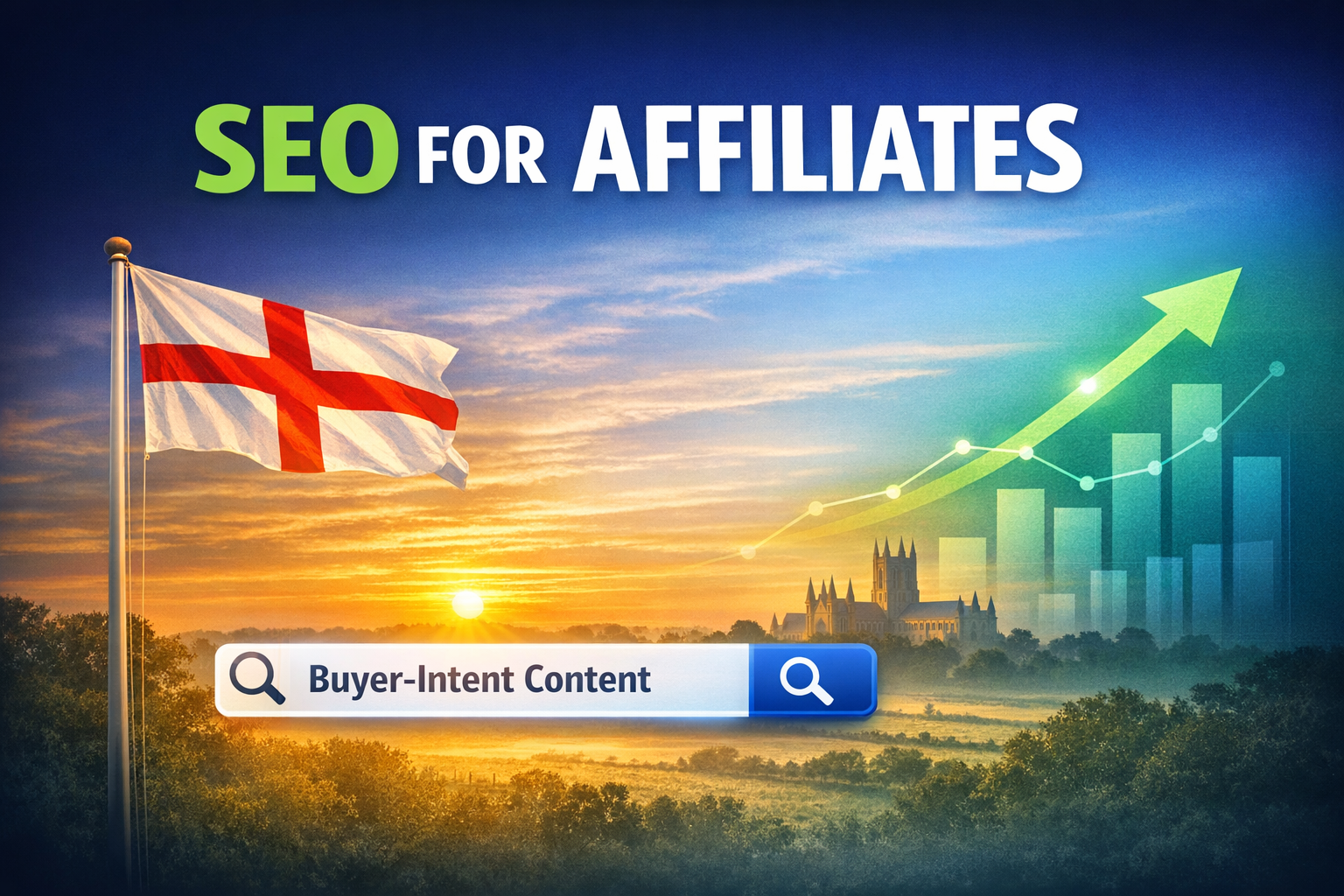
SEO for Affiliates: A No‑Fluff Guide to Ranking Buyer‑Intent Content
Most affiliates still talk about SEO like it’s 2015.
They obsess over traffic, not intent. They chase any keyword with a decent search volume. They write “informational” articles that bring in visitors who were never going to buy anything in the first place.
Then they look at their analytics and say, “SEO doesn’t work for me.”
Here’s the truth:
SEO absolutely works for affiliates in 2026 — if you focus on ranking buyer‑intent content and stop wasting energy on keywords that will never turn into commissions.
In this guide, I’m going to walk you through a no‑fluff approach to SEO specifically for affiliates. Not theory. Not generic “publish great content” tips. A practical way to:
- Find keywords that attract people ready to buy
- Create content that actually ranks and converts
- Build a small SEO engine that compounds over time
If you’re willing to think strategically and play the long game (without overcomplicating it), SEO can become one of your most reliable sources of buyer‑ready traffic.
What “Buyer‑Intent” Really Means (and What It Doesn’t)
Let’s start with a simple definition.
Buyer‑intent keywords are searches made by people who are actively considering a purchase. They’re not just researching the topic. They’re researching what to buy.
Classic examples:
- “[Tool A] vs [Tool B]”
- “Best for [specific person] 2026”
- “[Product] review”
- “Is [Product] worth it?”
There’s also a second layer of buyer‑intent keywords that sound more “how‑to” but still sit close to the decision:
- “How to start email marketing as a beginner” (perfect place to recommend an email tool)
- “How to launch a mini course fast” (perfect place to recommend a course platform)
What buyer‑intent is not:
- Super broad keywords like “email marketing,” “lose weight,” “affiliate marketing.”
- Purely informational keywords like “what is affiliate marketing,” “benefits of email marketing,” “history of keto.”
Those can be useful for brand building and long‑term authority, but if you’re after commissions, you start with the search terms that have wallets attached.
Step 1: Build a Short List of Buyer‑Intent Keyword Types
Instead of drowning in keyword tools and spreadsheets, I want you to start with just a handful of keyword types.
For affiliates, these are the workhorses:
- [Product] review
- “[Tool X] review”
- “[Course Name] review 2026”
- [Product A] vs [Product B]
- “ConvertKit vs MailerLite”
- “Shopify vs WooCommerce for beginners”
- Best [category] for [person/use case]
- “Best email marketing tools for coaches”
- “Best budget microphones for YouTube beginners”
- [Product] pricing / discount / alternatives
- “[Tool X] pricing”
- “[Tool X] alternatives”
- Outcome‑driven how‑tos with clear product ties
- “How to build a landing page without coding”
- “How to host your first webinar”
Your first job is to figure out how these patterns apply to your niche and offers.
Write down:
- The main products or categories you promote
- The types of people you help (beginners, coaches, local businesses, creators, etc.)
Then start combining those into potential keyword targets using the patterns above.
You’re not chasing volume here. You’re chasing relevance and intent.
Step 2: Check the SERPs Like a Human, Not a Robot
Before you write anything, you need to see what already ranks.
Search your potential keywords in Google and pay attention to:
- What types of pages are in the top 10? (blog posts, product pages, comparison sites, YouTube videos)
- Are big brands dominant, or do you see smaller niche sites ranking?
- What formats are working? (lists, in‑depth reviews, tables, FAQs)
Ask yourself:
- Can I create something at least as useful as the top 3 results?
- Is there a gap I can fill? (e.g. all the posts are generic, outdated, or ignore a particular audience segment you serve)
If the entire first page is dominated by giant brands and comparison engines with massive authority, that keyword may be too hard right now. Move to a more specific variation.
For example, instead of:
- “Best email marketing tools” (ultra competitive)
Try:
- “Best email marketing tools for fitness coaches”
- “Best simple email marketing tools for beginners in 2026”
You’re not trying to own the whole mountain on day one. You’re looking for achievable footholds where intent is still high.
Step 3: Create “Money Posts” Built Around One Clear Intent
Now it’s time to create the content that can actually rank and sell.
For buyer‑intent SEO as an affiliate, think in terms of money posts: a small set of highly focused pieces designed to rank and convert.
Each money post should:
- Target one main keyword (and a few closely related variations)
- Have a clear, descriptive headline (no clickbait, just clarity)
- Be structured for both humans and search engines
- Make your recommendations obvious and easy to act on
Here’s how I like to structure some of the main types.
a) Review posts
- Clear headline: “[Tool X] Review (2026): Who It’s For, What I Like, and What I Don’t”
- Intro: who you are, how you’ve used it, who the review is for
- Quick verdict box near the top (pros, cons, bottom line, CTA)
- Sections: features, real use cases, pros and cons, comparison to competitors, who it’s for / not for
- Strong conclusion with a clear call‑to‑action
b) Comparison posts
- Headline: “[Tool A] vs [Tool B] for [type of user]: My 2026 Verdict”
- Intro: why this comparison matters, your experience with both
- Summary table near the top
- Sections based on what actually matters: ease of use, features, pricing, support, who each is best for
- Final verdict and “choose this if / choose that if” breakdown
c) “Best of” posts
- Headline: “7 Best [of] for [type of person] in 2026”
- Intro: who this is for and how you chose the tools
- Short list of top picks with 1–2 sentence summaries
- Individual sections with pros, cons, ideal user, and your affiliate links
- FAQ section at the end to hit related questions and long‑tail keywords
Your money posts don’t need to be 10,000‑word monsters. They need to be useful, honest, and clearly targeted at someone trying to make a buying decision.
Step 4: On‑Page SEO That Actually Matters (No Tech PhD Required)
On‑page SEO doesn’t have to be complicated. For buyer‑intent affiliate content, you mainly need to get these pieces right:
- Title tag
- Include the main keyword and something that signals the benefit.
- Example: “ConvertKit vs MailerLite (2026): Which Is Better for Beginners?”
- Meta description
- Summarise the promise in a natural sentence or two.
- This isn’t a ranking magic wand, but it affects click‑through from search.
- URL
- Keep it short and readable, like
/convertkit-vs-mailerlite-review
- Keep it short and readable, like
- Headings (H2, H3)
- Use them to structure the page logically.
- Include related phrases where it’s natural: “ConvertKit features”, “MailerLite pricing”, “Which email tool is better for beginners?”
- Content itself
- Use the keyword and natural variations where they naturally fit.
- Forget about “keyword density.” Focus on clarity and thoroughness.
- Internal links
- Link from related posts to this money post using relevant anchor text.
- Example: from a “how to start email marketing” post, link to your email tool comparison.
- External links
- Link out to official product pages, documentation, or genuinely helpful resources.
- This sends quality signals and helps the reader.
If you get these basics right and the content is genuinely good, you’re ahead of most affiliates still stuffing keywords and hoping.
Step 5: Build Internal Links Like a Pro
Internal linking is one of the most underused levers for affiliate SEO.
Think of it this way:
- Your money posts are your main sales pages.
- Your other content (tutorials, opinion pieces, strategy posts, email content, etc.) should gently funnel people toward those money posts.
Practical steps:
- Every time you publish a new article, ask: “Which money post does this support?” and link to it.
- Go back through your existing content once a month and add links from older posts to your newer money posts.
- Create a “Start Here” or “Toolkit/Resources” page that links to all your key money posts.
Internal links help:
- Readers find what they actually need
- Search engines understand which pages are most important on your site
- Your buyer‑intent content accumulate authority faster
You’re basically creating little roads around your site that all connect back to your key revenue drivers.
Step 6: Promote Your SEO Content Like It Isn’t SEO
Here’s a mental shift that helps:
Stop treating SEO content like it only lives in search.
Every time you publish a buyer‑intent post, treat it as a central asset you’ll actively promote:
- Share it with your email list
- Break sections into short social posts and threads, and link back to the full article
- Turn key points into short videos and drop the link in your bio or comments
- Share it in relevant communities when it genuinely answers a question
This does three things:
- It gets traffic before you rank.
- It sends early engagement signals search engines like (clicks, time on page, links).
- It reminds you these posts are valuable, not just “SEO chores.”
SEO is a long game, but you don’t have to sit around waiting for Google. Use the content everywhere you can while the search rankings build in the background.
Step 7: Track What Matters and Ignore the Noise
It’s easy to get lost in SEO dashboards and forget why you’re doing this in the first place.
As an affiliate, the metrics that matter most are:
- Which pages are getting search traffic
- Which of those pages are getting clicks on your affiliate links
- Which offers and pages are actually generating commissions
You don’t need deep analytics to get started. Just:
- Log into your analytics tool to see your top 10–20 pages by organic traffic
- For each of those, check:
- Do I have a clear call‑to‑action on this page?
- Are my affiliate links easy to find and compelling to click?
- Is this traffic actually buyer‑intent, or just people learning?
Then:
- Double down on what’s working — more internal links, updated content, better CTAs.
- Rework or de‑emphasise pages that bring in lots of traffic but no clicks or sales.
The goal isn’t “more traffic.” The goal is more buyer‑intent traffic hitting pages designed to convert.
A Simple SEO Plan for Affiliates (You Can Actually Follow)
To pull this together, here’s a simple plan you can run for the next 90 days:
- Identify 5–10 buyer‑intent keywords closely aligned to your main offers.
- Create 5–10 strong money posts (reviews, comparisons, “best of” lists, outcome‑focused how‑tos).
- Optimise each for on‑page basics: titles, headings, URLs, internal links, CTAs.
- Promote each new post via email, social, and relevant communities.
- Every month, review your top organic pages and improve the ones with the best potential.
That’s it.
No 100‑page SEO plan. No obsession with obscure metrics. Just consistent work on the few pages most likely to make you money.
Final Thought: Rank for Decisions, Not Just Questions
If you take nothing else from this, take this:
Most affiliates try to rank for questions.
Strategic affiliates rank for decisions.
Questions like “what is email marketing” are crowded, vague, and low‑intent.
Decisions like “ConvertKit vs MailerLite for beginners” are specific, focused, and full of buying potential.
Aim your SEO there.
When you do, you’ll find that you don’t need millions of visitors. You just need the right thousands — or even hundreds — landing on pages built to help them decide and take action.
That’s SEO for affiliates in 2026. No fluff. Just buyer‑intent and smart structure.
Conclusion: SEO That Actually Moves the Needle
You don’t need to become an SEO nerd to win as an affiliate in 2026. You just need to be intentional about what you rank for and who you’re ranking for.
When you stop chasing every keyword and start focusing on buyer‑intent content — reviews, comparisons, “best of” posts, and outcome‑driven how‑tos — SEO stops being a vanity metric and starts becoming a real driver of commissions.
You’re not trying to impress an algorithm. You’re trying to help real people make smarter decisions, faster.
If you can do that consistently, search traffic becomes one of the most reliable, low‑stress assets in your entire business.
Next Step
If you want help picking your first 5–10 buyer‑intent keywords, planning your “money posts,” or tightening up existing content so it actually ranks and converts, come and join The Strategic Affiliate Facebook Group
That’s where I:
- Give feedback on members’ SEO content
- Help you choose the right keywords for your offers
- Work with you to build a simple 90‑day plan you can actually stick to
You don’t have to figure this out alone. Join the community, show me what you’re working on, and let’s turn your SEO into a focused, commission‑driving asset.