Email Marketing Strategy for Affiliate Promotions
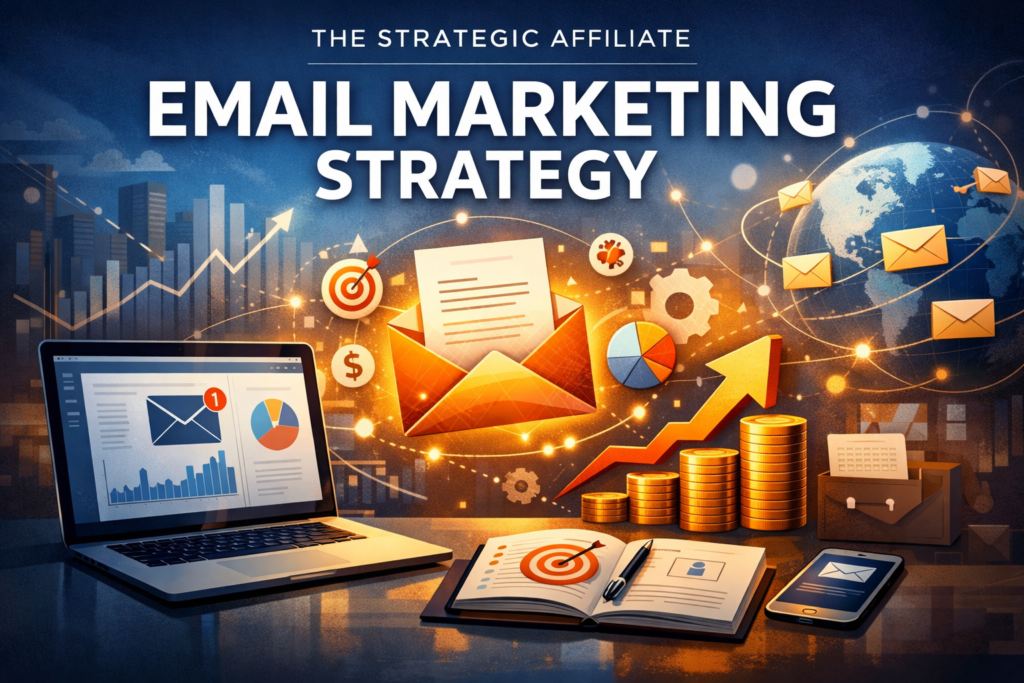
Email is still the most reliable way to turn casual readers into repeat buyers – but only if you use it intentionally.
If your “strategy” is to blast your list with random affiliate links whenever you remember, you’ll train people to ignore you. If instead you build a simple, structured email marketing strategy for affiliate promotions, you can make sales consistently without burning your list or feeling spammy.
What follows is the approach that has worked best for me over 19 years: a practical system you can drop on top of your “How to Start Affiliate Marketing” pillar and the assets you’ve already built (checklists, roadmaps, videos).
1. Why Email Still Matters for Affiliate Promotions
Every couple of years, someone declares email “dead”. Meanwhile, people quietly keep making a very good living from it.
Current data backs this up: email remains one of the highest‑ROI channels because you own the list, can talk to people directly, and aren’t at the mercy of algorithms. It’s particularly powerful for affiliates because:
- You can educate first, recommend second, instead of trying to close the sale in a single blog visit.
- You can sequence promotions over time – welcome series, launch windows, re‑promotions – instead of hoping people remember you.
- You can segment by interest and behaviour, so you’re not sending every offer to everyone.
In my own business, the biggest jumps in affiliate income didn’t come from more traffic; they came from treating email as the main engine of trust and promotion. That meant writing consistently, respecting the inbox, and having a clear plan for how affiliate offers fit into the bigger email picture.
The rest of this article lays out that plan – a repeatable email marketing strategy for affiliate promotions you can adapt to any niche.
2. Get the Fundamentals Right: List, Tool, and Promise
Before worrying about sequences and clever subject lines, you need three basics in place.
2.1. Build the right kind of list
Not all subscribers are equal. If you bribe people with “win a free iPad” and then send them hosting offers, don’t be surprised when nobody clicks.
Most email‑for‑affiliate guides now emphasise list quality over list size. For your strategy:
- Use niche‑specific lead magnets: your Niche Validation Checklist, 90‑Day Launch Roadmap, and now your Affiliate Product Selection Checklist are perfect.
- Make the opt‑in promise match what you’ll eventually promote:
- If the page is about starting affiliate marketing, tell people they’ll get tools, tips, and product recommendations to help them build and monetise their site.
The more closely your lead magnet and opt‑in copy align with your eventual offers, the higher your email conversion rates will be.
2.2. Use a proper email service provider
You don’t need an enterprise platform. But you do need:
- Segmentation / tags
- Automation
- Decent deliverability and compliance tools
Almost every up‑to‑date email marketing guide stresses proper authentication (SPF, DKIM, DMARC), clean lists, and clear consent to keep emails landing in inboxes. Set those up once, and you’ll have far fewer headaches.
2.3. Make a clear promise at signup
Your “welcome promise” sets expectations.
Examples for your brand:
- “Practical emails on starting and growing an affiliate site – with honest recommendations for tools that actually help.”
- “Weekly guides, checklists, and product recommendations to help you go from first niche idea to first affiliate sale.”
If you promise “zero promotions ever” and then start sending offers, people will feel tricked. If you promise “useful content + relevant recommendations”, it feels natural when you send an affiliate promotion.
3. Design a Simple Email Marketing Strategy for Affiliate Promotions
Let’s build the skeleton you can hang everything else on.
There are three core layers:
- A welcome / orientation sequence
- A rhythm of regular value emails
- Planned affiliate promotion slots woven into that rhythm
3.1. Welcome sequence: set the tone and introduce your world
Your welcome sequence is where you:
- Deliver the lead magnet
- Help them get a quick win
- Explain what to expect from you
- Gently introduce that you do recommend products
Most affiliate email guides suggest a short 3–7 email sequence over the first 7–14 days. For example:
- Email 1 – Deliver the thing
- Subject: “Here’s your Niche Validation Checklist”
- Content: link to the PDF, quick instructions, a bit about you, and a tease of what’s coming next.
- Email 2 – Quick win + soft recommendation
- A story about choosing a niche badly vs correctly.
- A link back to your “How to Start Affiliate Marketing” pillar.
- A soft mention of a tool you use (e.g. hosting or keyword tool), framed as “here’s what I personally use and why”.
- Email 3 – 90‑day roadmap + expectations
- Show them how the roadmap works.
- Explain your email schedule (e.g. “I’ll email you 1–2 times a week with practical guides and honest product recommendations.”)
- Email 4+ – Deepen trust
- Share more of your framework: niche → setup → content → traffic → monetisation.
- Link to key articles and videos.
- Include one clear call‑to‑action per email.
Notice that even here, affiliate promotions are woven in lightly. The focus is relationship and clarity first.
3.2. Regular value rhythm
After the welcome, your list moves onto your “steady state” rhythm. Most up‑to‑date advice says consistency beats intensity: 1–2 meaningful emails per week usually outperforms erratic bursts.
A simple pattern:
- One “how‑to” or “story + lesson” email per week
- One “curated + recommendation” email some weeks (not all)
For example:
- Week 1: “Why your first niche matters more than your first theme” (value)
- Week 2: “3 hosting mistakes beginners make” + your recommended host (value + affiliate)
- Week 3: “How I’d launch an affiliate site if I started in 2026” (value)
- Week 4: “Tools I actually pay for in my business” (value + affiliate)
This keeps most of your email marketing strategy for affiliate promotions anchored in useful content, with promotions as a natural part of the mix.
4. Map Affiliate Promotions to Subscriber Journeys, Not Just Broadcasts
The biggest mistake I see is treating every promotion as a one‑size‑fits‑all broadcast. Modern email marketing emphasises segmentation and behaviour‑based triggers for better relevance and conversions.
For affiliate emails, think in terms of journeys:
4.1. Journey 1: New to affiliate marketing
They’ve just opted in via your beginner content. Their path might be:
- Welcome sequence (as above)
- A “Start Here” series:
- Email: pick a niche
- Email: set up WordPress
- Email: publish your first pillar article
- Email: basic SEO and keyword research
- Along the way, you introduce:
- Hosting
- Keyword tools
- Essential plugins
- Your own course/community later
Your affiliate promotions here are positioned as enablers of the roadmap you’re teaching.
4.2. Journey 2: Already have a site, need optimisation
They came in on an SEO or monetisation article. For them:
- Fewer emails about “what is affiliate marketing”
- More about:
- Improving click‑through and conversions
- Email list building
- Better offers and programmes
Affiliate promotions might focus on:
- Better tools than they’re currently using
- Conversion and CRO tools
- Email and funnel tools
Most modern email platforms let you tag by entry point, link clicks, or self‑segmentation (e.g. a simple “Which best describes you?” link in an email). Use that to tailor which affiliate promotions they see and when.
5. Write Emails That Sell Without Feeling Pushy
You don’t need to become a shouty copywriter to sell affiliate offers. You do need to write emails that:
- Start with a clear problem
- Teach something useful
- Show why a particular product is a good solution
- Make it easy to act
Current guides on affiliate email marketing suggest avoiding vague “here’s a link, check it out” and instead building emails around specific campaigns and objectives.
Here’s a simple structure that’s worked well for me:
5.1. Problem → story → teaching → recommendation
Take hosting as an example.
- Subject: “The hosting mistake that cost me three months of rankings”
- Problem: Briefly tell the pain – site went down, slow load times, support nightmare.
- Story: A short, human story about what happened and what you learned.
- Teaching: Distil the practical lesson (e.g. what actually matters in hosting for an affiliate site: uptime, speed, support, simplicity).
- Recommendation:
- “Here’s the host I use now, and here’s why.”
- One or two main benefits, then a clear CTA:
- “If you’re at the stage of setting up your site, I’ve written a full guide and linked my recommended host here.”
You can use this pattern for almost any affiliate promotion:
- Email tool: “The newsletter mistake that cost me 30% of my list.”
- Keyword tool: “How I stopped guessing topics and started ranking more predictably.”
5.2. Best practices that still matter
Recent best‑practice lists for email in 2026 still stress some basics:
- Clear subjects, no clickbait – curiosity is good; deception kills trust.
- Plain, scannable content – short paragraphs, clear headings, one main idea per email.
- One main CTA – don’t throw five different offers at one email.
- Mobile‑friendly formatting – most people will read you on their phone.
- Link checks – test your affiliate links before sending.
If an email feels like something you’d be happy to receive yourself, you’re probably on the right track.
6. Automations That Do Quiet Heavy Lifting for You
The beauty of a good email marketing strategy for affiliate promotions is that once you’ve set up the core automations, they keep working while you’re busy writing or recording.
Here are the sequences worth investing time in:
6.1. Evergreen “tool stack” sequence
Once subscribers have had some time to engage with your content:
- Send a short series introducing your core tool stack:
- Hosting
- Keyword tools
- Email service provider
- Link management
- Any “must‑have” courses you genuinely stand behind
Structure:
- Email 1: “5 tools I’d use if I was starting from scratch in 2026” (overview + links)
- Email 2–4: One tool per email, with story + teaching + recommendation.
You can trigger this sequence based on:
- Time (e.g. 21 days after signup), or
- Behaviour (e.g. people who clicked on certain “tools” links)
6.2. Behaviour‑based follow‑ups
Modern email platforms make behaviour‑based triggers much easier. For affiliate promotions:
- If someone clicks your hosting link but doesn’t buy, you can:
- Send a helpful follow‑up:
- “I saw you were interested in hosting – here are 3 things to know before you commit.”
- Send a helpful follow‑up:
- If someone repeatedly clicks on tools or niche‑selection links:
- Send deeper content plus related offers.
These don’t have to be creepy. Keep them helpful, occasional, and focused on solving the problem they’re obviously thinking about.
6.3. Re‑engagement and list pruning
Deliverability has become stricter in recent years; guides now strongly recommend keeping your list clean to protect your sender reputation. Set up:
- A re‑engagement sequence for people who haven’t opened in X days (60–90 is typical).
- A clear opt‑down or unsubscribe option if they’re no longer interested.
This isn’t directly about affiliate promotions, but it keeps your future promotions out of spam.
7. Measure What Matters (And Ignore the Noise)
With so much data available, it’s easy to drown in metrics. For an email marketing strategy for affiliate promotions, the only numbers that really matter are:
- Open rate trends – healthy enough that you’re not in deliverability trouble.
- Click‑through rate to your key offers – are people interested?
- Earnings per subscriber / per 1,000 subscribers – is your list commercially healthy?
Other metrics (subject line tests, send‑time tweaks, etc.) can help, but don’t lose sight of the basics. Current email and affiliate guides both emphasise focusing on campaign objectives and ROI, not just vanity metrics.
In practical terms:
- Track clicks on each major affiliate link from email.
- Compare different email formats:
- Story‑led vs “here’s a deal”
- Short vs long
- Run simple A/B tests on:
- Subject lines
- Angle (pain‑focused vs aspiration‑focused)
Over a few months, you’ll see patterns: certain topics, formats, and offers consistently outperform others. Double down on those.
Conclusion: Treat Email as Your Main Affiliate Asset, Not a Side Channel
Email is where you get to:
- Talk to your people without algorithms in the way.
- Teach your frameworks in a structured way.
- Recommend products in context, with nuance and honesty.
- Build relationships that survive the ups and downs of SEO and social platforms.
A good email marketing strategy for affiliate promotions doesn’t mean shouting “BUY NOW” twice a week. It means:
- Clear expectations at signup
- A thoughtful welcome sequence
- A consistent value rhythm
- Strategic, honest promotions that fit your roadmap
- A few automations that keep quietly working
If you already have your How to Start Affiliate Marketing pillar, your checklists, and your 90‑day roadmap in place, email is the glue that holds them together. Use it well, and you won’t need to chase every new platform trend to keep your affiliate income growing.
If you’re serious about this, your next step is simple: sketch your welcome sequence on paper, decide on your weekly email rhythm, and choose one core affiliate offer to build a small email “campaign” around this month. Put that into motion before you try to draft another big strategy document.
FAQs: Email Marketing Strategy for Affiliate Promotions
1. How often should I email my list when promoting affiliate offers?
Most affiliates do well with 1–2 emails per week, mixing useful content with occasional, clearly positioned promotions. Current best‑practice advice warns against sudden bursts of daily sales emails after long silence; consistency and predictability build more trust and better deliverability.
2. Should I disclose affiliate links inside emails?
Yes. Transparency is both a legal and trust issue. Many affiliate email guides recommend including a brief note at the top or bottom of promotional emails (e.g. “Some of the links in this email are affiliate links, which means I may earn a commission if you buy through them, at no extra cost to you.”) That level of honesty tends to increase, not decrease, subscriber trust.
3. Can I promote multiple affiliate products in one email?
You can, but it’s usually better to have one primary call‑to‑action per email. If you include multiple offers, make one clearly dominant and keep the others as secondary mentions. Too many links can confuse readers and dilute clicks; several affiliate email guides specifically caution against “link soup”.
4. How do I avoid annoying my subscribers with affiliate promotions?
Anchor your promotions in real problems and helpful content, and keep the ratio of pure value to pure promo healthy (for example, 3–4 value‑first emails for every heavy promotion). Let people know at signup that you will occasionally recommend products. If you consistently help them, they’ll welcome relevant offers rather than resent them.
5. What’s the best email format for affiliate promotions: plain text or designed templates?
For most solo creators and affiliate marketers, a simple, “plain text‑ish” format tends to perform very well: it feels personal, loads fast on mobile, and avoids “newsletter ad” vibes. Recent best‑practice lists focus more on clarity, mobile optimisation, and deliverability than heavy design; a clean layout with minimal images usually hits the sweet spot.
If you’re serious about building an email marketing strategy for affiliate promotions, Kit is the tool I recommend starting with. It’s built specifically for creators, not corporate marketing teams, so the interface feels straightforward even if you’re not “technical”.
You get tags and automations that make proper segmentation easy, which is exactly what you need to send different affiliate offers to beginners vs more advanced subscribers without going mad. The free plan is generous for smaller lists, and you can spin up simple landing pages and opt‑in forms without touching your WordPress theme, which is handy when you just want to get a lead magnet live and collecting emails today.
What I like most is that Kit keeps emails looking like real messages from a real person, rather than glossy brochures. That tends to mean better engagement and more trust, which is ultimately what drives affiliate sales over the long term.
You can join completely free of charge and publish your Newsletter to up to 10,000 subscribers, Use my Link Here and be up and running today.