How to Build an Affiliate Marketing Funnel From Scratch (Step‑by‑Step)
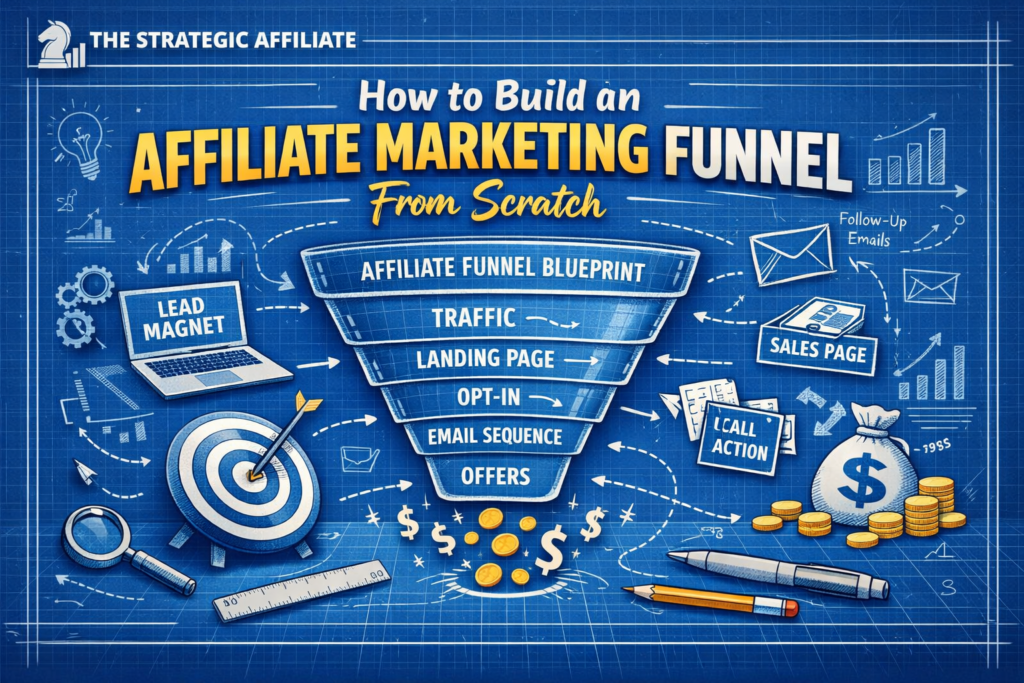
How to Build an Affiliate Marketing Funnel From Scratch
Most affiliates don’t have a funnel. They have a blog.
There’s a big difference.
A blog is a collection of articles. A funnel is a deliberate path that takes a complete stranger, builds trust with them over time, and eventually guides them towards a buying decision — naturally, without pressure, and in a way that serves them as much as it serves you.
If your affiliate site is getting some traffic but not making consistent sales, the missing piece is almost always the funnel. You’re getting visitors but not converting them into subscribers, and subscribers but not converting them into buyers.
In this guide I’ll show you how to build an affiliate marketing funnel from scratch — the structure, the tools, the content, and the sequence that ties it all together. This is the Traffic and Funnels layer that sits on top of your How to Start Affiliate Marketing foundation and connects directly to the systems and tools you already have in place.
1. What an Affiliate Marketing Funnel Actually Is (And Isn’t)
Before we build anything, let’s get clear on what a funnel actually means in the context of affiliate marketing.
A funnel is simply a guided journey from stranger to buyer. It’s called a funnel because at each stage some people drop off — and that’s fine. You’re not trying to convert everyone; you’re trying to serve the right people well enough that they trust your recommendations when it matters.
The classic affiliate funnel has four stages:
- Awareness — someone discovers you via Google, YouTube, social media, or a referral.
- Interest — they read or watch something useful and want more.
- Decision — they’re weighing up options and looking for a trustworthy recommendation.
- Action — they click your affiliate link and buy.
Most affiliate sites focus heavily on the awareness stage (SEO, content, traffic) and the action stage (affiliate links) and almost completely skip the middle — building genuine interest and guiding people to a confident decision.
That middle section is where your funnel lives, and it’s where most of your income will eventually come from.
Here’s a personal example of what this looks like in practice:
Someone finds my article on keyword research via Google. They read it, find it useful, and opt in for my free 90‑Day Affiliate Launch Roadmap. Over the following week they receive a sequence of emails that teach my framework, share my recommended tools, and link to my best content. By the time I mention a specific keyword tool in email 5, they’ve already had four useful interactions with me. That’s not a cold pitch — that’s a warm recommendation from someone they’ve started to trust.
That’s the difference a funnel makes.
2. The Four Core Components of an Affiliate Marketing Funnel
You don’t need complicated software or an expensive tech stack to build a working affiliate marketing funnel. At its core, every effective funnel has four pieces.
2.1. A traffic source
Someone has to find you first. For most content‑led affiliate businesses the main traffic sources are:
- Organic search (SEO) — people finding your articles via Google.
- YouTube — people finding your videos and clicking through to your site.
- Social media — people seeing your posts and following a link.
- Email referrals — subscribers forwarding your content to others.
Your traffic source determines who enters the funnel and in what frame of mind. Someone who found you by searching “best email marketing tools for beginners” is much closer to a buying decision than someone who stumbled across a generic “what is affiliate marketing” article. That distinction matters when you’re designing what happens next.
2.2. A capture mechanism (your lead magnet and opt‑in)
Once someone lands on your site, the most important thing your funnel needs to do is keep them — not just as a page view, but as a subscriber.
This is your lead magnet: a free, specific, immediately useful resource that gives someone a strong reason to hand over their email address.
Good lead magnets for an affiliate site:
- A checklist (e.g. “Niche Validation Checklist”)
- A one‑page roadmap (e.g. “90‑Day Affiliate Launch Roadmap”)
- A template (e.g. “Affiliate Review Template That Converts”)
- A mini guide or swipe file specific to your niche
- Access to a free community or challenge
The lead magnet should be directly related to the content that brought the visitor to your site in the first place. If someone lands on your keyword research article, offer a “Keyword Research Checklist for Affiliate Marketers” — not a generic “affiliate marketing guide.”
Specificity dramatically improves opt‑in rates, and a targeted subscriber is worth ten generic ones.
2.3. An email sequence (your trust‑building engine)
Once someone is on your list, this is where the real funnel begins. Your email sequence does the heavy lifting that a single blog post can never do on its own:
- It introduces you properly over time.
- It teaches your framework and approach in digestible chunks.
- It builds trust through consistent, useful content.
- It introduces your affiliate offers in context — as solutions to real problems, not random promotions.
The key principle here is that your email sequence is a conversation, not a broadcast. It should feel like a series of helpful messages from someone who genuinely knows what they’re talking about.
Our full email marketing strategy for affiliate promotions guide covers sequencing, segmentation, and promotion tactics in detail — well worth reading alongside this article.
2.4. Offer pages and destination content
Finally, your funnel needs destination pages — the content where your affiliate recommendations actually live and where the conversion happens.
These include:
- In‑depth product reviews
- Comparison posts (“X vs Y”)
- “Best [tool] for [audience]” roundups
- Tutorial or “how to use” guides with affiliate links woven in naturally
The funnel guides people towards these pages at the right moment — when they’re warm, informed, and ready to make a decision — rather than hoping a cold visitor stumbles across them via Google and immediately buys.
3. Mapping Your Funnel to Your Niche and Offers
A funnel only works when it’s built around a specific problem, a specific audience, and a specific set of offers. Generic funnels produce generic results.
Before you build anything, map out:
Who enters your funnel?
Be specific. “People interested in affiliate marketing” is too broad. “Beginners who want to start a content‑based affiliate site with no paid ads budget” is something you can build a focused funnel around.
What problem do they have right now?
What stage are they at? What’s their biggest frustration? What question are they typing into Google at 11pm?
What’s the logical journey from where they are to your core offer?
Map it out step by step. For example:
- They find your “how to get traffic to your affiliate site” article via Google.
- They opt in to get your 90‑Day Launch Roadmap lead magnet.
- They receive your welcome email sequence over 7–10 days.
- Email 3 introduces your recommended hosting and links to your WordPress setup guide.
- Email 5 introduces your recommended keyword tool with a real example from your own site.
- Email 7 points them to your “best email marketing tools” review.
- They click through and convert on Kit or whichever tool you’re promoting.
That’s a complete, logical funnel. Every step serves the reader’s journey and your income at the same time — which is exactly how it should work.
4. Building Your Email Sequence: The Heart of Your Affiliate Marketing Funnel
Your email sequence is where most of the conversion work happens in a properly built affiliate marketing funnel. This is why building your list from day one matters so much — every subscriber who enters your sequence has the potential to convert on multiple offers over time, not just one.
A simple, effective 7‑email welcome sequence for an affiliate funnel:
Email 1 – Deliver and delight
Deliver the lead magnet immediately. Keep it brief, warm, and personal. Include one clear next step such as a link to your most useful article while they wait for the download to load.
Email 2 – Your story
Share why you started in affiliate marketing. Be honest about the struggles, not just the wins. End with a lesson that’s directly relevant to where your subscriber is right now. Relatability builds more trust than polished success stories.
Email 3 – Your first soft recommendation
Teach something practical such as how to set up a WordPress affiliate site properly. Introduce one tool you genuinely use and trust as a natural part of the lesson. Link to your full setup guide and your affiliate link in context — not as a pitch, but as a “here’s what I use.”
Email 4 – A common mistake and the fix
Pick one mistake your audience makes repeatedly. Give them the fix in the email itself — don’t make them click to find out. At the end, mention one resource or tool that makes avoiding this mistake easier.
Email 5 – Your framework
Introduce your system or approach in plain terms. Reference your pillar content with a link: “I’ve laid out the full blueprint here.” Position your recommended tools as the natural equipment for following the framework.
Email 6 – Social proof and real results
Share a result: yours, a community member’s, or a case study from someone using the tools you recommend. Keep it honest and specific — vague income claims erode trust faster than they build it.
Email 7 – The full stack
Bring everything together: niche, platform, content, email, tracking. Share your recommended tool stack with brief context for each one. Multiple soft affiliate link placements — one per tool, all contextual.
After this sequence, move subscribers onto your regular email rhythm of one to two value emails per week with occasional promotions woven in naturally.
5. The Tech Stack You Actually Need (Kept Deliberately Simple)
One of the biggest reasons people never build a funnel is that they think it requires complicated, expensive software. It doesn’t.
For a content‑led affiliate marketing funnel, here’s all you need:
Email service provider
Kit (formerly ConvertKit) is what I recommend for most affiliates starting out. It handles sequences, tags, automations, and landing pages cleanly without requiring technical knowledge. The free plan covers everything you need to get started.
Landing page for your lead magnet
Kit can build this for you without touching WordPress. Keep it simple: one benefit‑led headline, three bullet points on what they get, and an opt‑in form. Overthinking the landing page is one of the most common reasons people delay launching their funnel for weeks unnecessarily.
Link management plugin
Every affiliate link in your funnel — whether in a blog post, an email, or a resource page — should run through a centralised link management plugin like Pretty Links or ThirstyAffiliates. This means you can update a link once and it updates everywhere, which is critical when programmes change their tracking URLs.
This is covered in much more detail in our affiliate link management tools and best practices guide, which is worth reading alongside this one.
Your WordPress site
Your blog posts, reviews, and comparison pages are the destination content in your funnel. Make sure every key page has a clear call to action and an email opt‑in opportunity, ideally above the fold or embedded naturally within the content.
Analytics
Google Analytics and Search Console for your site traffic. Your email provider’s built‑in reporting for open rates, click rates, and sequence performance. These two together give you everything you need to make intelligent decisions without paying for extra tools.
That is genuinely all you need. The complexity comes later if and when the business demands it — not on day one.
6. The Business System That Makes Your Funnel Work Long Term
A funnel is not a set‑and‑forget piece of machinery. The affiliates who build funnels that keep growing and improving treat them as living business systems — something to measure, refine, and update regularly.
That means building a few simple habits around your funnel:
Monthly funnel review
Once a month, check:
- Which emails in your sequence get the highest open and click rates?
- Which destination pages get the most traffic and the most affiliate clicks?
- Where do people drop off — which email do unsubscribes tend to happen after?
Use that data to improve your weakest link. One improvement per month compounds significantly over 12 months.
Regular content updates
Your destination pages — reviews, comparisons, and roundups — need to stay accurate. Tools change their pricing, programmes update their terms, and better alternatives emerge. Outdated recommendations erode trust fast.
Sequence refreshes
Every 6 months or so, reread your welcome sequence with fresh eyes. Does it still reflect how you teach? Are the tools you recommend still the best options? Is the tone consistent with your current brand?
Connecting your funnel to your wider systems
Your funnel doesn’t exist in isolation. It should connect to your content planning, your social media, your community, and your analytics in a coherent way. That’s what separates a properly run affiliate business from a blog with an opt‑in form bolted on.
For a deeper look at how to build the infrastructure around your content and funnel, our building the business systems around your content guide covers the full picture.
7. Your Funnel Launch Checklist: From Zero to Live in One Week
If you want to go from no funnel to a working funnel as quickly as possible, here’s a simple checklist:
Day 1–2: Set up your email platform
- Sign up for Kit on the free plan.
- Connect it to your WordPress site using their official plugin.
- Create a simple opt‑in form.
Day 3: Create your lead magnet
- Pick one specific, immediately useful resource your audience needs right now.
- Keep it simple: a one‑page checklist or short PDF roadmap is more than enough.
- Design it in Canva — give yourself a maximum of one hour.
Day 4: Build your landing page
- Use Kit’s landing page builder.
- One benefit‑led headline, three bullet points, opt‑in form.
- Publish it and get the URL ready.
Day 5–6: Write your email sequence
- Write emails 1–7 using the framework from section 4.
- Keep each one focused on one idea.
- Add your affiliate links contextually in emails 3, 5, 6, and 7.
- Set the sending schedule (e.g. day 0, 1, 3, 5, 7, 9, 11).
Day 7: Connect and test everything
- Add your opt‑in form or lead magnet CTA to your top 5 most trafficked articles.
- Test the full sequence yourself: opt in with a personal email address, receive email 1, check every link works.
- Fix anything broken before you promote it.
That’s a complete working funnel. Imperfect but live — which is infinitely better than perfect but still sitting in a draft document.
Conclusion: A Funnel Turns Your Content Into a Real Business
Without a funnel, your content works once. A visitor reads a post, maybe clicks a link, and disappears forever.
With a funnel, that same visitor becomes a subscriber, receives a sequence that builds genuine trust, gets introduced to your best recommendations in the right context, and has multiple chances to convert — now and over the coming months and years.
Building an affiliate marketing funnel from scratch does not have to be complicated or expensive. One strong lead magnet, one 7‑email welcome sequence, and a handful of well‑optimised destination pages is enough to transform a blog into a real affiliate business with a predictable income path.
Pair this with the full blueprint from How to Start Affiliate Marketing and you have everything you need to build income that compounds rather than income that depends on catching lightning in a bottle every month.
Your next step is simple: pick one lead magnet idea today, sign up for Kit, and have your opt‑in form live on your site by the end of this week. Everything else — the sequence, the destination pages, the tracking — gets built around that one first step.
Start the funnel. The rest follows.
FAQs: Building an Affiliate Marketing Funnel From Scratch
1. Do I need a funnel if I’m just starting out?
You don’t need a complicated funnel on day one, but you do need the basics: a way to capture email addresses and a short sequence that introduces your recommendations. Even a simple 3‑email welcome sequence is infinitely better than sending every visitor straight to an affiliate link with no follow‑up. Start simple, build from there, and add complexity only when the basics are working.
2. What’s the best email platform for building an affiliate funnel?
For most content‑led affiliate marketers, Kit (formerly ConvertKit) is the best starting point. It’s built specifically for creators, handles sequences and automations cleanly, has a generous free plan for smaller lists, and doesn’t require technical knowledge to set up. It also integrates directly with WordPress, which makes connecting your site and funnel straightforward.
3. How many emails should my welcome sequence have?
A sequence of 5–7 emails delivered over 7–10 days is a solid starting point for most affiliate funnels. That’s enough time to introduce yourself properly, deliver real value, and make a few contextual recommendations without overwhelming new subscribers. You can always extend the sequence later once you understand what your audience responds to best.
4. Can I build an affiliate marketing funnel without a website?
You can build a basic funnel using just a landing page and an email sequence without a full website. However, for long‑term, sustainable affiliate income, a content site gives you organic traffic that feeds the funnel consistently without you having to constantly pay for visitors or post on social media. The funnel and the content site work best together — one without the other will always underperform.
5. How long does it take for an affiliate funnel to start making money?
That depends on your traffic volume, your niche, and the quality of your offers and sequence. Most affiliates start seeing consistent funnel‑driven commissions once they have a few hundred engaged subscribers and a tested welcome sequence. The funnel itself can be live within a week; the income compounds as your list and traffic grow steadily over the following months.