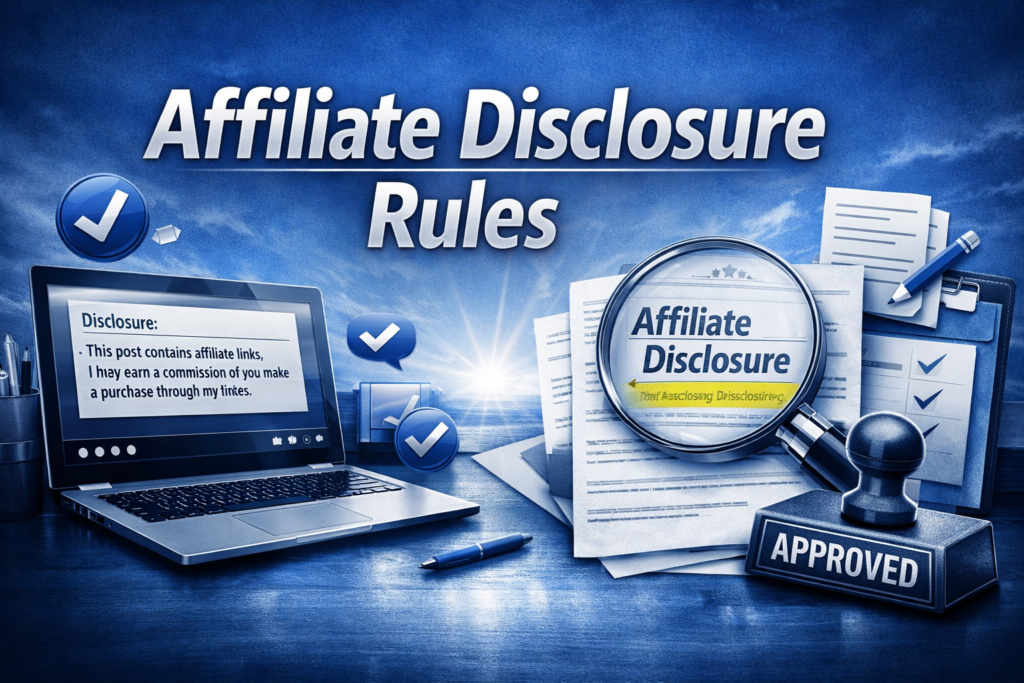
Affiliate Disclosure Requirements – FTC Compliance Templates and Legal Requirements
One of the fastest ways to blow up a promising affiliate business isn’t bad traffic or weak offers. It’s getting on the wrong side of the regulators.
Most beginners obsess over “how do I get clicks?” and “how do I get sales?”, but barely think about affiliate disclosure requirements until they get a warning, a nasty email from a network, or a payment hold. By then, you’re playing catch‑up.
The good news: staying on the right side of the FTC and other regulators is not complicated. You don’t need to be a lawyer; you just need to understand a few core rules, use clear language, and put your disclosures in the right places.
In this guide, I’ll walk you through the key legal requirements, show you practical disclosure examples you can copy, and explain how to bake compliance into your affiliate system from day one. This should sit right alongside your “How to start affiliate marketing” guide as part of the “do it properly” foundation. (link to pillar here)
Quick note: This is general information based on publicly available guidance, not legal advice. If you’re in doubt about your specific situation, talk to a qualified lawyer in your jurisdiction.
1. What Are Affiliate Disclosure Requirements and Why They Matter
At a high level, affiliate disclosure requirements are rules that say:
If you’re recommending a product or service and you have a material connection to the brand (commission, free product, sponsorship, etc.), you must clearly tell your audience.
The U.S. Federal Trade Commission’s Endorsement Guides, and similar guidance in the UK/EU, all point to the same core idea: endorsements must be truthful, not misleading, and transparently connected to any financial relationship.
Practically, that means:
- If you earn a commission when someone buys through your link, you must disclose it.
- If you got the product for free in exchange for coverage, you must disclose it.
- The disclosure must be clear, conspicuous, and close to the endorsement or link, not hidden in a footer or only in your privacy policy.
In 2026, compliance guides are blunt: regulators are actively watching affiliate links, social content, and even AI‑assisted endorsements. You’re expected to treat disclosure as a core part of your process, not an afterthought.
If you’re teaching people how to start affiliate marketing, modelling this correctly is part of your value. (link to pillar)
2. The Core FTC Rules You Need to Know (Without Legalese)
You don’t have to read the full Endorsement Guides cover to cover, but you should understand the main principles that apply to affiliate marketers. Recent summaries and checklists all highlight the same points:
- Disclose any material connection.
- Material connection = anything that might affect how a reasonable person sees your endorsement: commissions, free products, sponsorships, family/employment relationships, etc.
- Make disclosures clear and conspicuous.
- They must be easy to notice, read, and understand.
- Avoid vague terms like “collab”, “sp”, or “spon”. Use plain language: “I earn a commission…” or “This is sponsored”.
- Place disclosures close to the claim or link.
- Use the same language as the content.
- Be honest about your experience.
- Don’t claim results you haven’t had.
- Don’t endorse products you haven’t used if you’re implying you have.
- Don’t make unsubstantiated claims (e.g., medical claims) that require proof you don’t have.
Affiliate compliance guides for 2026 add one more point: document your approach (where you disclose, what wording you use) so you can show good‑faith effort if anyone ever questions you.
3. Where and How to Disclose on Blogs, YouTube, Email, and Social
Let’s make this practical. The rules are channel‑agnostic, but the implementation looks slightly different on each platform. Recent guides and examples give consistent recommendations.
3.1. On your website/blog
Best practice is to have three layers of disclosure on your site:
- Site‑wide disclosure / policy page
- A dedicated “Affiliate Disclosure” or “Disclaimers” page explaining that:
- you use affiliate links
- you may earn commissions
- how that works in general terms
- Linked from your footer and often from your Privacy Policy.
- A dedicated “Affiliate Disclosure” or “Disclaimers” page explaining that:
- Per‑page disclosure above the fold
- A short line near the top of any post containing affiliate links.
- It should be visible without scrolling (“above the fold”) so readers see it before/while reading.
- Near‑link disclosures when appropriate
Example blog disclosure (top of post):
This article contains affiliate links. If you click and purchase, I may earn a commission at no extra cost to you. I only recommend products I truly believe in.
Guides from Termly, ReferralCandy, and Raptive all show similar examples and emphasise clarity and placement over fancy legal jargon.
3.2. On YouTube and other video platforms
The FTC guidance and practical YouTube tutorials suggest you should:
- Say it out loud near the beginning of the video.
- Add on‑screen text (“I may earn a commission from links in the description”).
- Place a clear disclosure in the first lines of the description, right above or next to your affiliate links.
Example spoken disclosure:
“Some of the links in the description are affiliate links, which means I may earn a commission if you decide to buy through them. It helps support the channel at no extra cost to you.”
Example description disclosure (top of description):
Disclosure: This video contains affiliate links. I may earn a commission if you purchase through these links.
YouTube also has a “contains paid promotion” toggle, but current guidance is clear that this is not enough on its own – you still need a proper disclosure in plain language.
3.3. In email marketing
If you include affiliate links in emails, you need to disclose that relationship in the email itself, ideally close to the top or near the links.
Example email disclosure (header or footer of promotional emails):
This email contains affiliate links. If you buy through these links, I may earn a commission at no extra cost to you.
Raptive’s 2024 guide explicitly says disclosures in emails should be “clear, visible, and not buried in a tiny footer,” and that they’re required whenever affiliate links are present.
3.4. On social media (Instagram, TikTok, X, Facebook, etc.)
For posts and stories, compliance guides recommend:
- Put the disclosure in the post itself, not just your bio.
- Use clear terms like “ad”, “sponsored”, or “affiliate link”.
- Make sure it’s visible without tapping “see more” if possible.
- For Stories/Reels, superimpose the text on the image/video.
Examples:
- “Ad”
- “Paid partnership with [Brand]”
- “Affiliate link: I earn a commission if you buy.”
UK and EU regulators are even stricter about hiding disclosures in hashtags, but even the FTC commentary warns against burying #ad in a long string of tags.
4. Simple Affiliate Disclosure Templates You Can Adapt
There are lots of legal‑ese templates out there, but most current advice is: short, honest, human language wins.
Here are some templates you can adapt to your voice.
4.1. Site‑wide affiliate disclosure page
You can have a slightly more formal page, but still readable. For example:
Affiliate Disclosure
Some of the links on this site are affiliate links. This means that if you click on a link and purchase a product, I may receive a commission at no additional cost to you.
I only recommend products and services that I use myself or genuinely believe will add value to you. My goal is to help you build a sustainable affiliate marketing business, and affiliate partnerships help support the work that goes into this site.
All opinions expressed here are my own, and I aim to be as transparent as possible about any financial relationships I have with brands.
You can add a line specifying participation in particular programmes if you like (e.g. “As an Amazon Associate…”), as many guides and networks require.
4.2. Short blog post disclosure snippet
This article contains affiliate links. If you click and purchase, I may earn a commission at no extra cost to you. I only recommend what I’d use myself.
Place this just under the title, above the fold.
4.3. YouTube spoken and written disclosure
“Some of the links in the description are affiliate links, which means I may earn a commission if you decide to purchase through them. It helps support the channel at no extra cost to you.”
Disclosure: This video contains affiliate links. I may earn a commission if you purchase through these links. I only recommend tools I use or trust.
4.4. Email disclosure
This email contains affiliate links. If you buy through them, I may earn a commission at no extra cost to you. I only share offers I believe can genuinely help you.
4.5. Social media post disclosure
At the start or end of the caption:
Ad / Affiliate: I may earn a commission if you buy through this link.
These are straightforward and aligned with modern checklists; you can tune tone and wording to your brand, as long as you stay clear and honest.
5. Building Compliance Into Your Affiliate System (So You Don’t Forget)
The easiest way to mess this up is to rely on memory. The easiest way to get it right is to turn affiliate disclosure requirements into a checklist baked into your publishing process.
5.1. On your blog
Add to your publishing checklist:
- Does this post contain affiliate links?
- Is the short disclosure snippet visible above the fold?
- Are heavily promoted links labelled (e.g. “paid link” or “affiliate link”) when appropriate?
- Does the footer and/or sidebar link to your full Affiliate Disclosure page?
This can sit in the same SOP as your SEO checks (title, H1, meta description, internal links back to “How to start affiliate marketing”, etc.).
5.2. On YouTube
Add to your upload checklist:
- Did I verbally disclose near the start?
- Is there a simple disclosure line at the top of the description, above the fold?
- Is “contains paid promotion” toggled when appropriate (knowing it’s not enough on its own)?
You can create a default description template with your disclosure line pre‑filled, then customise per video.
5.3. In email and social
For emails:
For social:
- If you’re scheduling posts, keep a saved snippet or tag you always use (e.g. “Ad / Affiliate”).
- Make sure Stories/Reels templates have space reserved for a disclosure overlay.
2026 compliance guides hammer home that this should be systematic – you shouldn’t be “remembering” disclosure; it should be a step in your normal content process.
Conclusion: Treat Compliance as Part of Being a Pro
If you’re serious about building a long‑term affiliate business, understanding affiliate disclosure requirements is not optional. It’s part of being a professional.
Done right, it:
- keeps you aligned with the FTC and other regulators
- keeps you in good standing with affiliate networks
- actually increases trust, because you’re open about how you’re paid
Your next steps:
- Create or update your dedicated Affiliate Disclosure page using one of the templates above.
- Add a short disclosure snippet to any post that contains affiliate links.
- Update your YouTube description defaults and email templates to include clear disclosures wherever needed.
Once those are in place, every new piece of content you publish can be compliant by design, not luck.
FAQs: Affiliate Disclosure Requirements, FTC Compliance Templates and Legal Requirements
1. Do I really need a disclosure if the product isn’t paying me cash, just sending free stuff?
Yes. The FTC treats free products, discounts, or other perks as a “material connection” that must be disclosed if they could affect the weight or credibility of your endorsement. Even if no money changes hands, you should still clearly state that you received the product for free.
2. Is one site‑wide disclosure page enough to cover all my affiliate links?
No. Current guidance is clear that site‑wide disclosures alone are not enough. You need clear, conspicuous disclosures in each piece of content that contains affiliate links, ideally above the fold and/or near the links themselves. The site‑wide page is a useful extra layer, not a replacement.
3. Are hashtags like #ad or #affiliate sufficient on social media?
They can help, but only if they’re clear, prominent, and not buried in a block of hashtags. Using plain words like “Ad” or “Affiliate link” at the start or end of your caption is safer than relying on cryptic tags like #sp or #collab, which regulators have said may be ambiguous.
4. How often do I need to disclose in a long blog post or video?
You should disclose in a way that’s hard to miss for a typical viewer or reader. For long posts and videos, that usually means a clear disclosure near the beginning and, where appropriate, near particularly prominent calls to action or affiliate links. You don’t necessarily need to repeat it every paragraph, but it should never feel hidden.
5. What’s the risk if I ignore affiliate disclosure requirements?
Beyond losing trust with your audience, you risk:
- warnings or enforcement actions from regulators
- account issues or bans from affiliate networks that require compliance
- legal headaches if your endorsements are deemed deceptive
In 2026, enforcement emphasis is increasing around endorsements, influencers, and AI‑assisted content, so ignoring disclosures is a poor long‑term bet