Long‑Tail Keywords for Affiliate Marketing: How to Find Buyers, Not Browsers
Here’s something that took me an embarrassingly long time to figure out.
You can rank on page 1 of Google and still make almost no money.
I did it. I had articles sitting in position 3 and 4 for decent search terms, getting hundreds of visits a month, and the affiliate commissions were barely covering my hosting costs. The traffic was real. The problem was the intent behind it.
The people landing on those pages weren’t looking to buy anything. They were browsing, learning, killing time. And no amount of persuasive copywriting or clever call‑to‑action buttons was going to change that, because the decision to buy had already been made before they typed their search query — and they hadn’t made it.
When I shifted my focus to long‑tail keywords for affiliate marketing — specifically the ones that signal buying intent rather than casual curiosity — everything changed. More targeted traffic, higher conversion rates, and commissions that actually made sense relative to the effort involved.
In this guide I’ll show you exactly how to find those keywords, how to tell buyer intent from browser intent, and how to use long‑tail keywords to build affiliate content that converts rather than just content that ranks.
This sits within your Traffic and Funnels strategy and connects directly to your How to Start Affiliate Marketing blueprint.
1. What Long‑Tail Keywords Are (And Why They Matter More Than Head Terms)
Let’s get the definition out of the way first, because it’s important.
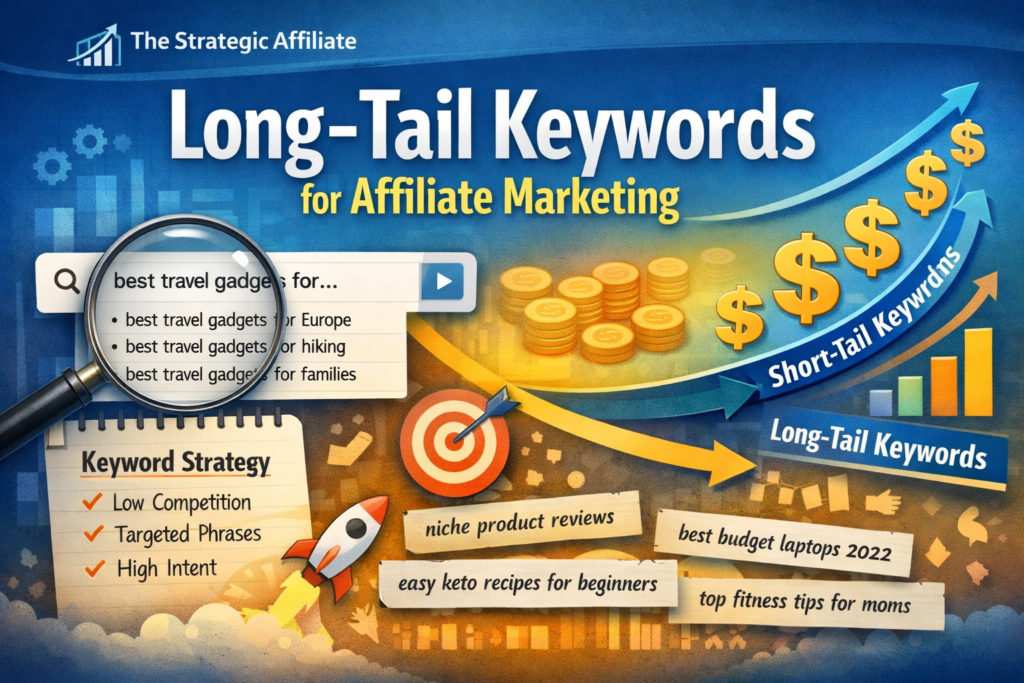
A head term is a short, broad keyword with high search volume and high competition:
- “affiliate marketing”
- “email marketing tools”
- “keyword research”
A long‑tail keyword is longer, more specific, lower competition, and — crucially for affiliates — usually much closer to a buying decision:
- “best email marketing tools for affiliate beginners in 2026”
- “how to do keyword research for an affiliate blog”
- “Kit vs Mailchimp for affiliate marketers”
The name “long‑tail” comes from the shape of a search demand curve. The head terms sit at the top with massive volume. The long‑tail stretches out to the right with thousands of lower‑volume but highly specific searches.
Here’s the insight that changes everything: the long‑tail collectively drives the majority of all searches, and it’s where most buying decisions actually happen.
Someone typing “affiliate marketing” into Google is probably just learning what it is. Someone typing “best affiliate programmes for UK bloggers in 2026” is actively looking for something to join. Those are completely different states of mind, and your content strategy should treat them completely differently.
For most content‑led affiliate businesses, long‑tail keywords for affiliate marketing are the fastest route to commissions that don’t require a domain authority of 70+ to achieve.
2. The Intent Stack: Understanding What Different Searches Actually Mean
Before you can find the right keywords, you need to understand the intent behind them. I use a simple three‑level framework I call the Intent Stack:
Level 1 – Informational (browsers)
These searchers want to learn. They’re not close to buying anything.
Examples:
- “what is affiliate marketing”
- “how does affiliate commission work”
- “what is a niche site”
Write content for these people to build awareness and capture email subscribers — not to drive affiliate clicks. They’re top‑of‑funnel visitors. They need educating first.
Level 2 – Navigational/Comparison (warm researchers)
These searchers know what they want to do and are comparing options. They’re getting closer.
Examples:
- “best keyword research tools for affiliate marketing”
- “Kit vs ActiveCampaign for bloggers”
- “Pretty Links vs ThirstyAffiliates”
This is where your “best X for Y” roundups and comparison posts live. Strong buyer intent. Good conversion potential. Worth targeting aggressively.
Level 3 – Transactional (buyers)
These searchers have basically made their decision and just need confirmation. They’re looking for a review, a final comparison, or a “how to get started with X” guide before they click buy.
Examples:
- “Mangools review for beginner affiliate marketers”
- “is Hostinger good for WordPress affiliate sites”
- “how to set up Kit for affiliate marketing”
These are your highest‑converting pages. They might get fewer visits than your Level 1 content, but the people who land on them convert at a completely different rate.
When you’re building out your long‑tail keyword strategy for affiliate marketing, you want a healthy mix of Level 2 and Level 3 content driving the majority of your commercial traffic.
3. How to Find Long‑Tail Keywords That Actually Convert
Now the practical part. Here are the methods I use to find long‑tail keywords for affiliate content that consistently drives commissions.
3.1. Google autosuggest and “People Also Ask”
Free, fast, and underused by people who should know better.
Start by typing your broad topic into Google — but don’t press enter. Look at the dropdown suggestions. Those are real searches people are making right now. Every one of them is a potential article idea.
Then search the term and look at the “People Also Ask” box. Expand each question — Google will load more questions underneath. This is a goldmine of long‑tail keyword ideas showing exactly what your audience is genuinely wondering about.
Finally, scroll to the bottom of the search results and look at “Related Searches.” More ideas, more intent signals, all free.
3.2. Your keyword research tool (used properly)
Whether you use Mangools, Semrush, Ahrefs, or Ubersuggest, the mistake most beginners make is searching a broad term and getting overwhelmed by the head keywords at the top.
Instead:
- Search your broad term.
- Filter by keyword difficulty — set a maximum of 30–40 if you’re a newer site.
- Filter by search intent if your tool allows it (commercial or transactional).
- Look for 3–5 word phrases rather than 1–2 word head terms.
- Pay attention to the questions filter — question‑based long‑tails often have lower competition and very clear intent.
The goal is to find keywords with:
- Enough volume to be worth targeting (even 100–300 searches a month is fine for a high‑intent term)
- A difficulty score your site can realistically compete for
- Clear buyer or comparison intent baked into the phrase
3.3. Competitor content analysis
Find 3–5 affiliate sites in your niche that are roughly your size or slightly bigger. Put their URLs into your keyword tool and look at which articles are driving their traffic.
You’re looking for:
- Long‑tail articles they’re ranking for that you haven’t covered yet
- Topics where their content is thin, outdated, or missing key angles
- “Best X for Y” posts where you can provide a genuinely better resource
This is one of the fastest ways to find proven long‑tail topics without having to guess at intent — if a competitor is ranking for it and driving traffic, the demand is real.
3.4. Your own audience (often overlooked)
Your email subscribers, Facebook group members, and Skool community are asking you questions every day. Those questions are long‑tail keywords.
When someone in your Facebook group asks “what’s the best keyword tool for a beginner who doesn’t want to spend a lot?” — that’s a real search query. Write the article. Answer the question properly. You already know there’s demand for it.
This is one of the reasons building a community alongside your content site compounds so well: your audience tells you exactly what to write next.
4. Mapping Long‑Tail Keywords to Your Affiliate Offers
Finding keywords is only half the job. The other half is making sure each keyword maps cleanly to a specific affiliate offer or recommendation.
Here’s how I approach this:
For every long‑tail keyword I want to target, I ask:
- What does the person searching this want to know or decide?
- Which of my affiliate offers is the most natural answer to their question?
- Is there a clear path from this article to a conversion?
Example:
- Keyword: “best email marketing tool for affiliate marketing beginners”
- Intent: they want a recommendation they can trust
- Offer: Kit (with your affiliate link)
- Path: article → clear recommendation with honest pros/cons → affiliate link → conversion
If there’s no clear offer that maps to the keyword, it might be a good email list builder but it’s not a strong commercial content piece. File it under Level 1 content and move on.
This is closely connected to the thinking in your <a href=”https://thestrategicaffiliate.co.uk/affiliate-product-selection-framework/”>Affiliate Product Selection Framework</a> — choosing the right offers for the right audience at the right moment is exactly what keyword‑to‑offer mapping is about.
5. Writing Content Around Long‑Tail Keywords That Actually Converts
Ranking for a long‑tail keyword is one thing. Converting that traffic is another. Here’s what I’ve found makes the biggest difference.
5.1. Match your content format to the intent
- “Best X for Y” searches want a roundup or comparison with clear winners.
- “[Tool] review” searches want an honest, detailed single‑product review.
- “How to [do X with tool]” searches want a tutorial or walkthrough.
- “[Tool A] vs [Tool B]” searches want a side‑by‑side comparison with a clear recommendation.
Don’t write a “how it works” essay when someone searched for a comparison. Match the format to what they actually came looking for.
5.2. Lead with your recommendation
For buyer‑intent content, don’t make people scroll to the bottom to find out what you recommend. Put a short verdict near the top — a “quick answer” box or a clear opening statement like “If you’re a beginner affiliate marketer looking for the best email tool, Kit is my recommendation and here’s why.”
People who already trust you will click that link immediately. People who want more detail will keep reading. Both outcomes work in your favour.
5.3. Answer the objections
Buyer‑intent searchers almost always have one or two specific doubts stopping them from committing. Address those doubts directly:
- “Is it worth the price for a beginner?”
- “Is it complicated to set up?”
- “Is there a free plan or trial?”
Handling objections within the content is one of the most underrated conversion tactics in affiliate marketing.
5.4. Use internal links to support and reinforce
Every long‑tail commercial article should link to:
- Your main pillar (for context and authority)
- Related articles in the same cluster (for depth)
- Your <a href=”https://thestrategicaffiliate.co.uk/seo-for-affiliate-content-keyword-research-for-buyer-intent/”>SEO for affiliate content</a> guide where relevant
Internal linking keeps people on your site longer, passes authority between pages, and gives search engines a clearer picture of your topical expertise.
6. Common Long‑Tail Keyword Mistakes Affiliates Make
After 19 years, these are the mistakes I see most consistently.
Targeting keywords with no commercial intent
Writing 2,000 words about “what is email marketing” and then wondering why no one clicks your Kit affiliate link. Informational keywords need informational content — not affiliate pitches.
Ignoring search volume entirely
Some affiliates go so long‑tail that they’re targeting phrases nobody actually searches for. Use your keyword tool to confirm there’s at least some volume before investing time in a full article.
Targeting one keyword per topic instead of a cluster
One article rarely ranks for just one keyword. Write your main article around the primary long‑tail, but naturally weave in related phrases throughout. Google will surface your page for multiple related searches if the content is comprehensive.
Not updating commercial content regularly
Your “best email marketing tools 2026” article needs refreshing in 2027. Outdated recommendations hurt credibility and rankings. Set a calendar reminder every 6 months to review your top commercial pages.
Conclusion: Stop Writing for Browsers, Start Writing for Buyers
If you take one thing from this article, make it this: not all traffic is equal, and the gap between a browser and a buyer often comes down to the keyword that brought them to your site.
Long‑tail keywords for affiliate marketing aren’t just a tactical trick. They’re a fundamental way of thinking about your content — as answers to specific questions from people who are already moving towards a decision, not just people who are vaguely curious about a topic.
Start by auditing your existing content. For each article, ask: is the keyword I’m targeting informational or commercial? If most of your traffic is coming from informational keywords, you know where the gap is.
Then use the research methods in this article to build out a cluster of buyer‑intent long‑tail articles that map directly to your core affiliate offers.
Pair this with the full foundation from <a href=”https://thestrategicaffiliate.co.uk/how-to-start-affiliate-marketing/”>How to Start Affiliate Marketing</a> and you have everything you need to turn your content into a genuinely commercial asset — one that works for browsers and buyers alike, but earns most of its income from the latter.
FAQs: Long‑Tail Keywords for Affiliate Marketing
1. How many monthly searches should a long‑tail keyword have to be worth targeting?
There’s no strict minimum, but most affiliate marketers find that anything above 100 monthly searches is worth considering for a high‑intent commercial keyword. The conversion rate on a 200‑search buyer‑intent term can easily outperform a 2,000‑search informational term, so don’t dismiss lower‑volume keywords purely on numbers. Intent and competition matter more than raw volume for affiliate content.
2. Can I target multiple long‑tail keywords in one article?
Yes, and you should. Write your article around one primary long‑tail keyword, but naturally include related phrases, questions, and variations throughout the content. Google will surface your page for multiple related searches if the content is comprehensive and well‑structured. This is sometimes called semantic SEO and it’s how strong affiliate content earns traffic from dozens of related queries, not just one.
3. How do I know if a keyword has buyer intent without a paid tool?
Google the keyword yourself and look at what’s on page 1. If you see product review sites, comparison posts, and “best X for Y” articles, that’s a strong signal of buyer intent. If you see Wikipedia, dictionary definitions, and broad educational articles, that’s informational intent. The SERP itself tells you what Google thinks the searcher wants.
4. Should I target branded keywords like “[Tool Name] review” as a new affiliate site?
Yes — branded review keywords are some of the highest‑converting long‑tail opportunities available to affiliates. They have clear buyer intent, relatively low competition compared to generic terms, and the people searching them are often one good review away from clicking buy. Just make sure your review is genuinely detailed and honest rather than a thinly disguised sales pitch.
5. How long does it take to rank for long‑tail keywords on a new affiliate site?
Most new sites start seeing rankings for lower‑competition long‑tail keywords within 3–6 months of publishing well‑optimised content, assuming decent on‑page SEO and some internal linking. Highly competitive long‑tails on established niches can take longer. The advantage of long‑tail keywords is that their lower competition means you can start getting traffic much earlier than you would targeting broad head terms.