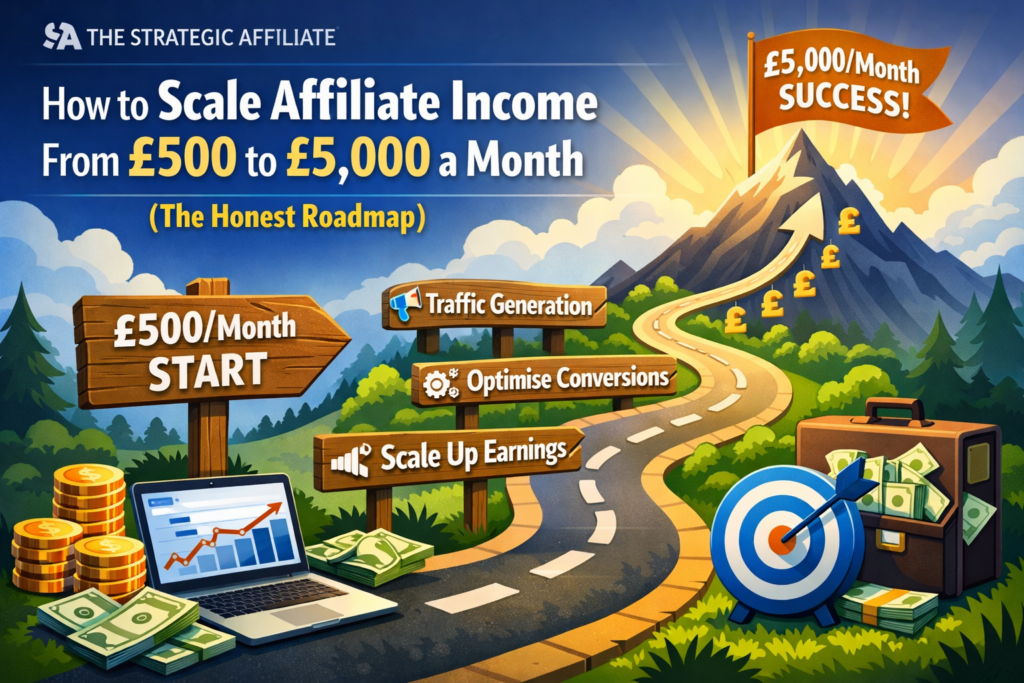
How to Scale Affiliate Income From £500 to £5,000 a Month (The Honest Roadmap)
Getting to £500 a month in affiliate income is genuinely hard. Most people never get there.
But here’s the thing nobody tells you: the skills that get you to £500 are not the same skills that get you to £5,000. The tactics that produced your first consistent commissions will plateau. The content volume that felt significant at the start becomes insufficient. The single affiliate programme that drove most of your early income becomes a vulnerability rather than a foundation.
Scaling affiliate income requires a different set of decisions — and most people don’t realise this until they’ve been stuck at the same monthly figure for six months wondering why the same approach that worked before has stopped moving the needle.
I’ve been through this transition multiple times across different sites and different niches over 19 years. The plateau between first income and real income is one of the most common points where affiliate marketers either figure out the next level or gradually lose momentum and stay where they are.
This post is the roadmap I wish I’d had at that stage. It covers the specific moves that compound modest affiliate income into something that changes your financial picture — without burning out, without chasing shortcuts, and without abandoning what’s already working.
If you’re still working towards that first £500, start with How to Start Affiliate Marketing: A Realistic Blueprint From 19 Years in the Trenches. The strategies in this post build directly on those foundations.
Why £500 a Month Is a Plateau, Not a Ceiling
Before getting into the how, it’s worth understanding why the plateau happens in the first place.
When you first start generating affiliate income, almost everything you do produces a return because you’re building from zero. Any content is better than no content. Any keyword targeting is better than none. Any affiliate programme is better than none. The gains feel significant because the baseline was so low.
By the time you’re at £500 a month, the easy wins are behind you. You’ve covered the obvious keywords in your niche. Your best-performing content is already written. The affiliate programmes you joined early are generating what they’re going to generate without further intervention.
The mistake most people make at this stage is doing more of the same — more content, more social posts, more of the same affiliate links — and expecting proportionally more results. It doesn’t work like that. You hit diminishing returns on the same inputs.
Scaling from £500 to £5,000 requires a fundamental shift in how you operate. You stop optimising for activity and start optimising for leverage. Every decision should be asking: where is the highest return on the time and effort I’m investing?
Move 1 — Audit What’s Already Working Before Adding Anything New
The first move when learning how to scale affiliate income isn’t to do more. It’s to understand precisely what’s already working — because you almost certainly have untapped potential in what you’ve already built.
Pull up your affiliate programme dashboards and your Google Analytics (or equivalent) and answer these questions:
Which three articles are generating the most affiliate clicks? These are your highest-leverage pages. They’re already attracting the right audience and generating intent. Are they fully optimised? Do they have strong calls to action throughout, or just at the bottom? Are they capturing email subscribers as well as sending traffic to affiliate links? Are they internally linked from other relevant posts?
Which affiliate products are converting best? Conversion rate varies enormously between products — sometimes a product with fewer clicks generates more commissions than one with more, simply because it converts better. Double down on what converts. Reduce the prominence of what doesn’t.
Where is your traffic coming from? If 80% is coming from organic search and 20% from email, and your email list is small but converting well, that tells you something important about where to invest next.
This audit typically takes a couple of hours and almost always surfaces two or three specific opportunities that were hiding in plain sight. Most affiliate marketers at the £500/month level have at least one underperforming high-traffic page that could double its commissions with some targeted optimisation.
Do this before adding any new content, joining any new affiliate programmes, or changing your strategy. You’re looking for leverage in what already exists.
Move 2 — Increase Revenue Per Visitor, Not Just Visitor Numbers
The instinct when trying to scale is to chase more traffic. More visitors means more commissions, right? Directionally yes — but traffic is slow and competitive to grow. Revenue per visitor is something you can improve immediately.
Here’s what that looks like in practice:
Upgrade your calls to action. Most affiliate content has a single CTA at the bottom of the article. Add contextual CTAs within the body of the content — after you’ve made a specific point that connects to the product benefit. A reader who’s just read a paragraph about why keyword difficulty matters is primed to click a link to your keyword tool recommendation. Don’t make them scroll to the bottom to find it.
Improve your product presentation. A well-designed product display box — an image, key benefits, a clear button — consistently outperforms a bare text link. If you’re not using a tool like Lasso or ThirstyAffiliates for your link management and display, the link management guide covers the options in detail.
Add comparison content. Comparison posts (Product A vs Product B) target high-intent keywords and convert at significantly higher rates than informational content. If you have strong review content, consider what comparison posts naturally sit alongside it.
Build internal pathways. A reader who lands on an informational article and bounces without clicking anything is a missed opportunity. Make sure your informational content has deliberate internal links to your conversion content — reviews, comparisons, and best-of roundups — so that readers who are ready to buy have a clear path to find it.
These changes compound. A 30% improvement in click-through rate on your three best pages, combined with a 20% improvement in conversion rate, can produce a meaningful revenue increase without a single new visitor.
Move 3 — Build and Monetise Your Email List Properly
If you’re generating £500 a month in affiliate commissions and you don’t have an active email list, you’re leaving a significant amount of money on the table every month.
Email is the highest-converting traffic channel available to affiliate marketers. A subscriber who joined your list because they read your content and trusted your recommendations is far more likely to act on an affiliate recommendation than a cold organic visitor. The relationship is already established.
At the £500/month level, most affiliate marketers have either neglected their list entirely or built one but not monetised it systematically. Fixing this is one of the fastest routes to scaling income without adding new content.
The email strategy guide covers the full mechanics, but here’s the core principle: your email list should be doing three things simultaneously.
Delivering value — regular content that reinforces your expertise and keeps subscribers engaged. This isn’t optional padding before the sales pitch. It’s the reason people stay subscribed and trust your recommendations.
Promoting affiliate products — not constantly, and not randomly. Specific products, to specific segments of your list, at appropriate moments in the relationship. A subscriber who joined via a post about keyword research is a warm lead for a keyword tool recommendation. Send them that recommendation at the right moment in a well-structured sequence and the conversion rate can be remarkable.
Driving traffic back to your best content — every email broadcast is an opportunity to send subscribers to your highest-converting pages. A post that’s generating good organic traffic can double its commission output if you’re also driving email traffic to it regularly.
If your list is small, the answer is to grow it faster — better lead magnets, more prominent opt-in placements, content upgrades on your highest-traffic posts. A list of 500 engaged subscribers who trust you is worth more than 5,000 passive ones who barely remember signing up.
Move 4 — Diversify and Upgrade Your Affiliate Programmes
Most affiliate marketers at the £500/month level are generating most of their income from one or two programmes. That concentration is a risk, and it’s also a ceiling.
Diversification here means two things: spreading risk across multiple programmes so that one merchant changing their terms doesn’t crater your income, and identifying higher-commission opportunities in your niche that you haven’t tapped yet.
Review your current commission rates. If you’ve been sending consistent traffic and conversions to a programme for six months or more, you have leverage. Many affiliate programmes will increase commission rates for top performers — but they won’t offer this proactively. You have to ask. The negotiating commissions guide walks through exactly how to approach this conversation, what data to bring to it, and what to ask for.
Look for recurring commission programmes. A single sale that pays a recurring monthly commission is worth significantly more over its lifetime than a one-time payment. SaaS products, membership sites, and subscription services often offer recurring affiliate commissions. If your niche has these options and you’re not prioritising them, you’re undervaluing your traffic.
Consider higher-ticket offers. There’s a meaningful difference between promoting a £30 product at 30% commission (£9 per sale) and a £300 product at 30% commission (£90 per sale). Both require roughly the same content and traffic investment. If your audience has the budget and the problem justifies a premium solution, higher-ticket offers are one of the most direct routes to scaling income without scaling effort proportionally.
This doesn’t mean abandoning what’s working. It means systematically identifying the gaps in your current programme mix and filling them strategically.
Move 5 — Build Systems That Multiply Your Output
At £500 a month you can run your affiliate operation as a one-person content machine and keep up with it. At £5,000 a month you cannot — not without working unsustainable hours that make the whole thing feel like a job you can’t escape.
Scaling income requires scaling output without scaling hours proportionally. That means systems.
The business systems guide covers this in depth, but the three that matter most at this stage of growth are:
Content production systems — templates, briefs, and workflows that let you maintain quality and consistency at higher volume. If every article starts from a blank page with no structure, your output is limited by your creative capacity on any given day. If every article starts from a proven template with a clear brief, you can produce more, faster, and with more consistent quality.
Link management systems — every affiliate link should be managed centrally so that changes take seconds rather than hours. If you’re not already using a link management plugin, this becomes critical as your content library grows and affiliate programmes evolve.
Performance tracking systems — a simple dashboard (even a spreadsheet) that shows you monthly: top performing pages by commission, email list growth, traffic by source, and conversion rates by affiliate programme. You can’t make good scaling decisions without this data, and pulling it together ad hoc every time you need it wastes time you don’t have.
Systems aren’t glamorous. They’re the thing experienced affiliate marketers talk about that beginners ignore — right up until they’re trying to manage 100 articles and 20 affiliate programmes without them.
Move 6 — Compound Content With Strategic Internal Linking
One of the most overlooked scaling strategies in affiliate marketing is internal linking — not as an SEO afterthought, but as a deliberate system for moving readers through your content towards conversion.
At the £500/month level, most sites have reasonable content but weak internal linking. Articles sit in relative isolation, receiving organic traffic but not feeding that traffic through to the pages most likely to generate commissions.
A strategic internal linking audit involves:
Going through your top ten traffic pages and identifying which high-intent conversion pages (reviews, comparisons, best-of posts) they should be linking to — and adding those links if they’re missing.
Ensuring every piece of informational content has at least one internal link to a relevant conversion page. The reader who just learned about the importance of keyword research should have a clear path to your keyword tool review.
Building topical clusters where pillar content links to cluster articles and cluster articles link back to the pillar and across to each other. This signals topical depth to Google and improves rankings across the entire cluster — not just the pillar page.
This work doesn’t require new content. It’s an investment of a few hours that can meaningfully improve both your organic rankings and your revenue per visitor on existing pages.
Conclusion
Scaling affiliate income from £500 to £5,000 a month is not about working harder on the same things. It’s about identifying where the leverage is, making smarter decisions about where to invest your time, and building systems that compound your output over time.
The moves in this post — auditing what’s working, improving revenue per visitor, building and monetising your email list, upgrading your affiliate programmes, building operational systems, and compounding content through internal linking — are not quick wins. But executed consistently over six to twelve months, they are the difference between a business that plateaus and one that scales.
The affiliate marketers generating £5,000+ a month aren’t working ten times harder than those generating £500. They’re working on the right things, in the right order, with the right systems underneath them.
If you’re building from the ground up, How to Start Affiliate Marketing: A Realistic Blueprint From 19 Years in the Trenches gives you the foundation this scaling roadmap sits on. Get the fundamentals right first — then come back to this post when you’re ready to push to the next level.
Frequently Asked Questions
Q1: How long does it realistically take to scale affiliate income from £500 to £5,000 a month?
For most affiliate marketers operating consistently, six to eighteen months is a realistic window — depending on niche competitiveness, how aggressively you build your email list, and how quickly you diversify your affiliate programmes. The compounding nature of affiliate income means the growth accelerates as the asset base grows, so the second half of that journey typically moves faster than the first.
Q2: What is the fastest way to increase affiliate income without creating new content?
Auditing and optimising existing high-traffic pages is the fastest route. Improving calls to action, upgrading product presentation, adding contextual internal links to conversion pages, and driving email traffic to your best-performing posts can all increase revenue from existing content without a single new article.
Q3: How important is an email list for scaling affiliate income?
Critical. Email consistently outperforms every other traffic channel for affiliate conversion because the relationship and trust are already established. Affiliate marketers who neglect their email list at the £500/month level almost always find it’s the biggest gap when they audit where their scaling ceiling is coming from.
Q4: Should I promote more affiliate products to increase income?
Not necessarily more — better. Adding volume without strategy just creates noise. The priority is identifying higher-commission opportunities within your existing niche, negotiating better rates with programmes you’re already sending traffic to, and prioritising recurring commission products over one-time payments where your niche allows.
Q5: How do I know when I am ready to scale rather than still building foundations?
When you’re generating consistent monthly income (even modest), have content ranking on page one or two for multiple keywords, and have an email list that’s actively growing — you’re ready to scale. If any of those three are missing, focus on the foundations first. Scaling an operation with weak foundations just amplifies the problems rather than the income.