What Is Domain Authority and Does It Actually Matter for Affiliate Sites?
“This post contains affiliate links. If you click through and make a purchase, I may earn a commission at no extra cost to you. I only recommend tools I use and trust”.
Domain authority is one of those metrics that affiliate marketers either obsess over or dismiss entirely — and both reactions miss the point.
I’ve watched people spend weeks trying to improve their domain authority score before they’ve published ten articles. I’ve also watched people ignore it completely and then wonder why their content isn’t ranking despite being genuinely good. Neither extreme serves you well.
After 19 years of building affiliate sites, my relationship with domain authority is more nuanced than either camp. It’s a useful signal. It’s not a ranking factor. It tells you something real about your site’s competitive position — but not what most people think it tells them, and not in the way most tools present it.
This post gives you the honest picture: what domain authority actually is, where it comes from, how Google actually thinks about site authority, and — most importantly — what affiliate marketers should actually be doing about it rather than watching a number in a third-party tool.
If you haven’t read the SEO for affiliate marketing guide yet, that’s the broader context this post sits within. And for the full picture of building an affiliate site that generates consistent income, How to Start Affiliate Marketing: A Realistic Blueprint From 19 Years in the Trenches is where to start.
What Domain Authority Actually Is
Let’s start with the most important clarification: domain authority is not a Google metric.
It was created by Moz — a third-party SEO software company — as a way to predict how well a website might rank in search results. Ahrefs has their own version called Domain Rating. Semrush calls theirs Authority Score. Mangools uses a similar metric in SiteProfiler.
These are all proprietary scores created by private companies based on their own algorithms and their own web crawl data. Google has never confirmed using any of them as a ranking signal, and has explicitly stated that it does not use third-party authority scores in its ranking systems.
So why does domain authority matter at all? Because despite being a third-party metric, it correlates reasonably well with real-world ranking performance — not because Google uses the score, but because the underlying factors that drive the score (primarily backlinks from other sites) are things Google does care about deeply.
Understanding that distinction is the foundation of thinking about domain authority correctly.
How Domain Authority Is Calculated
While the exact formula varies between tools, all domain authority metrics share the same core inputs:
Backlink quantity — how many other websites link to your domain. Each link from an external site is counted as a signal that your content is worth referencing.
Backlink quality — not all links are equal. A link from a high-authority site in your niche carries significantly more weight than a link from a low-quality directory or an unrelated site. The quality of your linking domains matters more than the quantity at higher authority levels.
Linking domain diversity — one hundred links from ten different domains is less valuable than one hundred links from one hundred different domains. Diversity of referring domains is a stronger signal than volume from a small number of sources.
Spam signals — links from spammy, irrelevant, or manipulative sources can actively drag your score down. Tools increasingly factor in link quality and penalise profiles that look artificially built.
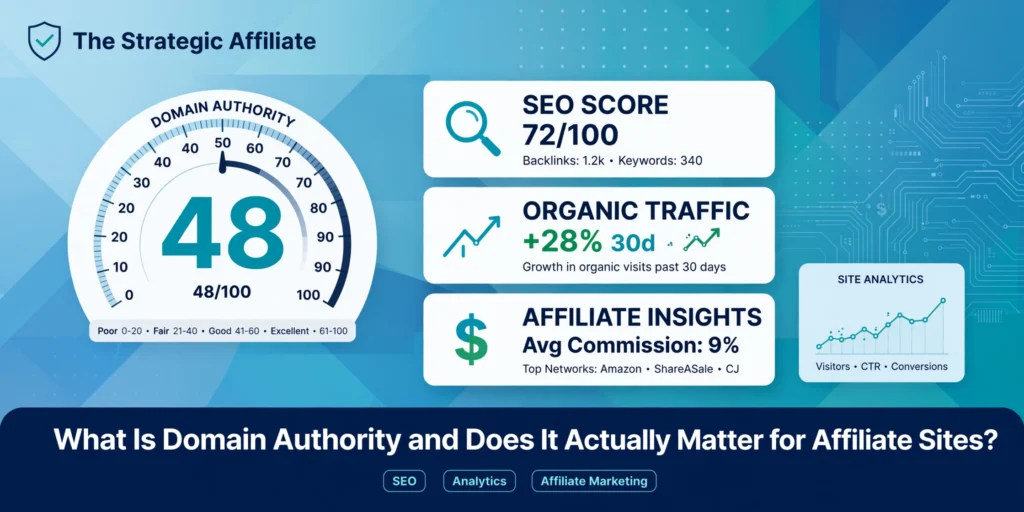
The score itself is typically expressed on a scale of one to one hundred, with higher scores representing stronger authority. New domains start near zero. Established sites with strong backlink profiles can reach sixty, seventy, or above. Major publications and authority sites often score in the nineties.
Critically — the scale is logarithmic, not linear. Moving from DA 10 to DA 20 is much easier than moving from DA 50 to DA 60. The higher you go, the harder each increment becomes.
What Google Actually Uses Instead
While Google doesn’t use third-party domain authority scores, it absolutely evaluates site authority — it just does it differently and more granularly.
Google’s approach to authority operates at multiple levels simultaneously:
PageRank — Google’s original algorithm, still in use in evolved form, measures the authority of individual pages based on the number and quality of links pointing to them. A page with strong backlinks from relevant, authoritative sources ranks better than an identical page without them. PageRank flows through internal links as well as external ones — which is why internal linking strategy matters more than most affiliate marketers realise.
Topical authority — this is increasingly central to how Google evaluates sites. Rather than measuring site-wide authority as a single score, Google assesses how authoritative a site is on specific topics. A site with fifty well-linked articles all about affiliate marketing SEO has stronger topical authority on that subject than a site with five hundred articles spread across twenty unrelated topics. For affiliate marketers building content clusters around specific niches, this is the most actionable form of authority to build.
E-E-A-T — Experience, Expertise, Authoritativeness, and Trustworthiness. Google’s quality evaluator guidelines explicitly assess content on these dimensions. For affiliate sites, E-E-A-T means demonstrating genuine experience with the products you review, expertise in your niche, authoritativeness through citations and backlinks from relevant sources, and trustworthiness through transparency, accurate information, and clear affiliate disclosures.
Link signals — Google does evaluate backlinks, but through its own crawl data and its own quality assessment rather than a third-party score. The factors it considers — relevance of the linking site, authority of the linking page, anchor text diversity, natural link growth patterns — are broadly similar to what third-party tools measure, which is why the correlation exists.
Does Domain Authority Actually Matter for Affiliate Sites?
Here’s the honest answer: it matters as a relative competitive indicator, not as an absolute target.
What I mean by that is this: if you’re trying to rank for a keyword and the top ten results are all from sites with DA 50-70, and your site has DA 8, that gap tells you something real and useful. You’re not going to outrank those sites on that keyword in the near term regardless of how good your content is. The authority gap is too large.
That’s a useful piece of information. It tells you to target less competitive keywords while you build your own authority — not to abandon the niche, but to find the accessible keywords that you can rank for now and build from there.
Conversely, if you’re targeting a keyword where the top results include sites with DA 15-25, and your site is at DA 12, the gap is small enough that genuinely better content and some focused link building can close it within months.
In this context — as a competitive benchmarking tool — domain authority is genuinely useful. You use it to calibrate your keyword targeting against your current competitive position. This is exactly how I use Mangools’ SiteProfiler in my own research.
What it’s not useful for: obsessing over your own score as an end in itself, spending money on low-quality link building schemes to artificially inflate it, or treating it as a direct proxy for Google rankings.
Why New Affiliate Sites Shouldn’t Panic About Low DA
If you’ve just launched your affiliate site and your domain authority is hovering around 1-5, that’s exactly where it should be. Every site starts there. The sites with DA 50 were at DA 5 once too.
The mistake new affiliate marketers make is treating low domain authority as a blocker — a reason they can’t rank for anything until the score improves. This misunderstands how the metric works and how Google actually evaluates new sites.
A new site with low domain authority can absolutely rank for the right keywords. Low competition, long-tail keywords with clear search intent are available to new sites — and ranking for those is exactly how you build the authority that eventually lets you compete for more challenging terms.
The practical approach for a new affiliate site:
Target keywords with KD under 20-25 on Mangools — these are achievable for low-authority domains. As your site builds authority through content and links, you graduate to more competitive terms.
Build topical authority through content clusters — publish a comprehensive pillar article on your core topic, then build cluster articles around specific subtopics. This internal content structure signals topical depth to Google independently of your backlink profile.
Focus on content quality over content volume — a smaller number of genuinely useful, well-researched articles builds authority faster than a large volume of thin content. Google’s quality signals are increasingly sophisticated at distinguishing between the two.
Build links naturally — every guest post, forum contribution, Reddit answer, and community mention that links back to your site adds to your authority profile incrementally. Slow and natural beats fast and artificial every time.
Your hosting also plays a role in how Google perceives your site’s technical credibility — a fast, secure, well-configured site on reliable hosting signals professionalism that cheap or unreliable hosting undermines. The hosting guide covers the options worth considering at different stages of site growth.
The Link Building Question for Affiliate Sites
Since domain authority is primarily driven by backlinks, and backlinks are something affiliate marketers actively try to build, it’s worth being specific about what actually works and what doesn’t in 2026.
What works:
Guest posting on relevant sites — writing a genuinely useful article for another site in your niche in exchange for a contextual link back to your site. The emphasis on genuinely useful is important. Thin guest posts on low-quality sites produce low-quality links. A well-written, substantive guest post on a relevant site with real traffic produces a link that moves your authority profile meaningfully.
Creating genuinely linkable content — the most reliable long-term link building strategy is creating content other sites want to link to. Original research, comprehensive guides, distinctive opinion pieces, and useful tools or templates attract natural links that third-party outreach never quite replicates.
Community participation — contributing genuinely useful answers on Reddit, Quora, and niche forums, with occasional links to relevant content where it’s appropriate and adds value. This builds links slowly but produces consistently relevant, contextual citations.
Digital PR — being quoted as an expert source in articles and publications in your niche. Services like HARO (Help a Reporter Out) connect journalists with expert sources. A mention in a mainstream publication carries significant authority weight.
What doesn’t work and carries real risk:
Buying links from link farms or private blog networks. Google has become increasingly sophisticated at identifying unnatural link patterns, and the penalties for manipulative link building can be severe — reducing rankings significantly or removing a site from search results entirely. No short-term authority gain is worth that risk for an affiliate site you’re building for the long term.
How to Track Your Authority Progress Without Obsessing
The healthy way to use domain authority metrics is as one data point in a monthly review rather than something you check daily.
Once a month, note your domain authority score in Mangools SiteProfiler or your preferred tool. Track the trend over time — is it moving in the right direction? More important than the score itself is the underlying data: are your referring domains growing? Is the quality of your backlink profile improving? Are the keywords you’re targeting showing ranking movement?
Google Search Console gives you the most accurate picture of how your site’s authority is actually translating into search performance — impressions, clicks, average position, and which queries are driving traffic. This is real data from Google’s own system rather than a third-party estimate, and it should take priority in your monthly review.
Combine Search Console data with a tool like Mangools SERPWatcher for rank tracking and you have a complete picture of your authority progress without needing to fixate on a single score.
Conclusion
Domain authority matters for affiliate sites as a competitive context indicator — it tells you how your site’s backlink profile compares to the sites currently ranking for your target keywords. That’s genuinely useful information for calibrating your keyword targeting strategy.
It doesn’t matter as a Google ranking factor, because Google doesn’t use it. It doesn’t matter as an end goal, because building links purely to inflate a third-party score produces the kind of artificial link profiles Google has become very good at identifying and discounting.
What matters for affiliate site authority — in Google’s terms — is topical depth through content clusters, genuine backlinks from relevant sources built over time, and E-E-A-T signals that tell Google your content comes from genuine experience and expertise.
Focus on those things consistently and your domain authority score will follow. Chase the score directly and you’re optimising for a metric rather than for the things that actually produce rankings and income.
For the complete SEO picture, the SEO for affiliate marketing guide covers everything that matters for affiliate sites in 2026. And for the full strategic context, How to Start Affiliate Marketing: A Realistic Blueprint From 19 Years in the Trenches is where the complete system starts.
Frequently Asked Questions
Q1: What is a good domain authority score for an affiliate site?
There is no universally good score — what matters is your score relative to the sites ranking for your target keywords. A DA of 15 is perfectly adequate for ranking on low-competition keywords where the top results are from sites with DA 10-20. The same score would be insufficient for competing against DA 60+ sites on high-competition terms. Focus on the gap between your score and your competitors’ scores rather than on reaching a specific number.
Q2: How long does it take to build domain authority for a new affiliate site?
Meaningful authority growth typically takes six to twelve months of consistent content publishing and natural link building. Early gains come faster — moving from DA 1 to DA 10 can happen within three to six months with consistent effort. Progress slows at higher scores because the logarithmic scale means each increment requires proportionally more authority signals. Patience and consistency produce more reliable results than any shortcut.
Q3: Can I rank on Google with low domain authority?
Yes — with the right keyword strategy. Low-competition, long-tail keywords are accessible to new sites with low authority. Google evaluates individual pages on their own merit, not just domain-wide authority. A well-written, properly optimised article on a relevant long-tail keyword can rank on a new domain. This is exactly how new affiliate sites build their first organic traffic and begin developing the authority that allows them to target more competitive terms over time.
Q4: Does buying backlinks improve domain authority and rankings?
It can temporarily improve third-party domain authority scores — but Google’s systems are sophisticated at identifying unnatural link patterns, and manipulative link building carries significant penalty risk. The short-term score improvement is not worth the long-term risk to a site you’re building for sustained income. Natural link building through quality content, guest posting, and community participation produces slower but durable authority growth.
Q5: Is domain authority the same across different SEO tools?
No. Moz’s Domain Authority, Ahrefs’ Domain Rating, Semrush’s Authority Score, and Mangools’ SiteProfiler metric are all different scores produced by different algorithms using different web crawl data. A site might score DA 35 on Moz and DR 28 on Ahrefs simultaneously — both are valid within their own systems but not directly comparable to each other. Pick one tool and track your score consistently within that tool rather than comparing scores across platforms.