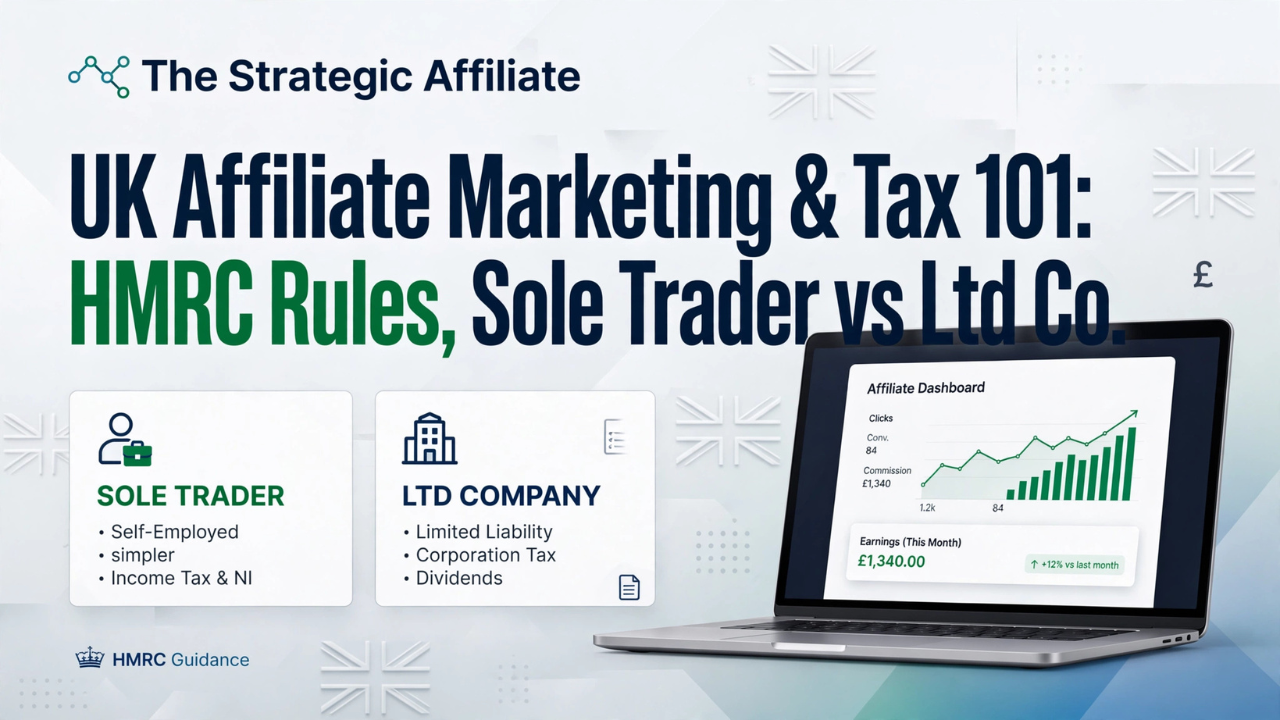
UK Affiliate Marketing & Tax 101: HMRC Rules, Sole Trader vs Ltd Co
If you earn affiliate commissions in the UK, that income is usually taxable and needs proper records. Once your total trading income goes over the £1,000 trading allowance in a tax year, you will generally need to tell HMRC; most beginner affiliates start as sole traders, while a limited company tends to make sense only when profits, retained cash, liability considerations or wider business plans justify the extra administration.www+1
This is a practical guide, not personal tax advice. Tax treatment depends on your circumstances. If you are unsure, speak to a qualified accountant or tax adviser before filing anything with HMRC.
Key takeaways
- Affiliate commissions are normally treated as taxable trading income.
- The tax year runs from 6 April to 5 April.
- The £1,000 trading allowance applies to your total qualifying trading income, not £1,000 per affiliate programme or website.
- You can usually claim either the £1,000 trading allowance or your actual allowable business expenses – not both.
- Sole trader status is the sensible starting point for most new UK affiliates.
- A limited company is not an automatic tax-saving move and brings extra reporting, accountancy and legal responsibilities.
- Keep records from your first commission, even if you have not yet made enough to register for Self Assessment.
Affiliate income: what HMRC is looking at
Affiliate marketing is simple on the surface. You recommend a product or service, someone buys or signs up through your tracked link, and you receive a commission.
From HMRC’s point of view, that commission is business income if you are doing it with a view to making money. It does not matter whether you call yourself a blogger, creator, publisher, influencer or affiliate marketer. It does not matter whether you work from the spare room, publish around a full-time job or earn through a US-based affiliate network.
The activity matters more than the label.
For most affiliate beginners, the income falls within self-employment or trading income. This can include:
- Affiliate commissions from networks such as Awin, Impact, Partnerize or Amazon Associates
- Recurring commissions from software or membership referrals
- Lead-generation payments
- Bonuses paid by affiliate programmes
- Sponsored content payments connected to your website or audience
- Free products, services, vouchers or trips supplied in return for promotional work
That final point catches people out. HMRC says income from online content can include money, gifts and services. If a brand sends you a product specifically because you will promote it, its value may need to be considered as business income.www+1
A free £20 sample sent with no expectation of coverage is one thing. A £750 laptop supplied in return for a review, social content and affiliate promotion is another. Record what happened, what the arrangement was and the value involved. If it is unclear, ask an accountant rather than guessing.
Do I pay tax on affiliate income in the UK?
In most cases, yes. The important distinction is between income, profit and the point at which you need to tell HMRC.
Income is the total commission you receive before expenses.
Profit is what remains after allowable business expenses, or after using the trading allowance if that is more suitable.
Tax is generally calculated on profit, alongside your other income. If you have a job as well as an affiliate site, your salary and affiliate profit can affect your overall Income Tax position.
The £1,000 trading allowance
The UK trading allowance can cover up to £1,000 of qualifying trading income in a tax year. The tax year is not January to December; it runs from 6 April to 5 April.
If your total gross trading income is £1,000 or less for the tax year, you will usually not need to tell HMRC about it or pay tax on it, subject to specific exceptions. If your gross trading income goes above £1,000, you usually need to register for Self Assessment and report it.
The word total matters.
You do not receive a separate £1,000 allowance for:
- Each affiliate network
- Each website
- YouTube commissions and blog commissions separately
- Affiliate income and a freelance side service
- Your own digital products and affiliate commissions
If these activities are part of your trading income, add them together when considering the threshold.
A simple example
Suppose you earn the following during one tax year:
| Income source | Amount |
|---|---|
| Awin affiliate commissions | £620 |
| Hosting affiliate programme | £350 |
| Amazon Associates commissions | £280 |
| Total gross trading income | £1,250 |
You are above the £1,000 threshold. You should not assume that only the final £250 matters. You would normally report the activity and then choose the most appropriate deduction method: actual allowable expenses or the £1,000 trading allowance.
Now imagine your actual business expenses were £180. In that case, claiming the £1,000 trading allowance may produce a lower taxable profit than claiming £180 of expenses.
But if your actual allowable expenses were £1,850, claiming expenses is likely to be more beneficial than using the £1,000 allowance.
You cannot claim both. HMRC’s guidance is clear: if you use the £1,000 trading allowance, you cannot also deduct business expenses.
This is one reason good records matter from day one. You cannot make a sensible choice at tax-return time if you have no idea what you spent.
Sole trader affiliate marketing UK: the default starting point
For the majority of beginner affiliates, operating as a sole trader is the simplest route.
You do not need to form a company merely because you have a website, earn commissions or want to look professional. You can use your own name or trade under a business name, keep records of your income and expenses, and register for Self Assessment when required.
As a sole trader:
- You and the business are legally the same person.
- You report business income and expenses through Self Assessment.
- You pay Income Tax and, where applicable, National Insurance based on your profits and overall circumstances.
- You keep the profits personally after tax.
- You are personally responsible for business debts and obligations.
For a small affiliate business with limited financial risk, this is normally manageable and proportionate.
Affiliate marketing is often a low-overhead business. You may have website hosting, software subscriptions, a domain name, training, content costs and perhaps a home-office element. You are unlikely to have stock, premises, employees or large supplier debts in the early stages.
That does not mean there is no risk. You still need sensible disclosures, a privacy policy, compliance with relevant programme terms and proper financial records. But you do not need to overcomplicate your structure before you have proven that the business earns.
What you may be able to claim as a sole trader
Allowable expenses must be wholly and exclusively for the business, although some costs can be apportioned where there is mixed personal and business use.
Examples that may be relevant to an affiliate marketer include:
- Website hosting, domains and business email
- WordPress themes, plugins and website maintenance tools
- Keyword research, analytics and SEO software
- Email marketing platforms
- Stock images, video tools or design software
- Advertising costs, where used
- Business banking fees or payment-processing charges
- Accountancy fees
- Training that updates or improves skills used in your existing business
- A reasonable business-use portion of phone, broadband or home-working costs
Keep receipts, invoices and subscription records. A bank statement alone may show that you paid £99 to a software company, but it may not make clear what the expense was for or whether it was business-related.
Be careful with training. A course that updates skills you already use in your affiliate business may be allowable. Training that prepares you for an entirely new trade can be treated differently. This is worth checking with an accountant if the cost is significant.
Sole trader vs limited company for affiliate marketers
A limited company can be useful, but it is not a badge of seriousness and it is not a magic way to “pay less tax”.
A company is a separate legal entity. It has its own finances, records, responsibilities and tax return. You become a director, and you must treat company money differently from personal money.
Here is the practical comparison.
| Factor | Sole trader | Limited company |
|---|---|---|
| Setup | Simple; register for Self Assessment when needed | Incorporate at Companies House and maintain statutory records |
| Legal position | You and the business are the same legal person | The company is separate from you |
| Tax process | Profit reported on your Self Assessment return | Company pays Corporation Tax; you may also pay tax when taking money personally |
| Admin | Lower | Higher: accounts, confirmation statement, Corporation Tax return, payroll or dividend records where relevant |
| Money in the business | Your money, subject to tax obligations | Company money is not personal money |
| Privacy | Limited public disclosure | Company details and annual accounts are publicly filed |
| Best suited to | Most early-stage affiliates and side businesses | Established businesses with a clear reason for incorporation |
| Professional fees | Often manageable with basic bookkeeping support | Usually higher accountancy and compliance costs |
For the 2026 to 2027 financial year, the small-profits Corporation Tax rate is 19% for eligible company profits up to £50,000, with marginal relief between £50,000 and £250,000, and a 25% main rate above that. Those figures do not tell you your total personal tax position, because you must also consider how you take money from the company and the tax on salary or dividends.
That is why you should not make the decision based on a headline Corporation Tax rate.
When a limited company may be worth discussing
It can be sensible to speak to an accountant about incorporation when:
- Your affiliate profits are consistently growing.
- You do not need to withdraw all the profits personally.
- You want to leave money in the business to fund content, contractors, advertising or product development.
- You are building a broader publishing, training or digital-product company.
- You have commercial reasons to separate personal and business finances.
- You expect to work with larger partners or clients who prefer contracting with a company.
- You want tailored advice on tax planning that accounts for your household income, not just your affiliate earnings.
The key word is consistently.
Do not form a company because you have earned £1,500 in commissions and saw somebody on Facebook say “Ltd is more tax efficient.” The extra accountancy costs and administration can outweigh any benefit, particularly if you need every pound of the profit for personal living costs.
HMRC deadlines affiliate marketers need to know
Deadlines are where an avoidable admin task turns into penalties and stress.
For a new sole trader who needs to report income for the first time, the main dates are usually:
| Task | Typical deadline |
|---|---|
| Tax year ends | 5 April |
| Register for Self Assessment | 5 October following the end of that tax year |
| Paper tax return | 31 October |
| Online Self Assessment return | 31 January |
| Pay tax due for the previous tax year | 31 January |
| Second payment on account, where applicable | 31 July |
For example, if you earned more than £1,000 in qualifying trading income in the tax year ending 5 April 2026, you would normally need to register by 5 October 2026 and file your online tax return and pay tax due by 31 January 2027.
Do not leave registration until January. You need time to receive your Unique Taxpayer Reference, organise your figures and understand what you owe.
Do not forget payments on account
This is one of the biggest shocks for a newly profitable affiliate.
Depending on your circumstances, HMRC may ask for payments on account towards the following year’s tax bill. These are normally due on 31 January and 31 July.
In plain English, your first meaningful Self Assessment bill can include:
- The tax due for the previous tax year
- The first advance payment towards the next tax year
That is why you should set aside money from every commission rather than treating all incoming payments as spendable cash.
A separate savings account for tax is one of the simplest systems you can put in place. Decide on a percentage with your accountant or use a cautious temporary percentage until you understand your likely bill. Move the money as commissions arrive. It is far easier than trying to find a lump sum next January.
VAT: when affiliate marketers need to pay attention
VAT is not a concern for most new affiliates, but it should not be ignored forever.
The VAT registration threshold is £90,000 of taxable turnover. You must register if your taxable turnover for the previous 12 months goes above that threshold, or if you expect it to exceed the threshold in the next 30 days. You can also register voluntarily in some circumstances.
A few important points:
- VAT turnover is not the same as profit.
- The threshold looks at taxable turnover, not how much cash you personally withdraw.
- The VAT treatment of affiliate commissions can depend on the precise contractual arrangement, where the affiliate network or merchant is based, and what service you are supplying.
- International affiliate networks can create complexity that is not obvious from a dashboard payment figure.
If your commission income starts approaching the threshold, get VAT-specific advice early. Do not wait until you have crossed it and are trying to reconstruct months of transactions.
A simple record-keeping system that actually works
You do not need complicated software to get started. You need consistency.
Set up a spreadsheet, bookkeeping app or accountant-approved system with the following columns:
| Date received | Network or merchant | Commission amount | Currency | Sterling value | Invoice or statement saved? | Notes |
|---|---|---|---|---|---|---|
| 15 May | Affiliate network | £74.20 | GBP | £74.20 | Yes | Hosting referral |
| 30 May | Software partner | $120.00 | USD | Record GBP equivalent | Yes | Monthly recurring commission |
Track expenses in a separate tab or report:
| Date | Supplier | Expense | Amount | Business purpose | Receipt saved? |
|---|---|---|---|---|---|
| 2 June | Hosting provider | Annual hosting | £120 | Website hosting | Yes |
| 5 June | Email platform | Monthly subscription | £18 | Email list management | Yes |
Then create a routine:
- Record income once a month. Download affiliate-network statements and save them in a clearly named folder.
- Record expenses as they happen. Do not rely on memory at year-end.
- Separate business and personal spending. A separate bank account or dedicated card makes life much easier.
- Set aside money for tax. Treat it as unavailable.
- Review your profit quarterly. This helps you see whether the business is improving and whether you need professional advice.
- Keep documents for the required period. Ask your accountant what applies to your situation and keep records securely.
If you use a bookkeeping package, choose one you will actually maintain. A perfect system that you abandon after three weeks is worse than a basic spreadsheet you update every month.
Step-by-step: what to do next
Here is the no-nonsense action plan for a UK affiliate marketer.
- Add up all qualifying side-income receipts for the current tax year. Include commissions, bonuses, sponsored content and relevant non-cash benefits.
- Check whether total trading income is above £1,000. Do not assess each programme separately.
- Start recording every payment and expense now. Even if you are below the threshold today.
- Choose between actual expenses and the trading allowance only when you have the figures. Do not assume the allowance is always best.
- Register for Self Assessment by 5 October after the tax year ends if you need to file.
- Put tax money aside as you earn. Do not wait for the January deadline.
- Stay a sole trader unless there is a clear commercial or tax-planning reason to incorporate.
- Speak to an accountant before forming a limited company or when income becomes substantial, international, VAT-relevant or complicated.
- Build your affiliate business as a system. Good records, sustainable traffic, clear content and sensible offers will serve you far better than chasing a quick commission.
Build the business properly
Tax admin is not the exciting part of affiliate marketing. Nobody starts a website because they are desperate to reconcile commission statements and save receipts.
But treating the financial side seriously is part of building an asset rather than a hobby. A simple system protects you, helps you understand actual profit and makes it easier to make better decisions as the business grows.
The same applies to your content, traffic and offers. If you want a clear framework for building a more deliberate affiliate business – rather than throwing links at a website and hoping – explore The Strategic Affiliate Income System. It is designed to help you build the foundations before you worry about scaling.