The Simple Affiliate Marketing Funnel Every Beginner Should Build First
Most affiliate beginners think a funnel is something complicated.
They picture expensive software, multiple landing pages, video sales letters, countdown timers and an inbox full of automated emails. Then they decide they are not ready for it and carry on publishing blog posts without any clear route for visitors to take next.
That is a mistake.
A simple affiliate marketing funnel is not about pushing people into buying something. It is about helping the right person move from a question to a useful answer, then to the next step when they are ready.
For a new affiliate website, you do not need a complicated funnel. You need a clear path:
Helpful content → useful free resource → email follow-up → relevant recommendation
That is enough to start.
In this guide, I will show you the simple affiliate marketing funnel I would build first if I were starting again today. It is designed for affiliate beginners, UK creators and anyone who wants to build a proper online asset rather than throw links at a website and hope.
What an Affiliate Marketing Funnel Actually Is
Let’s break this down.
A funnel is simply the journey a person takes from first finding you to taking action.
For an affiliate marketer, that action might be:
- Joining your email list
- Reading another article
- Downloading a checklist
- Watching a useful tutorial
- Clicking through to a product review
- Starting a free trial
- Buying a product through your affiliate link
- Joining your own course or community
The key is that each step should make sense.
If somebody finds your article because they want to know how to choose an affiliate niche, do not immediately send them to a sales page for an email marketing tool. They are not ready for that yet.
Help them choose a niche first.
Then, if they need a website, explain the next step. If they need traffic, give them a useful guide. If they want a plan, offer a checklist or a short email series.
Good funnels are logical.
They do not force the reader to leap from “I am curious” to “buy this now.”
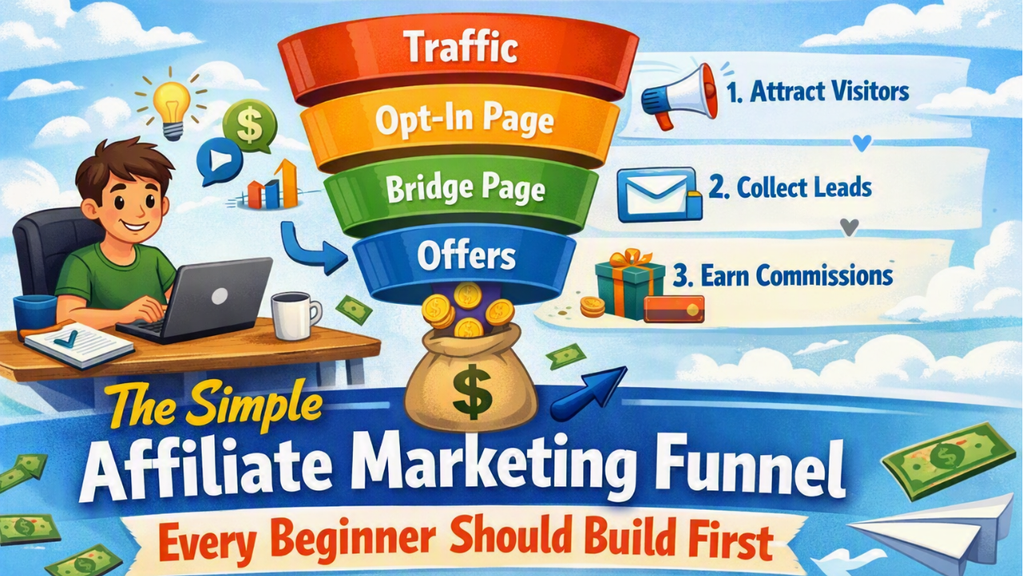
The simplest version looks like this:
| Funnel stage | What the visitor needs | Your job |
|---|---|---|
| Traffic | An answer to a question | Publish helpful content |
| Lead capture | A useful next step | Offer a relevant free resource |
| Follow-up | More clarity and trust | Send useful emails |
| Recommendation | A sensible solution | Recommend a relevant product or service |
| Conversion | Confidence to act | Make the next step clear and honest |
That is the full picture.
It does not need to be more complicated at the beginning.
An affiliate funnel normally starts with traffic, gives the visitor a useful reason to subscribe, follows up through email and then introduces a relevant offer when it fits their problem.
Start With One Clear Reader Problem
The first mistake many affiliate beginners make is trying to build a funnel around a product.
They join an affiliate programme, see a decent commission rate, and then ask: “How do I get people to buy this?”
That is backwards.
Start with the reader’s problem.
For example, if you help people start affiliate websites, the real problems may be:
- “I do not know what niche to choose.”
- “I do not know how to build a website.”
- “I have no idea what to write about.”
- “I do not know how to get visitors.”
- “I do not want to spend money on tools I do not understand.”
- “I am worried affiliate marketing is too late or too complicated.”
Each one of those problems can become the beginning of a funnel.
Here is an example.
A person searches Google for:
“How to choose an affiliate niche”
They find your article. The article helps them narrow their ideas and avoid common niche mistakes.
Near the end, you offer a free Affiliate Niche Selection Worksheet.
They enter their email address. You send the worksheet immediately, then follow up with a short sequence that helps them assess demand, choose a topic and think about relevant products.
A few days later, you recommend a suitable WordPress hosting plan because they now have a niche and are ready to build their site.
That is a sensible journey.
The hosting offer is not random. It is the next practical step.
This is why traffic and funnels work best when they are connected. Your article brings in a visitor with a specific question. Your lead magnet gives them a helpful next action. Your emails continue the conversation. Your recommendation solves the next problem.
That is how you build trust.
The First Funnel I Would Build
If you are starting a new affiliate website, I would not build five funnels.
I would build one.
For The Strategic Affiliate audience, I would start with this:
The Affiliate Site Launch Funnel
Traffic source:
Helpful blog content, LinkedIn posts, relevant Facebook-group discussions and search traffic.
Entry article:
“How to Start Affiliate Marketing” or a more specific beginner article such as “How to Get Your First 100 Visitors to a New Affiliate Website.”
Lead magnet:
The Affiliate Site Launch Checklist or a 30-Day Affiliate Action Plan.
Email sequence:
Five emails that help the reader move from confusion to a simple plan.
Relevant affiliate offers:
Hosting, a WordPress tool, an email marketing platform or a keyword research tool, depending on where the subscriber is in the process.
Next step:
A soft invitation to The Strategic Affiliate Income System for people who want the complete training and personal support.
That is all you need.
The goal is not to create a maze of pages. It is to give your reader a useful, logical route forward.
A simple example
Imagine somebody finds your article on LinkedIn:
“How to Get Your First 100 Visitors to a New Affiliate Website”
They read it and see that you recommend starting with a clear niche, specific content and a basic email list.
At the end of the article, you offer:
“Want a simple weekly traffic plan? Download the free Affiliate Traffic Checklist.”
They sign up.
You then send:
- The checklist.
- An email about choosing topics people actually search for.
- An email about why internal links matter.
- An email explaining how traffic and funnels work together.
- An email recommending a relevant tool or inviting them to explore your full system.
That is a genuine affiliate income system. It is not aggressive. It gives people help at the stage they are actually at.
Step One: Create Content That Brings the Right Visitors
Your funnel starts before the email form.
It starts with the content people find.
A useful article should answer a specific question and give the reader enough value that they trust you with the next step.
For affiliate beginners, strong content topics often include:
- How to choose an affiliate niche
- How to build an affiliate website
- How much it costs to start affiliate marketing
- How to get traffic without paid ads
- How to write affiliate product reviews
- How to build an email list from a new website
- How to add affiliate links to WordPress
- How to choose your first affiliate programmes
- Why affiliate websites get traffic but no sales
You do not need to write about every possible subject at once.
Start with the questions your audience asks before taking action.
Google’s guidance is still sensible here: create content that puts people first, gives them a satisfying answer and uses SEO to help the right people find it. It is not about publishing content for the sake of producing more pages.
Give every article one next step
Every important article should give the reader a sensible next action.
That might be:
- Read a related guide
- Download a checklist
- Join an email course
- Compare two relevant tools
- Watch a tutorial
- Explore a product review
- Learn about your full course
Do not ask visitors to do six things at once.
If your article is about starting an affiliate website, the best next step may be a site-launch checklist.
If your article is about traffic, the best next step may be a traffic plan.
If your article is a product comparison, the best next step may be a clear affiliate recommendation.
One clear action works better than a cluttered page full of competing buttons.
Step Two: Offer a Lead Magnet People Actually Want
A lead magnet is simply something useful you give away in exchange for an email address.
It does not need to be huge.
In fact, a short, focused resource is often more useful than a 60-page PDF nobody reads.
The best lead magnets solve one small, immediate problem.
For affiliate marketers, good examples include:
- The Affiliate Site Launch Checklist
- A 30-Day Affiliate Action Plan
- A niche selection scorecard
- A first-five-blog-posts planner
- An affiliate product review template
- A content planning worksheet
- A simple traffic checklist
- A welcome-email sequence template
The important thing is relevance.
If your article is about traffic, offer a traffic-related checklist.
If your article is about niche selection, offer a niche worksheet.
If your article is about email marketing, offer a welcome-sequence template.
Do not put a generic “Subscribe for updates” box at the end of every article and expect people to be excited.
People subscribe when they can see a clear benefit.
Keep the opt-in page simple
Your landing page needs:
- A clear headline
- A short explanation of what they will receive
- Three to five bullet points explaining the benefit
- A simple form
- A clear button
- A brief privacy statement
For example:
Build Your First Affiliate Website With a Clear 30-Day Plan
Download the free Affiliate Site Launch Checklist and stop guessing what to do first.
Then list the outcomes:
- Choose a niche you can build around
- Set up the essential website foundations
- Plan your first useful content
- Choose relevant affiliate offers
- Start building traffic and an email list
That is clear. It tells the visitor what they are getting and why it matters.
If you collect emails from UK readers, be clear about what they are signing up for and what emails they can expect. The ICO’s direct-marketing guidance covers email marketing under PECR, and valid consent should be clear, specific and based on a positive opt-in action.
Step Three: Send a Short Welcome Sequence
This is where many people lose momentum.
They create a lead magnet, collect a few email addresses, send the download, and then disappear for three months.
Your welcome sequence is where trust starts to build.
You do not need complicated automation. You need a small set of useful emails that help the subscriber make progress.
Here is a simple five-email sequence for affiliate beginners.
| Subject idea | Purpose | |
|---|---|---|
| 1 | Your Affiliate Site Launch Checklist | Deliver the promised resource and welcome the subscriber |
| 2 | The biggest mistake new affiliate sites make | Help them avoid a common early error |
| 3 | What to do before joining affiliate programmes | Give practical advice and link to useful content |
| 4 | Why traffic is not enough on its own | Explain the role of email, content and follow-up |
| 5 | The next step if you want a proper system | Introduce a relevant tool, guide or course softly |
Email one: Deliver what you promised
Keep it simple.
Thank them for signing up. Give them the guide. Explain what it will help them do. Then ask one question:
“What is the biggest thing stopping you from getting started?”
Replies are valuable. They show you what people are actually worried about.
Email two: Teach something useful
Do not promote anything yet.
Explain a common mistake, such as choosing a niche only because somebody said it was profitable. Give the reader a practical way to avoid it.
Email three: Link to useful content
Send them to a strong article on your site.
For example, your How to Start Affiliate Marketing guide can act as the main hub for beginners who need the wider picture.
Email four: Explain the system
This is where you can explain that traffic alone is not enough.
You want the right visitors, a clear next step, an email list and relevant offers.
That is the difference between getting occasional clicks and building predictable affiliate income.
Email five: Make a relevant recommendation
Only now should you introduce an offer.
It may be a hosting company, email platform, keyword tool or course. The offer should match what the subscriber has been learning.
You are not forcing a sale. You are saying:
“If you are ready for this next step, here is the tool or training I would consider.”
That is how you recommend affiliate products without sounding pushy.
Step Four: Recommend the Right Offer at the Right Time
The best affiliate recommendation is not the product with the highest commission.
It is the product that makes sense for the reader’s next step.
For example:
| Reader situation | Useful next step | Possible recommendation |
|---|---|---|
| They have chosen a niche but have no website | Build a simple WordPress site | Hosting and domain provider |
| They have content but no email list | Add a basic signup form | Email marketing platform |
| They have content but no traffic plan | Research keywords and publish focused articles | Keyword research tool |
| They get visitors but no sign-ups | Improve their lead magnet and opt-in page | Landing-page or email tool |
| They want a full plan and support | Follow a structured system | The Strategic Affiliate Income System |
This is where many affiliates go wrong.
They recommend products because the commission looks good, not because the product helps the reader.
That approach may create a few sales in the short term. It does not build trust.
Your audience will notice if every article ends with the same unrelated product link.
A better approach is to be specific:
“This tool is useful if you are ready to build an email list and want something simple. It is not the right choice if you do not yet have a website or a clear reason for people to subscribe.”
That kind of honesty helps readers make better decisions. It also makes your recommendations more credible.
Step Five: Keep the Funnel Simple and Measure What Matters
You do not need to measure every click, scroll and page view from day one.
But you should know whether the basic funnel is working.
Start by tracking:
- How many people visit the article
- How many people see the opt-in offer
- How many join the email list
- Which emails get opened and clicked
- Which links people click
- Which questions they reply with
- Whether any affiliate links or course pages get visits
- Which content brings the most relevant subscribers
That is enough to begin.
If 500 people read an article but nobody signs up, your lead magnet may not be relevant enough.
If people sign up but nobody opens the emails, your subject lines or email delivery may need work.
If people open the emails but never click, the content may not be leading clearly to a next step.
Do not treat the data as a reason to panic. Use it to improve.
A funnel is not built once and forgotten. It improves as you learn more about your audience.
For example, you may discover that people who join through a traffic checklist care far more about content ideas than keyword tools. That tells you what your next email, article or lead magnet should focus on.
Beginner Mistakes to Avoid
Most affiliate funnels fail because they are either too complicated or not connected to what the audience needs.
1. Building a funnel before you have useful content
Do not build a five-page funnel if you have no helpful articles, no clear niche and no traffic source.
Start with content. Your funnel works better when people arrive with a genuine question.
2. Using a vague lead magnet
“Join my newsletter” is not a strong offer.
Give people a specific, useful reason to subscribe.
3. Sending affiliate offers too early
If the first email after somebody signs up is a sales pitch, you have not earned the right to make it.
Help them first. Build trust. Make recommendations when they fit.
4. Creating too many funnels at once
One good funnel is better than five unfinished ones.
Start with one audience problem, one lead magnet, one welcome sequence and one logical next step.
5. Forgetting the human side
Automation is useful, but do not let it make you distant.
Invite replies. Read what people say. Answer questions. Use their concerns to improve your content and offers.
Your email list is not a number. It is a group of people who have trusted you with access to their inbox.
Key Takeaways
The first affiliate marketing funnel you build does not need to be complicated.
It needs to be useful.
Remember the basic structure:
- Create helpful content around a clear reader problem.
- Offer a relevant lead magnet that gives people a quick win.
- Send a short email sequence that helps them move forward.
- Recommend a product, service or course only when it genuinely fits their next step.
- Watch what people do and improve the system over time.
This is how traffic and funnels work together.
Your content attracts the right visitor. Your lead magnet gives them a reason to stay connected. Your emails build trust. Your recommendations help them take the next practical step.
That is the basis of an affiliate income system that can grow into predictable affiliate income over time.
If you want more practical help with content, email, traffic and conversion, explore the Traffic and Funnels Pillar Page. If you are still at the beginning, start with How to Start Affiliate Marketing. And if you want a complete structure covering niche, offers, content, traffic and personal support, take a look at The Strategic Affiliate Income System.