How to Track Affiliate Funnel Results Without Getting Lost in Analytics
If you are building an affiliate site, email list, or simple landing-page funnel, you will eventually face the same question most affiliate beginners ask:
How do I know what is actually working?
You may have Google Analytics installed. You may be checking clicks inside an affiliate dashboard, looking at email open rates, reviewing Search Console data, and refreshing WordPress stats more often than you would like to admit.
The problem is not a lack of data. The problem is having too much of it.
When you are new to traffic and funnels, it is easy to get buried in charts, percentages, reports, and platform dashboards. You start looking at every number because you do not yet know which ones matter. Before long, you have plenty of information but very little clarity.
Here is the truth: you do not need to track everything.
You need to track the few numbers that tell you where people are dropping out of your funnel, what is bringing in the right visitors, and what needs improving next. Once you can see that clearly, your affiliate income system becomes far easier to manage.
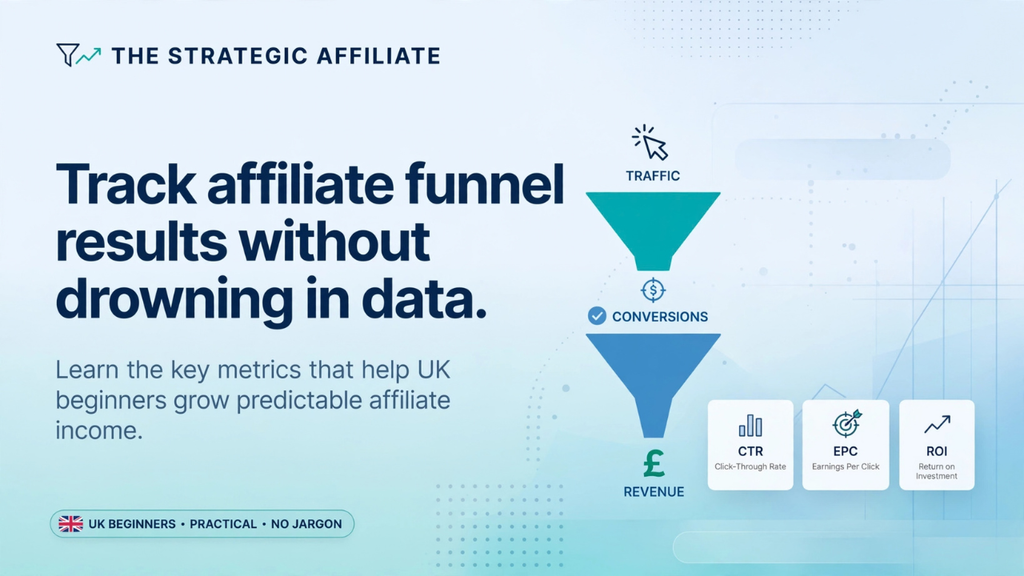
This guide will show you how to track affiliate funnel results without becoming obsessed with analytics. It is written for affiliate beginners and UK creators who want a simple, practical way to make better decisions, improve conversions, and work towards more predictable affiliate income.
Start With the Funnel, Not the Dashboard
Before opening Google Analytics, affiliate dashboards, email reports, or spreadsheets, take a moment to define your funnel.
A funnel is simply the route someone takes from discovering your content to taking a useful action. In affiliate marketing, that action might be joining your email list, clicking through to a merchant, starting a free trial, or buying a product through your affiliate link.
A basic affiliate funnel might look like this:
- Someone finds a blog post through Google.
- They read the article and click a call to action.
- They join your email list to receive a checklist, guide, template, or mini-course.
- They receive an email sequence.
- They click an affiliate recommendation.
- They buy from the merchant or sign up for a trial.
It may sound obvious, but most beginners do not realise that each stage needs its own measurement.
If you only check sales, you will not know whether the issue is traffic, the page itself, the opt-in offer, your email sequence, the affiliate offer, or the merchant’s checkout process.
For example, imagine you publish a review of an email marketing platform aimed at new bloggers in the UK.
- The article gets very little traffic: your main problem is visibility.
- The article gets visitors, but nobody clicks your affiliate link: the content or offer is not convincing enough.
- People click the link but do not buy: the merchant’s pricing, trial, checkout, or product fit may be the issue.
- People join your list but ignore your emails: your follow-up needs work.
Without funnel tracking, these situations can all look like the same problem: “I am not making sales.”
They are not the same problem. They require different fixes.
The Only Funnel Numbers Most Beginners Need
You can get very detailed with reporting later. At the beginning, keep it simple.
For most affiliate beginners, there are five core numbers worth tracking consistently:
- Traffic to your key content or landing page
- Opt-ins or leads collected
- Affiliate link clicks
- Affiliate conversions or sales
- Revenue or commission earned
That is enough to give you a useful picture of your funnel.
You can add more detail once you have steady traffic and activity. But if you are getting only a handful of visitors per week, tracking bounce rates, device types, page scroll depth, and dozens of event reports will not improve your business.
Let’s break down the essentials.
1. Traffic: Are the Right People Reaching Your Content?
Traffic is the starting point. Without visitors, there is nothing to convert.
But raw traffic alone is not the goal. A thousand irrelevant visitors are usually less useful than 100 people actively looking for a solution you can help with.
For a UK affiliate site, this might mean attracting people searching for terms such as:
- “best email marketing software for small business UK”
- “how to start affiliate marketing in the UK”
- “best website hosting for beginners UK”
- “how to build an email list for affiliate marketing”
- “WordPress themes for affiliate blogs”
The best traffic usually comes from people who already have a question, a problem, or an intention to take action.
When looking at traffic, focus on:
- Which pages bring in the most visitors
- Where those visitors come from
- Which search queries bring them in
- Whether the traffic is growing over time
- Whether visitors from a source take the next step in your funnel
Google Search Console is particularly useful for content-led affiliate sites because it shows the search terms people use before clicking through to your site. Google Analytics can help you see what happens after they arrive.
You do not need to check these every day. Once a week or once a month is usually enough when you are building organic traffic.
2. Opt-ins: Are Visitors Joining Your List?
If you use a lead magnet or newsletter, your next key metric is opt-ins.
An opt-in happens when someone gives you their email address in exchange for something useful. This could be a beginner guide, a simple checklist, a template, a free email course, or a resource list.
For example, if you have written an article called “How to Start Affiliate Marketing in the UK”, you could offer a free download called:
The Beginner Affiliate Marketing Setup Checklist
That is relevant to the reader’s immediate problem. It gives them a practical reason to join your list.
Your basic opt-in rate is:
Opt-in rate=Number of page visitorsNumber of opt-ins×100
So if 500 people visit a page in a month and 25 join your list, your opt-in rate is 5%.
Do not panic if your numbers are small at first. A page receiving 30 visitors per month will not give you enough data to judge with confidence. What matters is creating a baseline and improving it over time.
Track:
- Visitors to the page
- Number of new subscribers
- Opt-in conversion rate
- Which lead magnet or page generated the subscribers
You do not need a complex reporting system. A simple spreadsheet can do the job perfectly well.
3. Affiliate Link Clicks: Are People Interested Enough to Explore?
Affiliate link clicks are one of the most useful signals in your entire funnel.
A sale may take time. A person may click today, compare alternatives, watch YouTube reviews, speak to a business partner, and buy a week later. But a click tells you they were interested enough to investigate the offer.
If you have traffic but few affiliate clicks, you should look at your content and calls to action.
Ask yourself:
- Is the product genuinely relevant to the article?
- Have I clearly explained who the product is for?
- Do I mention benefits in plain English?
- Is the affiliate link visible at the right point?
- Have I answered common objections?
- Is the call to action specific?
- Am I recommending a product I would genuinely suggest to a beginner?
A vague line such as “Click here to learn more” rarely gives readers much reason to act.
A more useful call to action might be:
If you want a straightforward email platform for building your first list, you can compare the current plans and free-trial option here.
That is clearer. It gives context and helps the reader understand what happens next.
For tracking, use a link-management tool, your email platform’s click reports, UTM tags where appropriate, or event tracking within your analytics setup. The exact tool matters less than being able to distinguish one important link from another.
For instance, you may want to know whether readers click:
- A comparison-table link near the top of the article
- A text link inside the main explanation
- A button after your recommendation
- A link in your email follow-up
- A link from a YouTube description or social post
This will show you where interest is strongest.
4. Conversions: Are Clicks Turning Into Results?
A conversion is the action the merchant wants the visitor to take.
Depending on the programme, this could be:
- A purchase
- A free trial
- A paid subscription
- A booked call
- A completed application
- A product registration
- A lead submission
Your affiliate dashboard should show some form of conversion data, although the detail varies widely between programmes.
Some affiliate networks update sales quickly. Others may show pending transactions, delayed approvals, cancellations, or commissions only after a validation period. This is normal, especially with software subscriptions, finance products, travel, retail, and higher-priced services.
When reviewing conversions, look for patterns rather than reacting to a single sale or a single quiet week.
For example:
- 200 clicks and no sales may suggest a poor product match, weak merchant page, or tracking issue.
- 20 clicks and two sales may indicate a very strong audience-product match.
- Several leads but few approved commissions may mean the merchant has strict qualification criteria.
- A product with lower commission but reliable conversions may outperform a high-ticket offer that rarely sells.
This is why you should not judge affiliate offers purely by commission rate.
A £20 commission that converts regularly can be more valuable than a £300 commission that almost nobody buys.
5. Revenue: Is the Funnel Becoming Financially Useful?
Revenue matters, but it should be viewed in context.
Do not just ask, “How much did I earn this month?”
Ask:
- Which page produced the commission?
- Which traffic source produced the visitor?
- Which offer converted?
- Did the person buy straight away or after joining my list?
- What content led them into the funnel?
- Is this repeatable?
That is how you move from random commissions to a more predictable affiliate income system.
If one article earns £50 in commission from 100 visitors, while another earns nothing from 1,000 visitors, the first article may be far more valuable. It may deserve more internal links, a better lead magnet, updated content, supporting articles, or paid promotion later on.
The goal is not to chase vanity metrics. It is to identify what creates meaningful results.
Build a Simple Affiliate Funnel Tracking Sheet
You do not need expensive software to start tracking your funnel properly.
A basic Google Sheet can give you a clearer view than several disconnected dashboards. Create one row for each important content page, landing page, email sequence, or campaign.
Here is a simple example:
| Funnel asset | Period | Visitors | Leads | Opt-in rate | Affiliate clicks | Sales | Commission |
|---|---|---|---|---|---|---|---|
| Beginner hosting guide | August | 420 | 18 | 4.3% | 31 | 2 | £46 |
| Email marketing review | August | 260 | 22 | 8.5% | 40 | 3 | £72 |
| Free affiliate checklist | August | 180 | 29 | 16.1% | 12 | 1 | £18 |
This does not need to be perfect. It needs to be consistent.
Update it monthly, or weekly if you have enough traffic and are actively testing changes. The point is to make your numbers visible in one place so you can make sensible decisions.
You might also add columns for:
- Traffic source
- Main target keyword
- Email sequence name
- Affiliate programme
- Content update date
- Notes on what you changed
- Total content cost or ad spend, if relevant
If you make a significant change, write it down. For example:
- Added a comparison table on 12 August
- Changed the call to action on 20 August
- Rewrote the introduction on 3 September
- Added a new lead magnet on 10 September
- Sent an email campaign to existing subscribers
This stops you from guessing later. You will be able to connect changes with results.
Use One Question for Each Stage
The easiest way to avoid analytics overload is to ask one simple question at each stage of your funnel.
| Funnel stage | Main question | What to check |
|---|---|---|
| Traffic | Are the right people finding me? | Search queries, traffic sources, page visits |
| Content | Are visitors engaging with the page? | Time on page, scroll behaviour, next-page actions |
| Lead capture | Are they joining my list? | Opt-ins and opt-in conversion rate |
| Affiliate click | Are they interested in the offer? | Affiliate link clicks and click-through rate |
| Conversion | Does the offer turn interest into action? | Sales, leads, trials, conversion rate |
| Revenue | Is this worth improving further? | Commission, earnings per page, repeatability |
You do not need to inspect all of these every time you open your reports.
Choose the stage that appears weakest and investigate that first.
For example, if your article has 1,000 visitors but only five clicks on a relevant affiliate link, do not spend the next hour studying your email open rate. Your priority is the article and its call to action.
If 100 people click through to the offer but no sales appear, then it makes sense to examine product fit, the merchant page, pricing, audience expectations, and tracking.
This is a far calmer and more useful way to work.
Track Attribution Without Making It Complicated
Attribution simply means working out where a result came from.
In a perfect world, every sale would tell you exactly which article, email, social post, and link led to it. In reality, affiliate marketing is rarely that tidy.
People move between devices. They return later. They search for the brand directly. Cookie windows expire. Ad blockers affect analytics. Some affiliate programmes provide limited reporting.
That does not mean tracking is pointless. It means you need to use sensible approximations.
Here are practical ways to improve attribution without turning your website into a technical project.
Use Clear Link Names
If your link tool allows it, label links clearly.
Instead of having several generic tracking links for the same product, use names such as:
- hosting-guide-top-button
- hosting-guide-comparison-table
- hosting-guide-final-cta
- welcome-email-hosting-link
- newsletter-september-hosting
This makes it easier to see which placement earns clicks.
Add UTM Tags to Your Own Campaign Links
UTM tags are small pieces of information added to a URL. They help analytics tools identify where visitors came from.
For example, when linking from a Facebook post to your own article, you might use a URL that identifies Facebook as the source and the specific post as the campaign.
Use them mainly for links pointing to your own website, such as traffic from social media, email newsletters, YouTube descriptions, or paid ads. Be cautious about adding UTM parameters directly to affiliate links unless the affiliate programme permits it and you understand how its tracking works.
Keep your naming consistent. For example:
- Source: facebook
- Medium: social
- Campaign: affiliate-beginners-guide
Consistency matters more than complexity.
Use a Simple “How Did You Find Us?” Question
If you sell your own digital product, coaching, course, or service alongside affiliate offers, consider asking new leads or customers how they found you.
A simple optional question can reveal useful information that analytics misses:
- Google search
- YouTube
- Facebook group
- Friend or recommendation
- Newsletter
- Other
It will not be perfect, but it can show trends over time.
Accept That Some Sales Will Be Unclear
You will sometimes see a commission appear in an affiliate dashboard with no obvious source.
That is normal.
Do not spend hours trying to assign every pound of commission to a specific click. Instead, focus on broad patterns:
- Which pages drive the most clicks?
- Which offers convert most reliably?
- Which traffic sources bring people who take action?
- Which topics attract your best subscribers?
That is enough to make better content and funnel decisions.
Set Up a Weekly and Monthly Review Routine
One of the best ways to get lost in analytics is to check your figures constantly.
Daily checking creates emotional decision-making. A quiet Tuesday can make you think a page has failed. One commission can make you believe an offer is a winner before there is enough evidence.
You need a rhythm.
For most affiliate beginners, a short weekly review and a deeper monthly review work well.
Your Weekly Check-In
Spend 20 to 30 minutes reviewing:
- New traffic to your main pages
- New email subscribers
- Affiliate link clicks
- Any sales, leads, or trials
- The best-performing content from the past week
- Any obvious technical or tracking issues
Then choose one small action for the following week.
For example:
- Improve one call to action
- Add internal links to an important article
- Write a supporting article around a search query
- Create a better lead magnet for a high-traffic page
- Send a helpful email related to a popular article
- Update an outdated product comparison
Do not give yourself ten major tasks based on one report. Pick the most obvious opportunity.
Your Monthly Review
At the end of each month, look for trends.
Compare the current month with the previous month and ask:
- Did traffic rise, fall, or stay steady?
- Which content attracted the most qualified visitors?
- Which pages generated the most affiliate clicks?
- Which affiliate offers produced conversions?
- Did email subscribers increase?
- Did the funnel make more, less, or similar commission?
- What change had the clearest positive effect?
- What needs attention next month?
Your monthly review is where you make strategic decisions. Your weekly check-in is where you keep the machine moving.
That balance helps you stay informed without becoming trapped in data.
Know the Difference Between a Traffic Problem and a Conversion Problem
This is one of the most important skills in affiliate marketing.
Many people see low income and immediately think they need more traffic. Sometimes that is true. Often, it is not.
Here is a simple way to diagnose the issue.
When You Probably Need More Traffic
You likely have a traffic problem if:
- Your main pages receive very few visitors
- You are not ranking for relevant search terms
- Your social posts get little reach or engagement
- You have not built an email list yet
- Your content does not target clear beginner questions
- You are publishing sporadically without a focused topic plan
In that situation, concentrate on traffic and funnels at the top of the journey. Create useful content around real search intent, build topic clusters, improve internal links, and share your work where your audience already spends time.
For example, a UK creator teaching beginners how to build an affiliate site might create a group of connected articles:
- How to start affiliate marketing in the UK
- How to choose an affiliate niche
- WordPress setup for affiliate beginners
- How to write an affiliate review
- How to get traffic to a new affiliate site
- How to build an affiliate email list
These articles can link to each other and guide readers naturally towards a relevant lead magnet or offer.
When You Probably Need Better Conversion
You may have a conversion problem if:
- Your traffic is reasonable but opt-ins are low
- Visitors read articles but rarely click affiliate links
- You get plenty of clicks but few sales
- Your emails are opened but not clicked
- Your offer does not closely match the reader’s problem
- Your calls to action are weak, vague, or hidden
In that situation, more traffic may simply send more people into a leaky funnel.
Fix the weakest step first.
For instance, if an article attracts 800 visitors a month but only two people join your list, test a more relevant lead magnet. If readers are clicking but not buying, consider whether you are recommending the right product for that specific audience.
A beginner earning their first online income does not necessarily need the same tool as a well-funded agency. The best affiliate recommendations are specific, honest, and matched to the reader’s stage.
Focus on Conversion Quality, Not Just Volume
Not all clicks have equal value.
A person who lands on a broad, curiosity-led article may be early in their research. They might enjoy your content, join your list, and return later. That is still useful.
A person reading a detailed comparison between two email marketing tools is usually closer to making a decision. They may be more likely to click an affiliate link and convert.
This is why content intent matters.
You can think of your content in three broad groups:
- Informational content answers early questions, such as “what is affiliate marketing?”
- Problem-solving content helps readers overcome a specific challenge, such as “how do I get traffic to my affiliate website?”
- Commercial content helps readers make a choice, such as “best email marketing platforms for UK beginners”
You need all three. But you should not expect them to perform in exactly the same way.
Informational content often builds trust and brings in new readers. Commercial content often drives more affiliate clicks. Problem-solving content can do both, especially when it includes a practical recommendation.
Your tracking should reflect that.
Do not write off a beginner guide simply because it does not generate immediate sales. It may bring in subscribers who later buy through a different article or email. At the same time, do not treat a high-traffic article as a success if it never helps readers move further into your affiliate income system.
Use Benchmarks Carefully
Beginners often search for the “right” conversion rate.
They want to know whether a 2% opt-in rate is good, whether a 5% affiliate click-through rate is poor, or whether one sale from 100 clicks means the funnel is broken.
Benchmarks can be useful for perspective, but they are not rules.
Your results will vary based on:
- Your niche
- Traffic source
- Search intent
- Product price
- Product category
- Audience trust
- Device type
- Merchant checkout process
- Affiliate cookie length
- Whether the visitor already knows the brand
- How new your website is
A visitor searching for a £10 digital template behaves differently from someone comparing £80-per-month business software. A reader coming from a trusted email recommendation behaves differently from someone who clicked a casual social post.
The best benchmark is your own previous performance.
If a page’s affiliate click rate improves from 2% to 4%, that is meaningful. If the same page begins generating more email subscribers after you change the lead magnet, that is useful evidence.
Track your baseline, make one sensible change, and watch what happens.
Beginner Mistakes to Avoid
There is no need to make funnel tracking complicated, but there are a few traps worth avoiding.
1. Tracking Too Many Numbers
The biggest mistake is trying to monitor everything.
You do not need 40 metrics when you are starting out. Focus on traffic, leads, clicks, conversions, and commission. Add detail only when it helps you make a decision.
If a report does not tell you what to improve, it is probably not worth your attention yet.
2. Judging Results Too Quickly
Organic traffic, email trust, and affiliate sales take time to build.
Do not rewrite an article after three days because it has not made a sale. Give content enough time to be indexed, discovered, and tested by real users. Review trends over weeks and months, not just days.
3. Treating Every Visitor the Same
A visitor from a broad social-media post may not be as ready to buy as someone searching Google for a specific product comparison.
Look at intent. Track where people came from and what page they landed on. This will help you understand which traffic sources bring readers who are likely to take action.
4. Ignoring Link Clicks
Some affiliates only look at sales. That makes diagnosis much harder.
Link clicks tell you whether your content and call to action are doing their job. If nobody clicks, work on the article, positioning, recommendation, or link placement before worrying about the merchant’s checkout page.
5. Changing Everything at Once
If you rewrite the headline, change the lead magnet, move every affiliate link, alter the design, and switch products at the same time, you will not know what caused the result.
Make one or two meaningful changes, note the date, and review the outcome. This is slower than random tinkering, but it produces better learning.
A Simple 30-Day Tracking Plan
If you want a practical place to start, use the next 30 days to build a simple routine.
Week One: Map Your Current Funnel
Choose one important page or campaign.
Write down:
- The page URL or campaign name
- Its main traffic source
- The action you want visitors to take
- The lead magnet, if you use one
- The affiliate offer you recommend
- The affiliate links on the page
- Where you can see click and conversion data
Do not try to map your entire business in one sitting. Start with one funnel.
Week Two: Set Up Basic Measurement
Make sure you can see:
- Page visits
- New subscribers from the page
- Affiliate link clicks
- Sales or leads in the affiliate dashboard
- Commission earned
Create a simple spreadsheet and enter your starting numbers.
If you cannot track a particular stage perfectly, write down what you can measure. Imperfect tracking is still much better than guessing.
Week Three: Improve One Weak Point
Look at the funnel and choose the weakest stage.
If traffic is low, improve the article’s search focus and internal links.
If opt-ins are low, make the lead magnet more relevant.
If affiliate clicks are low, improve your recommendation and call to action.
If clicks are strong but conversions are weak, review whether the offer is genuinely right for your audience.
Make one clear improvement rather than several unrelated changes.
Week Four: Review and Repeat
Review the numbers again.
You may not see dramatic results in 30 days, especially with SEO traffic, but you should have more clarity. You will know what you are measuring, where people are dropping off, and which action to take next.
That is real progress.
Key Takeaways
Tracking an affiliate funnel does not need to become a full-time job.
Keep your focus on the stages that matter:
- Bring the right people to your content.
- Give them a useful next step, such as a relevant lead magnet or helpful resource.
- Track affiliate link clicks so you can see genuine interest.
- Monitor conversions and commission over time.
- Use a simple spreadsheet to keep your data in one place.
- Review weekly for small improvements and monthly for bigger decisions.
- Fix the weakest stage in the funnel before chasing more traffic.
- Measure trends, not isolated days or individual sales.
The aim is not to become an analytics expert. The aim is to understand your readers well enough to improve the path from useful content to a relevant recommendation.
That is how traffic and funnels begin to work together. Over time, it is also how you build a more reliable and predictable affiliate income.
Keep Building Your Funnel
If you want more practical help with getting visitors, improving conversions, and building an affiliate income system that makes sense for beginners, explore the Traffic and Funnels Pillar Page on The Strategic Affiliate.
You can also visit the How to Start Affiliate Marketing pillar page for step-by-step guidance on choosing a niche, creating helpful content, selecting affiliate programmes, and building your first foundation as an affiliate marketer.
The most important thing is to start simple. Track one funnel, improve one stage, and let the results guide your next move.