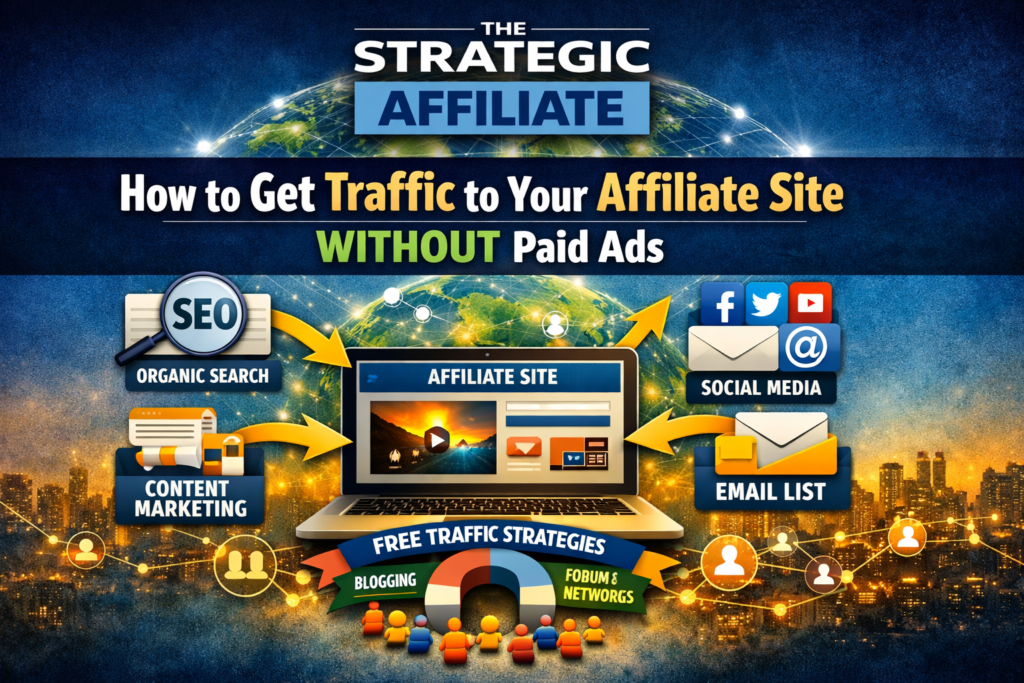
How to Get Traffic to Your Affiliate Site Without Paid Ads
Affiliate disclosure: This article contains affiliate links. If you purchase through them I may earn a small commission at no extra cost to you. I only recommend tools and resources I personally use and trust.
The number one question I get from affiliate marketers at every stage of their journey is some version of the same thing.
How do I get more traffic?
Not how do I write better content. Not how do I choose better products. Not how do I build a better funnel. Traffic. Because without it none of the rest matters — you can have the best affiliate site in your niche and if nobody is finding it you are earning nothing.
The good news is that paid advertising is not the answer and it never has been for most affiliate marketers. Paying for traffic before you have a proven conversion system is one of the fastest ways to burn through money and demoralise yourself at the same time.
The strategies I am going to walk you through in this article are the ones I have used to build traffic across multiple affiliate sites over 19 years — none of them require an ad budget and all of them compound over time, meaning the work you do today keeps sending you traffic months and years from now.
By the end of this article you will have a clear picture of every free traffic source available to an affiliate marketer, how each one works, and exactly where to start.
SEO AND ORGANIC SEARCH
Organic Search — The Traffic Source That Compounds
Organic search is the foundation of every serious affiliate site and it is where the majority of your long-term traffic will come from if you build it properly.
The principle is straightforward. Someone types a question into Google. Your article answers that question better than anything else on the first page. Google shows your article. That person clicks through to your site. If your content and affiliate recommendations are good, some percentage of those visitors convert into commissions.
The beauty of organic search traffic is that it is targeted, free, and self-sustaining. An article that ranks on page one of Google in month four will still be sending you traffic in year three without any additional effort on your part. That is the compounding effect that makes SEO the most powerful long-term traffic strategy for affiliate marketers.
Getting there requires three things done consistently.
Keyword research. Every article you publish should be built around a specific keyword that real people are searching for. Not a guess — a researched term with clear buyer intent and a difficulty level your site can realistically rank for. I use Mangools for this because it gives accurate data at a price point that makes sense for affiliate marketers who are not running enterprise-level operations.
On-page optimisation. Your target keyword needs to appear in the right places — the title, the first paragraph, at least one H2 subheading, the meta description, and naturally throughout the body of the article. Beyond that your content needs to be comprehensive enough to genuinely answer the search query better than what is already ranking.
Internal linking. Every article you publish should link to other relevant articles on your site. This distributes authority across your content, keeps readers on your site longer, and signals to Google that your site has depth and structure rather than a collection of isolated pages. For a full breakdown of how to build an SEO strategy that puts all of this together read the SEO pillar guide on The Strategic Affiliate.
For your hosting foundation — the platform your site runs on affects your SEO more than most people realise. Page speed, uptime, and server response times are all ranking factors. I recommend Hostinger for affiliate sites at every stage because the performance is strong, the pricing is fair, and the NVMe storage on the Business plan means your site loads fast without needing to compensate with a stack of caching plugins.
Get started with Hostinger here — 20% Discount
LONG TAIL KEYWORDS
Long-Tail Keywords — How Small Sites Beat Big Ones
This deserves its own section because it is the specific SEO strategy that makes organic traffic achievable for sites that are not yet established authorities.
A new affiliate site competing for the keyword web hosting is up against Forbes, TechRadar, and every other high-authority domain that has been publishing in that space for years. Winning that fight in the short or medium term is not realistic.
Competing for best budget web hosting for a new affiliate site in the UK is a completely different proposition. The search volume is lower. The competition is dramatically lower. And the person typing that specific phrase is much further along their buying journey than someone typing two generic words into Google.
Long-tail keywords are how small and medium-sized affiliate sites generate real traffic and real commissions without waiting five years to build the domain authority to compete on broad terms.
The formula is simple. Find specific, lower-competition keywords with clear buyer intent. Build comprehensive content around each one. Publish consistently. Within three to six months you will have a library of articles each driving targeted traffic from specific search queries — and that library compounds in value every month.
For a deeper look at how to find and use long-tail keywords across your affiliate content read the long-tail keyword strategy guide on The Strategic Affiliate.
EMAIL MARKETING AS A TRAFFIC SOURCE
Email Marketing — The Traffic Source You Actually Own
Most affiliates think of email as a conversion tool. It is that — but it is also one of the most reliable traffic sources you have because it is the only one completely immune to algorithm changes.
Google can update its rankings overnight. Facebook can cut your organic reach. Pinterest can change what it surfaces. Your email list cannot be taken from you and nobody else controls who sees your messages.
Every time you publish a new article, send an email to your list about it. Not a long elaborate newsletter — a short personal note. Three or four sentences. Here is what I published this week, here is why it matters, here is the link. That is it.
Done consistently this turns your email list into a reliable traffic source that sends a predictable number of visitors to every piece of content you publish regardless of where it sits in Google rankings.
The compounding effect is significant. A list of five hundred engaged subscribers that grows by fifty people a month is sending meaningful traffic to every article within a year — traffic that exists entirely independently of search engine rankings.
I build and manage every email list using Kit. The free plan is genuinely capable and covers everything you need until you reach ten thousand subscribers. There is no reason not to start building your list from day one of your affiliate site.
Start your free Kit account here — Join Kit Free
For a full guide on how to build your email list and use it as both a traffic and conversion asset read the email marketing guide on The Strategic Affiliate.
SOCIAL MEDIA TRAFFIC
Social Media — Consistent Presence Over Volume
Social media is a traffic source that rewards consistency and punishes sporadic effort. The affiliates who get meaningful traffic from social media are not posting twenty times a day — they are showing up regularly on one or two platforms with content that genuinely helps their audience.
The key principle is that social media posts should never be primarily link drops. They should be standalone pieces of value — insights, tips, honest reflections, questions — that build an audience who trust you enough to click through to your content when you do share a link.
Facebook is where I focus most of my social media effort and it delivers consistent traffic through a combination of a personal profile, a business page, and a private community group. The 4:1 approach works well — four posts that deliver value with no link, one post that promotes a specific piece of content or offer. That ratio keeps your audience engaged and means your promotional posts land in a feed that has already built goodwill rather than feeling like broadcast advertising.
Pinterest is worth serious attention for affiliate marketers in visual niches — home, lifestyle, food, fashion, personal finance. Pinterest functions more like a search engine than a social network which means content has a much longer shelf life than on Facebook or Instagram. A well-optimised Pinterest pin can send traffic for years from a single piece of content.
The traffic social media sends is generally lower intent than organic search but it builds brand recognition and audience trust that eventually converts — particularly through the email list capture that sits behind every piece of content you share.
CONTENT REPURPOSING
Content Repurposing — Getting Multiple Traffic Streams From One Piece of Content
Most affiliate marketers write an article, publish it, share it once, and move on. That is leaving most of the value of every piece of content on the table.
A single well-researched article can generate traffic from multiple sources if you repurpose it intelligently.
The blog article ranks in organic search and captures email subscribers through the opt-in form at the bottom.
A summary of the key points becomes a Facebook post that drives social traffic.
The same content reformatted becomes a Pinterest pin that drives search traffic from Pinterest’s algorithm.
The core insight from the article becomes an email to your list that drives direct traffic and strengthens the relationship with existing subscribers.
If you are comfortable on camera the article becomes the script for a short YouTube video that captures a completely different audience who prefer video content over written articles.
None of this requires creating new content from scratch. It requires taking content you have already created and presenting it in formats that reach different audiences on different platforms.
For affiliate marketers publishing three articles per week that repurposing strategy means fifteen to twenty additional pieces of content going out across platforms every week without writing a single extra word.
For a deeper look at how to combine written content with video as part of your traffic strategy read the video and blog content guide on The Strategic Affiliate.
GUEST POSTING AND COMMUNITY
Guest Posting and Community Participation — Building Traffic Through Authority
These two strategies are slower to show results than SEO or email but they build the kind of domain authority and brand recognition that accelerates everything else.
Guest posting means writing articles for other established sites in your niche. You provide them with quality content, they provide you with a link back to your site and exposure to their audience. Done well, a single guest post on a high-authority site in your niche can send referral traffic for years and deliver a domain authority boost that lifts your own rankings.
The pitch needs to be specific and valuable. Not I would like to write for your site. A specific article title, a brief outline, and a clear explanation of why their audience would benefit from it. Most guest post pitches fail because they are generic. A specific, well-researched pitch to a relevant site lands significantly better.
Community participation means being genuinely helpful in the spaces your target audience already occupies. Facebook groups, Reddit communities, Quora, niche forums. Answer questions thoroughly. Share your genuine expertise. Include a link to your content only when it is directly and genuinely relevant to the question being asked.
This is not a spam strategy. It is a visibility and trust strategy. When people see you consistently providing useful answers in the communities they already trust, they start following you, visiting your site, and eventually joining your email list.
THE TRAFFIC SYSTEM
Putting It Together — Traffic as a System Not a Set of Tactics
The mistake most affiliate marketers make with traffic is treating each source as a separate isolated activity. Write some articles for SEO. Post on social occasionally. Send an email sometimes. Guest post when they feel like it.
That approach produces inconsistent, unpredictable traffic that never quite builds the momentum you need.
Treating traffic as a system means every source feeds into every other source.
Your SEO content attracts organic search visitors who join your email list. Your email list drives traffic to every new article you publish. Your social media presence amplifies your content and drives new visitors into the top of your system. Your guest posting builds domain authority that improves your organic rankings. Every part reinforces every other part.
That system does not produce dramatic results in week one. But at month six, month twelve, and beyond it produces traffic that is predictable, diverse, and growing steadily without requiring proportionally more effort as it scales.
That is how to get traffic to your affiliate site without paid ads. Not one magic strategy — a connected system of consistent free traffic sources that compound over time.
What to Do Next
If you are serious about building consistent traffic to your affiliate site without spending on ads the next two steps are straightforward.
First make sure your hosting is solid. Everything I have described in this article requires a site that loads fast, stays online, and gives you the technical foundation for proper SEO. Hostinger is what I recommend and use. The Business plan with NVMe storage is the right starting point for most affiliate sites.
Get started with Hostinger here — 20% Discount Here
Second start your email list today if you have not already. It is the one traffic source you own completely and it compounds every month you build it. Kit is free to start and stays free until ten thousand subscribers.
Start your free Kit account here — Join Kit For Free Here
And if you want to go deeper on the complete system behind building consistent affiliate traffic, content, and commissions join the free Strategic Affiliate Community below. It is where affiliates at every level ask questions, share progress, and get direct feedback on what they are building.
Join the free community here — The Strategic Affiliate
FAQS
Frequently Asked Questions
How long does it take to get traffic to a new affiliate site without paid ads?
With a consistent SEO and content strategy most new affiliate sites start seeing meaningful organic traffic within three to six months. The first few months are slower as Google indexes and evaluates your content. By month six to twelve a site publishing consistently on well-researched long-tail keywords will typically be generating several hundred to several thousand organic visitors per month depending on the niche and content quality.
What is the best free traffic source for affiliate marketing?
Organic search from Google is the best long-term free traffic source for most affiliate sites because it is targeted, self-sustaining, and compounds over time. Email marketing is the most reliable short to medium term source because it is immune to algorithm changes and delivers traffic to every piece of content you publish. The two work best used together as part of a connected traffic system.
Do I need to be on every social media platform to get traffic?
No. Trying to maintain a consistent presence on every platform simultaneously is one of the fastest routes to burnout and poor results everywhere. Pick one or two platforms where your target audience actually spends time and show up there consistently. Done well on one platform beats done poorly across six every time.
How many articles do I need to publish before I start getting traffic?
There is no fixed number but consistency matters more than volume. A site publishing three well-researched articles per week will outperform a site that publishes twenty in a month and then goes quiet. Google rewards consistent publishing signals and a library of thirty focused articles targeting specific long-tail keywords will generate more traffic than a hundred poorly targeted pieces.
Can I build meaningful affiliate traffic without paying for any tools?
You can get started for very little. Google Search Console is free and gives you ranking and traffic data. Kit is free until ten thousand subscribers. Google Autocomplete and People Also Ask are free keyword research methods. As your site grows investing in a proper keyword research tool like Mangools makes a meaningful difference to the quality of your content targeting but it is not essential on day one.