How to Sell on Instagram: Turn Views into Customers
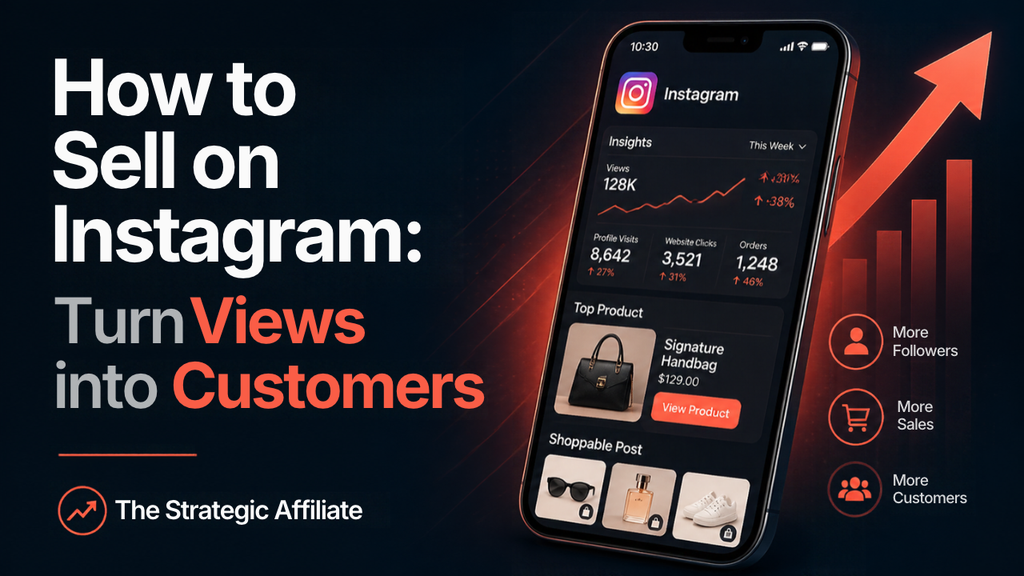
A practical guide to creating content that builds trust, starts conversations and gives people a reason to buy.
Views are easy to celebrate.
A Reel gets attention. Your phone starts buzzing. A few new followers arrive.
Then you check your enquiries, sales or affiliate dashboard.
Not much has changed.
That gap is where plenty of Instagram marketing goes wrong. We spend so much time thinking about getting noticed that we forget to decide what should happen afterwards.
A view is not a customer. A follower is not a sale. And a busy account is not necessarily a useful part of your business.
Learning how to sell on Instagram means connecting those separate pieces: the content somebody sees, the problem they want solved, the page they visit and the decision they make next.
You do not need to turn every post into a sales pitch. You need a clear reason for the right person to keep moving.
In this guide, we will work through that process, with particular attention to affiliate marketers, website publishers and small online businesses. You will see how to use Reels to attract relevant visitors, give those visitors somewhere worthwhile to go, and build a routine you can maintain.
No promise of overnight income.
Just a more purposeful way to use the attention you earn.
1. Choose Your Sales Journey Before You Create More Content
Before you plan another Reel, answer one question:
What do you actually want someone to buy?
It sounds obvious. Yet “make money from Instagram” is often the entire plan.
That leaves too much undecided.
Your content, links and calls to action should reflect your business model. Selling handmade products is not the same as recommending software through an affiliate programme.
If you sell your own physical products
Your journey might be:
Reel demonstrating the product → product page → checkout.
Eligible businesses can also investigate product catalogues and shopping features. However, availability depends on factors including supported countries and account eligibility. Check Meta’s current requirements before building your plan around a particular feature.
Whatever tools you use, the customer still needs the basics: a clear description, an accurate price, delivery information and a trustworthy way to pay.
A shopping feature cannot compensate for an unclear offer.
If you promote affiliate products
Your journey will often look different:
Reel addressing a problem → helpful article → relevant recommendation → merchant website.
You are not usually managing the product, checkout or fulfilment. Your job is to help the reader decide whether the recommendation suits them.
Suppose your audience consists of new website owners.
A Reel about “three things to check before buying WordPress hosting” could lead to a detailed hosting guide. That guide can explain the trade-offs, compare suitable options and include clearly identified affiliate links.
The Reel earns attention. The article provides the detail needed to make a decision.
If you sell services or digital products
Your next step might be a course information page, a consultation enquiry or a useful resource that introduces your approach.
Do not make an interested visitor guess.
My preference is to choose one main journey for each campaign. You can run a business with several offers, but an individual piece of content needs a clear job.
Write the journey in one sentence:
“This Reel helps beginner affiliates recognise a tracking problem, then sends them to a guide that explains how to fix it.”
If you cannot explain the connection that simply, tighten the plan before creating the content.
2. Make Your Profile Explain Why Someone Should Stay
Think of your profile as a signpost.
Someone watches a useful Reel, taps your name and wants to know whether there is more here for them.
Do they immediately understand what you cover?
Or do they find an unclear bio, several unrelated offers and a link labelled “click here”?
Your profile should answer three questions:
- Who is this account for?
- What does it help them do?
- Where should they go next?
Write a bio around the reader’s needs
“Entrepreneur. Creator. Dreamer. Helping you succeed.”
That could describe thousands of accounts. It gives a visitor very little to work with.
A more useful example for an affiliate education account would be:
Practical affiliate marketing for beginners.
Build useful content, choose relevant offers and organise your business.
Start with the free guides below.
It is not trying to sound impressive.
It is trying to be understood.
That is usually the better copywriting decision.
Make the destination easy to recognise
If your Reel promises a guide to choosing an email platform, the profile link should make that guide easy to find.
Do not make visitors inspect a long list of vaguely labelled buttons.
Use descriptive wording:
- Compare beginner email marketing tools.
- Read the Instagram selling guide.
- Build your first affiliate content plan.
You do not have to remove every other link. Simply make the relevant next step obvious.
Use pinned content and Highlights to answer recurring questions
GoDaddy recommends using Highlights to organise useful material such as tutorials, product information and common questions.
For an affiliate-focused account, suitable categories might include:
- Start Here.
- Tutorials.
- Tool Reviews.
- Common Questions.
- About.
Choose labels that help a visitor, rather than clever names they need to interpret.
Pinned content can serve a similar purpose: introduce your approach, explain who your advice suits and point towards a useful starting resource.
The aim is not to make the profile look busy.
It is to make it easy to understand.
3. Create Reels That Attract Potential Buyers, Not Just Viewers
A popular Reel and a commercially useful Reel are not necessarily the same thing.
An entertaining clip can attract people who have no interest in your subject or offer.
That does not make entertainment worthless. It means reach alone is not enough to judge whether the content did its job.
I would rather build a series around specific audience problems than repeatedly chase topics with no connection to the business.
Start with a problem your reader recognises
Broad topic:
“Affiliate marketing tips.”
Specific problem:
“Your affiliate review gets visitors, but nobody clicks the product links.”
The second gives you something useful to explain. It also tells the viewer whether the content is relevant to them.
Try building Reels around four types of questions.
Problem recognition
Help viewers spot something that is going wrong.
Example hook:
“Getting Instagram views but no website visitors? Check what you ask people to do next.”
Demonstration
Show a process or product in use.
Example hook:
“Here is how I would organise a week of affiliate content in a simple spreadsheet.”
If you demonstrate a tool, show the work it helps someone complete. A tour of menus is rarely as useful as a clear task.
Comparison
Explain a decision.
Example hook:
“Do you need a full website builder, or would a simple landing page do the job?”
Avoid declaring a universal winner when the answer depends on the reader’s circumstances.
Objection handling
Address something that prevents action.
Example hook:
“You do not need to recommend ten different tools in every article. Start with the problem the reader actually has.”
These ideas create a connection between the short video and a fuller explanation on your website.
Give the Reel a complete point
Do not withhold every useful detail just to force a click.
A better structure is:
- Identify the problem.
- Explain one useful principle.
- Give a brief example.
- Offer the deeper resource.
For example:
“If your Reel promises help choosing a beginner email platform, do not send people to a general homepage. Send them to the comparison. The full guide explains what to check before paying.”
The viewer gets something useful immediately. The article offers depth rather than rescuing an empty video.
Use one clear call to action
“Like, follow, comment, share, save, visit my website and download my guide.”
That is not direction. It is a list of competing requests.
Choose the action that fits the content.
For an article-led campaign:
“I have explained the full process in the guide linked from my profile.”
For a service enquiry:
“Send me a message with the problem you are trying to solve.”
For an eligible product-tagging setup:
“Tap the product tag to see the details.”
Keep it honest and specific.
The purpose of the call to action is to remove uncertainty, not apply pressure.
4. Send Every Interested Visitor to the Right Page
The next part of how to sell on Instagram happens after someone leaves the app.
That is where the promise needs to hold up.
Imagine watching a Reel about affordable email tools for beginners. You tap through expecting a practical comparison.
Instead, you reach a homepage promoting an advanced marketing course.
The course might be good. It is still the wrong destination for that promise.
Match the page to the Reel
Use the same subject and recognisable wording across the journey.
For example:
- Reel: “Three checks before choosing your first email platform.”
- Destination article: “How to Choose an Email Marketing Platform as a Beginner.”
- Relevant next step: compare suitable platforms or follow a setup tutorial.
This is message matching in plain English: the visitor finds what they expected.
You can introduce other resources later. First, fulfil the promise that earned the click.
Make the page useful on a phone
Before promoting an article, open it on your own mobile.
Check:
- Can you read the introduction without fighting a pop-up?
- Does the heading confirm you reached the right place?
- Are paragraphs manageable?
- Are buttons easy to identify?
- Do links work?
- Are comparisons readable on a small screen?
- Does the page explain the next step clearly?
Do not rely entirely on how attractive the article looks on a desktop monitor.
Walk through the same journey your visitor will take.
Give the article a clear commercial purpose
An affiliate article should help a reader decide, not simply surround them with links.
Explain:
- What problem the product addresses.
- Who it is suitable for.
- What limitations matter.
- What it costs, where verified.
- Which alternatives deserve consideration.
Sometimes the most useful recommendation is not to buy yet.
If a reader can solve the problem with a tool they already own, say so. A helpful publishing business needs room for that answer.
Connect the pieces with a repeatable process
This is where Instagram becomes part of your business rather than another task demanding attention.
You need a routine for planning the article, creating related Reels, checking links, following up and reviewing results.
The Systems guide on The Strategic Affiliate explains how tracking, publishing, email and optimisation fit into that wider process.
Start simply.
One useful article can support several Reels, each addressing a different question. Those Reels can lead to the same resource without repeating exactly the same message.
That is a more manageable approach than inventing an unrelated destination for every video.
5. Build Trust Before You Ask for the Sale
People need more than a recommendation.
They need a reason to believe it.
For affiliate publishers, that means explaining the thinking behind the offer rather than treating commission as the selection criterion.
Be specific about benefits and limitations
“This tool is amazing” tells the reader almost nothing.
A useful recommendation might say:
“This could suit a solo publisher who wants a straightforward welcome sequence. If you need complex automation across several businesses, compare the more advanced options before committing.”
That is a hypothetical example, not a claim about a particular product.
Notice what it does: identifies a user, describes a task and acknowledges a limitation.
Apply the same approach to demonstrations, comparisons and reviews.
If you have tested something, explain what you tested. If you have not used it personally, do not imply that you have.
You can write a useful researched comparison without inventing experience.
Answer questions without turning every conversation into a pitch
Direct messages can help you understand what an interested person needs.
Ask a relevant question:
“Are you starting your first website, or moving an existing one?”
That answer changes the advice.
Sending the same affiliate link to everyone may be quick, but it avoids the actual decision the person needs help making.
If you sell through messages, use a reputable payment process rather than asking someone to send sensitive payment details in the conversation. GoDaddy’s guide describes secure payment links as one option for sellers handling enquiries through DMs.
For affiliates, check the programme’s rules about permitted promotional channels before sharing links through messages.
Treat disclosures as part of clear communication
For UK publishers, affiliate advertising needs to be recognisable as advertising.
The Advertising Standards Authority advises using a clear, prominent “Ad” label upfront where the content is advertising. It also explains that a post can count as affiliate advertising even when the attributable link is not contained in that specific post.
Do not assume “affiliate” buried among hashtags, or a general statement in your bio, makes every promotional post clear. ASA guidance says relevant advertising content needs appropriate identification.
A straightforward example is:
“Ad — this post promotes a tool through an affiliate relationship.”
Use wording that accurately describes your arrangement and check the guidance for your circumstances.
Use genuine evidence
Customer stories, screenshots and demonstrations can support a recommendation, but context matters.
Do not present an exceptional result as the normal outcome. Do not invent testimonials. Get permission before reusing customer content, as the GoDaddy guide also recommends.
Be equally careful with urgency.
A genuine deadline can help someone make a decision. A countdown that resets every morning tells a different story.
Trust is not something you add at the end of a sales page.
It runs through the claims you make, the examples you choose and the limitations you are willing to mention.
6. Measure the Journey and Fix the Weakest Step
You cannot understand the commercial value of Instagram by looking only at views.
You need to know what happens between the Reel and the outcome.
For a simple article-led affiliate campaign, I would track:
- Reel topic and publication date.
- Views and available engagement data.
- Profile activity and external link activity, where available.
- Visits to the destination article.
- Affiliate link clicks.
- Reported sales, commissions or relevant enquiries.
Use the data your account, website analytics and affiliate programme actually provide. Not every platform will report the same information.
Compare attention with action
Imagine two hypothetical Reels.
The first receives 15,000 views and sends 20 visitors to your guide.
The second receives 2,000 views and sends 50 visitors.
The first won on reach. The second generated more article visits.
That does not prove which one produced more revenue. You still need the later-stage data.
But it gives you a better question than “Which got the most views?”
Ask:
“Which content attracted people who wanted the next step?”
Diagnose before changing everything
Different symptoms suggest different things to investigate.
Plenty of views, little profile activity
Check whether the subject attracts the right audience and whether the next step is clear.
Profile visits, few website visits
Check your bio, link labels and whether the promised resource is easy to find.
Article visits, few affiliate clicks
Check whether the article answers the question, explains the recommendation and makes the relevant links visible.
Affiliate clicks, few reported sales
Investigate offer fit, price, merchant-page quality and tracking limitations. The problem may not sit entirely within your Instagram content.
Avoid drawing conclusions from tiny samples.
One quiet afternoon does not establish that a strategy is broken.
Use tracking carefully
Campaign tags can help distinguish website visits from different sources. Where your affiliate programme supports them, sub-IDs can help identify the content associated with reported activity.
Keep naming consistent.
A simple campaign label is more useful than a complicated tracking setup you stop maintaining.
Remember that attribution has limits. Somebody might discover you through Instagram, return through search and buy later. Treat reports as evidence to interpret, not a perfect record of every influence on the purchase.
Test paid promotion only when the next step works
Paid promotion is an option, not a required starting point. GoDaddy discusses Explore ads as one way to reach additional audiences.
Before spending, check that your page works, your tracking is sensible and you have a clear idea of what an enquiry or customer is worth.
For affiliates, commission economics matter.
A campaign can generate sales and still lose money if the advertising cost exceeds the commission received.
More traffic is not automatically the solution to a weak journey.
7. Conclusion: Build a Sales Process You Can Repeat
The practical answer to how to sell on Instagram is not “post more”.
It is to connect the work.
Choose an audience. Understand a problem. Create something useful. Offer a relevant next step. Then check what happened.
If you are starting from scratch, use the next month to build one complete journey.
Week one: choose the destination
Pick one audience problem and one useful article or product page.
Review your profile so it clearly explains who you help and where visitors should go.
Week two: create a small series
Make three Reels around the same subject:
- One identifying the problem.
- One explaining a practical step.
- One answering a common objection.
Each should provide value on its own and lead naturally to the destination.
Week three: improve the follow-through
Check the mobile page, links, disclosures and calls to action.
Answer genuine questions. Note anything readers repeatedly misunderstand.
Those questions are useful material for improving the article and planning future content.
Week four: review the evidence
Look at visits, clicks, enquiries and any reported commercial outcomes.
Keep what appears useful. Improve the weakest step. Give yourself enough evidence before abandoning the entire approach.
You do not need a complicated funnel for every Reel.
You need a journey you can explain, maintain and improve.
If you are serious about making Instagram part of a sustainable affiliate business, start with one useful article and a small group of connected Reels. Use the Systems guide linked above to organise the publishing, tracking and follow-up around them.
The goal is not another account that keeps you busy.
It is content that helps the right people take a worthwhile next step.
Frequently asked questions
1. Do I need an Instagram Shop to promote affiliate products?
Not for a website-led affiliate strategy. You can use content to introduce a subject and direct interested visitors towards a relevant guide or comparison on your website.
Do not assume you can add any third-party affiliate offer to a shopping catalogue. Check Meta’s eligibility requirements and your affiliate programme’s promotional rules before using commerce features. Meta maintains country-specific information about Shops availability.
2. Can I sell through Instagram without a website?
You can handle enquiries through DMs and use appropriate secure payment links for your own products or services. GoDaddy describes this as an option for sellers testing an offer before building a full online store.
For an affiliate publisher, a website gives you space for detailed comparisons, tutorials and recommendations. It is a useful destination for readers who need more information than a short video can provide.
3. How many followers do I need before I start selling?
Do not use an arbitrary follower milestone as permission to start building your sales journey.
A useful offer still needs the right audience and a clear next step. Separately, particular commerce features have their own eligibility conditions, so check those rather than assuming follower count is the only consideration.
Start by making your content and destination useful to the people already finding you.
4. How often should I publish Reels?
Start with a schedule you can maintain without sacrificing the quality of your articles or recommendations.
For example, test two or three purposeful Reels a week around one useful resource. That is a manageable trial plan, not a universal rule.
Review the quality of the visits and enquiries they generate before deciding whether publishing more is worthwhile.
5. Do I need to disclose affiliate promotions on Instagram?
Yes. Where content qualifies as affiliate advertising, make its commercial nature clear.
For UK audiences, ASA guidance recommends clear, prominent identification such as “Ad” upfront. A disclosure elsewhere on your profile does not replace appropriate disclosure on the relevant content.