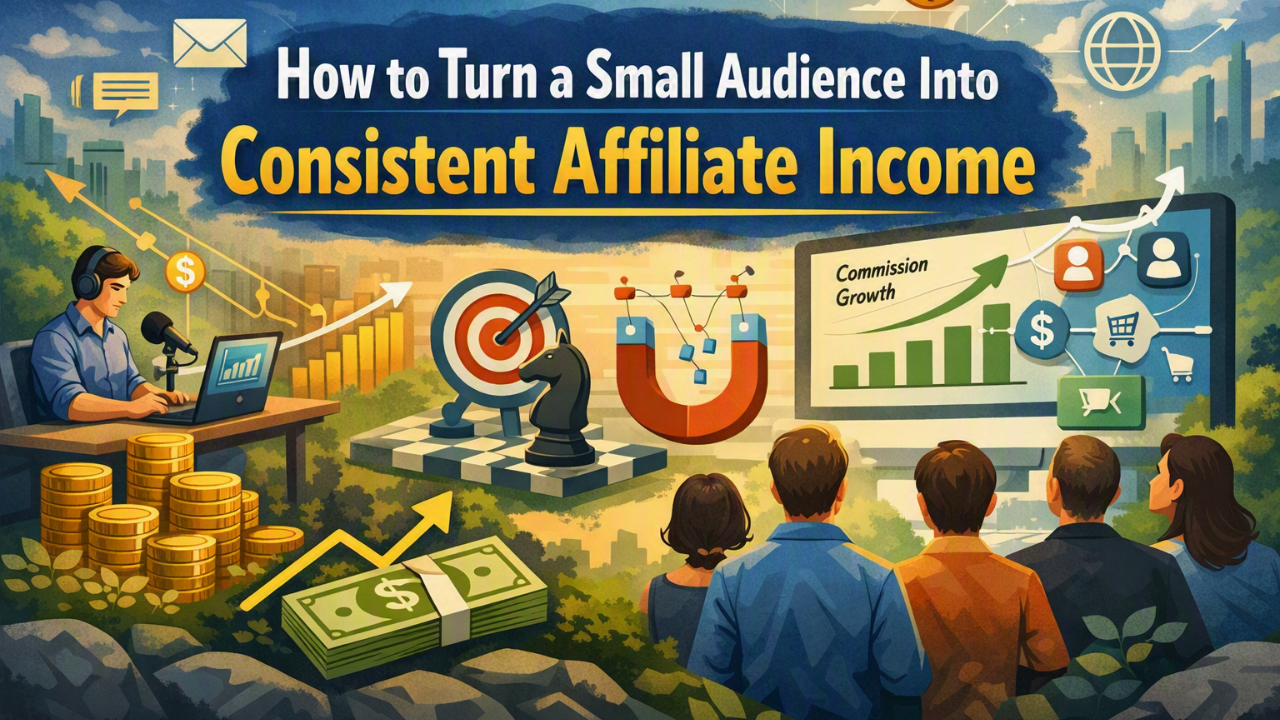
How to Turn a Small Audience Into Consistent Affiliate Income
A small audience can feel discouraging when you are trying to make money with affiliate marketing.
You might have a few hundred followers, a modest email list, or a website getting only a handful of visitors each day. You look at established creators with huge social accounts and thousands of subscribers, then wonder whether there is any point carrying on.
Here is the truth: you do not need a massive audience to build affiliate income.
You need the right people, useful content, relevant offers and a simple system that moves people from interest to action. A small audience that trusts you is worth far more than a large audience that barely notices what you publish.
After more than 19 years in affiliate marketing, I have seen beginners make one common mistake again and again. They chase reach before they learn how to help the people already listening. They want thousands of clicks when they have not yet given their first 100 visitors a clear reason to click, subscribe or buy.
Let’s break this down. This guide will show you how to turn a modest audience into a more reliable source of affiliate commissions without becoming pushy, posting all day on social media or pretending to be someone you are not.
Small Does Not Mean Unprofitable
Most affiliate beginners measure success by follower count.
That is understandable. Follower numbers are visible. They make it easy to compare yourself with other people. But followers do not automatically become income. Plenty of accounts with 20,000 followers earn very little because their audience is broad, distracted or not interested in buying anything.
On the other hand, a small, focused audience can produce consistent affiliate income when you understand three things:
- What your audience is trying to achieve
- What is stopping them from achieving it
- Which products, tools or services can genuinely help
Imagine two UK creators.
The first has 15,000 Instagram followers who enjoy motivational quotes and general business tips. The second has an email list of 500 people who want help starting a WordPress blog, choosing web hosting and learning the basics of affiliate marketing.
The first creator may get more likes. The second creator is more likely to earn commissions because their audience has a clear problem and is actively looking for solutions.
This is why a small audience can be a strength. It gives you room to listen properly. You can reply to comments, answer emails, notice recurring questions and create content around the problems people actually have.
That is where a proper affiliate income system begins.
Start With a Clear Audience Problem
Most beginners do not realise that affiliate marketing works best when it starts with the audience, not the product.
They join an affiliate programme, get a link, then try to find somebody to send it to. That is backwards.
Instead, identify one specific problem your audience wants to solve. The more clearly you understand that problem, the easier it becomes to create useful content and recommend suitable products.
For example, if your audience is made up of people who want to start a small online business, their questions might include:
- Which website platform should I use?
- Do I need to pay for expensive tools?
- How do I get people to visit my website?
- Can I start with only a few hours a week?
- What is the simplest way to collect email subscribers?
- Which affiliate programmes are suitable for beginners?
Each question gives you a potential article, email, video or social post. More importantly, each question can lead naturally to a relevant recommendation.
If somebody is trying to build a basic WordPress website, they may need hosting, a theme, an email provider, keyword research tools or a course that explains the process. You are not inventing a need. You are helping them make a decision.
The best place to start is with a simple audience worksheet. Write down:
- Who you are helping
- What they want
- What frustrates them
- What they have already tried
- What they need to know before they buy
- What products or services they may need along the way
Do not try to serve everyone. “People who want to make money online” is too broad. “UK beginners who want to build an affiliate website alongside a full-time job” is much clearer.
Once you understand the person you are speaking to, your content becomes sharper. Your recommendations become more relevant. Your audience starts to see you as somebody who understands their position.
Build Trust Before You Ask for the Click
People do not click affiliate links simply because you have placed them in a post.
They click when they trust your judgement.
Trust is built through helpfulness, honesty and consistency. It is built when you explain things clearly, admit where something is not right for everybody and recommend products because they solve a real problem.
That means you should not promote every offer that lands in your inbox.
Over the years, I have seen far too many affiliates promote products they have never used, barely understand or would never buy themselves. They fill their content with big claims, use fake urgency and wonder why readers stop engaging.
Your audience may not say it directly, but they can sense when they are being sold to.
A better approach is to make your recommendations specific.
Instead of saying, “This is the best email marketing tool,” explain who it is for:
This is a good option for a beginner who wants to build a simple email list without spending days learning complicated software. It may not be the best fit for someone who needs advanced automation from day one.
That one sentence does more for trust than a page full of hype.
You should also be open about affiliate links. A simple disclosure is enough:
Some links in this article are affiliate links. If you buy through them, I may earn a commission at no extra cost to you.
There is no need to make it awkward. Transparency makes you look more professional, not less.
If you are new to this side of the business, start with the basics in my How to Start Affiliate Marketing guide. It covers the core foundations before you worry about scaling traffic or building complex funnels.
Use Content to Create Buying Intent
Not all content has the same purpose.
Some posts attract attention. Some build trust. Some answer questions. Some help readers make a buying decision. A good affiliate site needs a mixture of all four.
If you only publish broad motivational content, you may get engagement but little income. If every post is a product review, people may feel you only want their money.
The answer is to create content around the reader’s journey.
Awareness content
This content helps people understand their problem or spot an opportunity.
Examples include:
- How to start a blog while working full-time
- Why most beginner affiliate websites fail to get traffic
- What you need before joining an affiliate programme
- How much does it cost to start a website in the UK?
This type of content attracts people who are still learning. It may not always lead to an immediate sale, but it introduces the right readers to your site.
Consideration content
This content helps readers compare options and make choices.
Examples include:
- WordPress vs Wix for an affiliate website
- Best UK web hosting for beginner bloggers
- MailerLite vs ConvertKit for a small email list
- Free keyword tools vs paid keyword tools
This is often where affiliate links perform well because the reader is closer to making a decision.
Decision content
This content helps someone take the next step.
Examples include:
- My honest review of
- Is [tool] worth it for affiliate beginners?
- How to set up [tool] step by step
- Bestfor beginners on a budget
-
Sale!

AI‑Powered Facebook Money System
Original price was: £27.00.£17.00Current price is: £17.00.
-
Sale!

A reader searching for “best web hosting for beginner bloggers UK” has more buying intent than somebody searching for “how do blogs make money?” Both are useful audiences, but they need different content.
The aim is not to turn every visitor into a buyer immediately. The aim is to help them at the stage they are currently in.
Turn One Piece of Content Into a Simple Funnel
Traffic and funnels do not need to be complicated.
The word “funnel” makes some people picture pages of automation, aggressive sales messages and endless pop-ups. It does not have to be any of that.
At its most basic, a funnel is simply the path somebody takes from finding you to taking action.
For a small affiliate site, it may look like this:
- A reader finds your helpful article through Google, Pinterest, Facebook or a link you shared.
- They read the article and get a useful answer.
- They click through to a related guide, product review or comparison.
- They join your email list for a checklist, guide or regular tips.
- They receive further help and relevant recommendations over time.
- When the timing is right, they click an affiliate link and make a purchase.
That is all a funnel needs to be in the beginning.
Here is a practical example for UK creators in the affiliate marketing space:
A beginner finds your article called “How to Start an Affiliate Website From the UK.” In the article, you explain the basic steps and recommend a relevant hosting provider. You also offer a free “First Affiliate Website Checklist” in exchange for their email address.
Over the next week, you send them a few useful emails:
- Email one: The three things to decide before buying hosting
- Email two: The easiest first pages to create on a new website
- Email three: Why publishing helpful content matters more than a fancy logo
- Email four: The tools you personally use or recommend to get started
None of those emails need to be pushy. You are simply continuing the conversation and helping somebody move forward.
This is why an email list matters. Social media posts disappear quickly. Search traffic can fluctuate. But an email list gives you a direct line to people who have chosen to hear from you.
For a more structured approach to offers, content and email follow-up, explore The Strategic Affiliate Income System. It is designed to help you build a business around a repeatable process rather than random promotion.
Focus on Higher-Value Actions, Not Vanity Metrics
A small audience becomes more profitable when you focus on actions that matter.
Likes are nice. Views can be encouraging. But neither pays the bills on its own.
Pay attention to:
- Which articles bring visitors from search engines
- Which emails receive replies or clicks
- Which social posts start meaningful conversations
- Which affiliate links get clicked
- Which offers convert into commissions
- Which topics your audience repeatedly asks about
You do not need complicated analytics in the beginning. You simply need to develop the habit of noticing patterns.
Let’s say you publish ten articles. Six get little attention, two get steady traffic and two attract comments, email replies and affiliate clicks.
That tells you something. Rather than writing ten more unrelated articles, create more content around the two topics that already show signs of interest.
This is where predictable affiliate income starts to become possible. Not because every post succeeds, but because you learn what your audience responds to and do more of it.
A useful monthly review could include these questions:
- What content attracted the most relevant visitors?
- Which article generated the most affiliate clicks?
- Did any reader ask a question I should turn into new content?
- Which offer is being ignored, and why?
- What is the next logical problem my audience needs help solving?
Small improvements build up. Better headlines, clearer calls to action, more relevant offers and stronger internal links can make a noticeable difference without needing thousands more visitors.
Give People More Than One Way to Find You
You do not need to be everywhere. In fact, trying to master every platform is one of the quickest ways to burn out.
Pick one primary traffic source and one supporting channel.
For many affiliate beginners, a sensible combination is:
- A website for evergreen articles and search traffic
- An email list for ongoing contact
- One social platform for sharing content and starting conversations
If you enjoy writing, your main focus might be SEO content and email. If you are comfortable speaking on camera, you might use YouTube to send viewers to detailed guides on your website. If you have an active Facebook group, you could use that to understand common questions and direct people to your most useful resources.
The important point is that the channels work together.
A short Facebook post can point people to an in-depth article. The article can encourage people to join your email list. The emails can lead people to a relevant tutorial, review or recommendation.
That is a much stronger strategy than dropping affiliate links into random posts and hoping somebody buys.
Your website remains the centre of the system. It is where your best content lives, where your links are organised and where you can build an asset you control. Browse the Systems section for practical ideas on connecting content, email and offers in a way that feels manageable.
Make Your Offers Relevant and Easy to Understand
The easiest affiliate offer to promote is one that fits naturally into the content.
If you write a guide on choosing website hosting, link to hosting. If you write a tutorial on building an email list, mention the email platform you use. If you publish a review of a course, explain exactly what it covers, who it helps and where it falls short.
Do not force products into content where they do not belong.
Your reader should be able to see the connection between their problem and your recommendation without feeling manipulated.
A useful affiliate recommendation should answer these questions:
- What does this product help the reader do?
- Who is it best for?
- Who is it not for?
- What does it cost?
- Is there a free trial, guarantee or lower-cost alternative?
- Have you used it yourself, researched it properly or seen it work in a relevant situation?
If you cannot answer those questions, you probably should not promote it yet.
Where possible, promote offers that support the wider journey of your audience. A beginner building a site may need hosting first, then a keyword tool, then email marketing software, then training on traffic and funnels. Those offers can fit together naturally because they solve connected problems.
That is far more useful than promoting unrelated products simply because the commission looks attractive.
Five Beginner Mistakes to Avoid
Small audiences can produce results, but a few common mistakes can slow you down badly.
1. Promoting too many products
When you recommend everything, your audience does not know what you actually stand for.
Start with a small number of tools, services or courses that match your niche. Learn them well. Create useful content around them. Add more only when there is a clear reason.
2. Waiting for a bigger audience
Do not tell yourself you will start affiliate marketing properly once you reach 1,000 followers or 10,000 monthly visitors.
Start helping the people you have now. Those early readers give you valuable feedback and teach you what content is worth creating.
3. Writing only promotional content
If every article is a review or sales page, readers will quickly lose interest.
Balance product-focused content with tutorials, problem-solving guides, personal lessons, comparisons and useful checklists.
4. Ignoring email from day one
You do not need a huge list for email marketing to matter.
Start collecting email addresses early, even if only a few people sign up at first. It gives you a way to build a relationship beyond a single website visit or social post.
5. Changing direction every week
Most affiliate beginners do not fail because they chose the wrong niche or platform. They fail because they keep abandoning one plan for another before the first plan has had time to work.
Give your content strategy enough time. Publish consistently. Review what is happening. Adjust based on evidence, not panic.
Key Takeaways
A small audience is not a reason to give up. It is a reason to get more focused.
- Build around a clear audience problem, not a random affiliate product.
- Create helpful content for different stages of the buyer journey.
- Earn trust through honesty, clarity and relevant recommendations.
- Use your website, email list and one traffic channel to create a simple path from content to commission.
- Measure clicks, replies, conversions and useful engagement instead of obsessing over follower counts.
- Stick with a sensible plan long enough to learn what works.
The goal is not to become the loudest person in your niche. The goal is to become useful to the right people.
If you are ready to build a more organised affiliate business, explore the beginner guides, traffic strategies and funnel tutorials across The Strategic Affiliate. Start with the main affiliate marketing pillar guide, then work through The Strategic Affiliate Income System when you are ready to turn your content into a clearer, more consistent process.