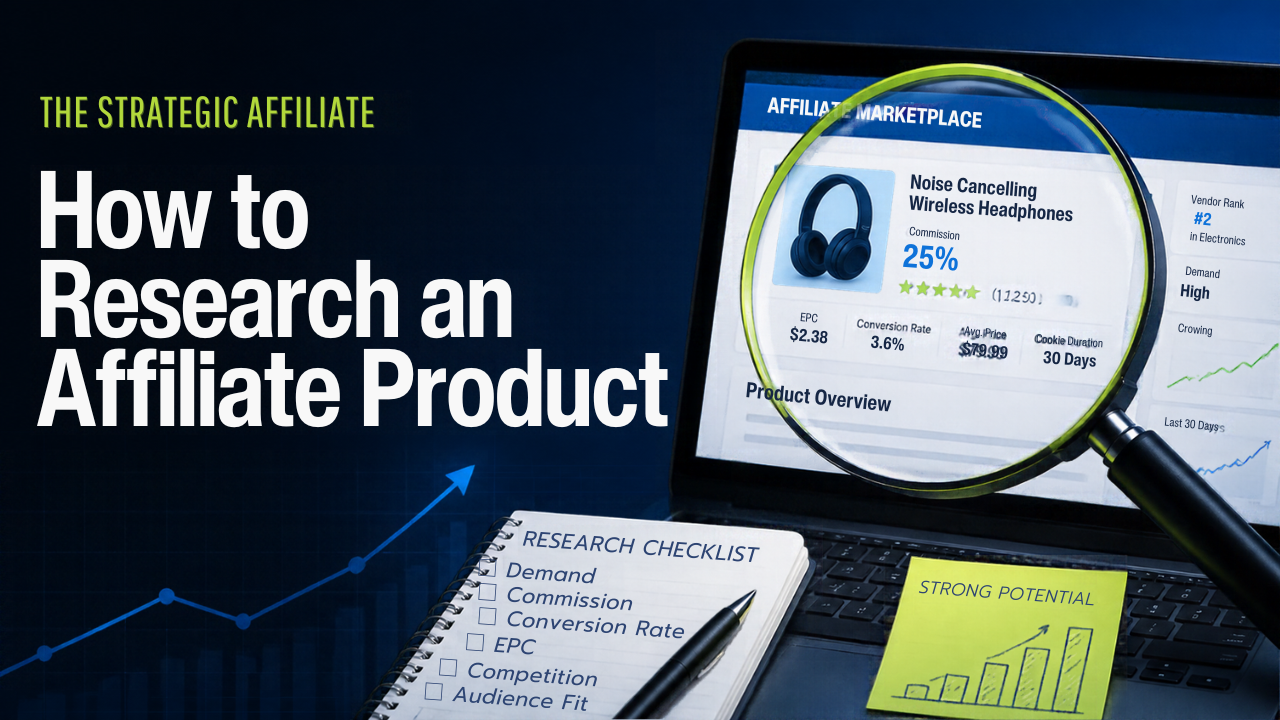
How to Research an Affiliate Product Before Putting Your Name Behind It
Finding an affiliate product is usually the easy part. Deciding whether it deserves your recommendation takes more work.
The sales page looks convincing. The commission is attractive. Other affiliates are promoting it. But you still have an important question to answer: would you feel comfortable recommending it to someone who trusts your judgement?
That hesitation is useful. It means you are thinking beyond the next commission.
You do not need to become a professional product tester or spend weeks investigating every purchase. You do need a practical way to check what a product promises, how it works, where it falls short and what happens when a customer needs help.
This guide explains how to research an affiliate product using a repeatable process. You will finish with a clearer idea of what to check, what evidence to keep and when to walk away.
Start with the customer, not the commission
Before opening the affiliate dashboard, write down who the product is supposed to help.
“People who want to make money online” is too broad. “A UK-based beginner who needs to collect email subscribers and send a simple welcome sequence” gives you something useful to assess.
That distinction matters because a product can be good without being right for your audience.
A sophisticated email platform might suit an established business with several lists and complex automations. The same platform could leave a beginner paying for features they cannot yet use.
Create a short customer profile:
- What does this person want to achieve?
- What can they already do?
- What is their realistic budget?
- Which tools do they currently use?
- What would make the product unsuitable?
Then finish this sentence:
“I am checking whether this product helps [specific person] achieve [specific task] within [relevant constraints].”
Keep that sentence beside you throughout your research. It stops impressive features and generous commissions from distracting you from the actual job.
Step 1: Turn the sales claims into questions you can check
A sales page tells you how the seller wants the product to be understood. Your job is to work out which statements you can support.
Start by recording the main claims. Focus on promises that would influence someone’s buying decision.
These might include:
- “Build your first landing page in ten minutes.”
- “No technical experience required.”
- “Works with your existing website.”
- “Includes everything you need.”
- “Get support whenever you need it.”
Now turn each statement into a question.
What counts as a finished landing page? Does “no technical experience” include connecting a domain? Which website platforms are supported? Does “everything” include email delivery, hosting and payment processing?
“Support whenever you need it” could mean live help around the clock. It could also mean a help centre that remains accessible while the support team is offline.
Do not fill those gaps with optimistic assumptions.
Separate features from outcomes
A feature is something the product provides. An outcome is something the customer hopes to achieve.
An email tool might provide automated sequences. That does not establish that its users will make sales.
A course might contain lessons on search traffic. That does not establish that a beginner will reach a particular visitor count.
When researching, keep those categories separate:
“The platform includes an automated welcome sequence builder.”
That is a feature you can inspect.
“The platform will generate predictable affiliate income.”
That is a much broader promise, requiring evidence beyond the presence of an automation tool.
An affiliate income system involves more than buying software. Your assessment should not turn one useful component into a promise about the whole business.
Step 2: Check what the customer actually pays for
Look beyond the price displayed beside the main purchase button.
Your reader needs to understand the cost of using the product for their intended purpose, not simply the cost of opening an account.
Check:
- Monthly and annual billing options.
- Whether the headline monthly price requires annual payment.
- Usage limits on the advertised plan.
- Essential features reserved for higher plans.
- Optional and necessary add-ons.
- Renewal terms and introductory discounts.
- The billing currency and whether VAT is included or added.
For UK creators, a dollar-priced subscription needs explaining accurately. Do not present a rough currency conversion as a guaranteed sterling charge.
Use a hypothetical example to test the real cost. Suppose a landing-page service costs £15 a month, but your reader also needs a separate email platform and a paid integration to deliver their lead magnet. The useful comparison is the combined setup, not just the £15 entry price.
Read cancellation and refund terms separately
Cancelling future payments and getting a refund are different questions.
Find out:
- How customers cancel.
- Whether cancellation takes effect immediately or at renewal.
- Whether annual payments are refundable.
- Whether a trial becomes a paid subscription automatically.
- Whether a refund promise has conditions.
- What happens to stored work after cancellation.
If the sales page and terms appear inconsistent, ask the seller to clarify in writing.
Do not describe a purchase as “risk-free” simply because a refund badge appears near the checkout.
Step 3: Test a complete beginner task
Here’s the truth: clicking around a dashboard is not the same as using a product.
A useful test follows a real task from beginning to end.
For an email marketing platform, that might mean:
- Open an account.
- Create a subscriber list.
- Build a sign-up form.
- Connect the form to a landing page.
- Write a welcome email.
- Subscribe using a test address.
- Confirm that the email arrives and its links work.
For an online course, it might mean completing one relevant module, following the instructions and checking whether the promised result is achievable with the stated resources.
For a physical product, it might involve assembly, ordinary use, cleaning and storage.
Choose the test before you begin. Otherwise, it is easy to explore the features you enjoy and miss the awkward steps your reader will face.
Record friction, not just failures
Something does not have to be broken to make it difficult for a beginner.
Watch for:
- Instructions that assume prior knowledge.
- Settings hidden in unexpected places.
- Unexplained terminology.
- Tutorials that show an older interface.
- Steps that require another paid tool.
- Mobile layouts that need manual correction.
Keep brief notes as you work.
“Connecting the form required three settings changes that were not covered in the quick-start guide” is more useful than “the setup was confusing”.
Also distinguish first-time setup from repeated use. A tool might take an afternoon to configure but become straightforward afterwards. Your review should explain both stages.
Step 4: Be clear about what you have actually tested
Not every affiliate beginner can afford to buy every product they want to cover.
That does not mean you must pretend to have hands-on experience.
You can research documentation, inspect a public demo, attend a walkthrough, request review access or examine a free plan. However, each method has limits.
A demonstration shows what the presenter chooses to show. A free plan may not include the paid features you are discussing. Temporary review access may not reveal renewal or cancellation problems.
Use wording that matches your evidence:
“I tested the free plan by building a sign-up page and sending a welcome email.”
Or:
“This overview is based on the published documentation and a product demonstration. I have not tested the paid plan.”
Avoid phrases such as “I found it effortless” when you have only watched somebody else use it.
If a company provides free access, make that relationship clear. The access can help you investigate, but it should not decide your verdict.
Step 5: Ask support a genuine question
Support deserves its own test because your reader may need help after following your recommendation.
Choose a real question that matters to the intended customer.
For example:
“I run a WordPress website and want subscribers to receive a workbook after signing up. Can I do this on the entry-level plan, and which steps require an integration?”
That question checks product suitability and gives the support team something specific to answer.
Record:
- Which support channel you used.
- When you contacted them.
- When the first useful reply arrived.
- Whether they answered the actual question.
- Whether the instructions worked.
- Whether further clarification was needed.
A fast acknowledgement is not the same as a helpful resolution.
Also check the published support hours. A service advertised around another country’s working day may still be suitable for a UK audience, but readers should understand when help is available.
Keep the conclusion proportionate
One helpful interaction does not prove that support is always excellent. One slow reply does not prove the opposite.
Write what happened:
“My setup question received a useful reply the following working day.”
That is a clear observation. “Their support is unbeatable” goes well beyond what you tested.
Step 6: Look for the limitations that affect the buying decision
A recommendation becomes more useful when you explain who should not buy.
Start with the restrictions most likely to matter to your audience:
- Subscriber, contact or storage limits.
- Restrictions on downloads or exports.
- Missing integrations.
- Branding on entry-level plans.
- Extra charges as usage increases.
- Skills needed to get started.
- Features that work differently on mobile.
- Difficulty moving to another provider.
For a course, check prerequisites, lesson currency, access duration and the availability of feedback.
For a physical product, consider practical issues such as dimensions, replacement parts, consumables and delivery coverage.
The aim is not to collect complaints. It is to identify limitations that could change a sensible customer’s decision.
Write a “not suitable for” statement
Try this before drafting the review:
“I would not recommend this product to someone who…”
If you cannot finish that sentence, your research probably needs another pass.
For example:
“I would not recommend this platform to someone who needs several separate client accounts on the cheapest plan.”
That does not make the platform bad. It makes the recommendation more precise.
Step 7: Build an evidence trail
You do not need a complicated reporting system. A folder and a simple document will do.
Keep:
- The date you checked the product.
- The plan or version you examined.
- Screenshots of relevant settings and limits.
- Links to pricing, documentation and terms.
- Notes from completed tasks.
- Support replies.
- Questions you could not resolve.
This gives you a basis for writing something more useful than a rewritten sales page.
Match each statement to its evidence
A simple research table can help:
| What you want to say | Evidence needed | What to do if it is missing |
|---|---|---|
| Beginners can complete the setup | A realistic setup test and clear notes | Describe the instructions without claiming ease |
| The entry plan includes a feature | Current plan details and, ideally, access to the feature | Mark it as unverified |
| Support answered effectively | A recorded support interaction | Avoid a broad judgement about support quality |
| The product delivers a result | A relevant test with stated conditions | Explain the promise without endorsing the outcome |
Be particularly careful with income screenshots and testimonials.
Ask what the figures represent. Is that revenue or profit? Over what period? What spending, audience size or prior experience sits behind the result?
If you cannot establish those details, do not turn the example into an expectation for beginners.
Step 8: Read outside reviews without borrowing their conclusions
Other customers’ experiences can reveal questions worth investigating.
Look for detailed reviews that explain the reviewer’s situation, the version used and the problem encountered.
A comment such as “terrible software” tells you very little. A review explaining that an account export excluded certain fields gives you a specific issue to check.
Look for patterns, but keep the context:
- Are several people describing the same problem?
- Are the reviews recent enough to be relevant?
- Is the complaint about the product or an unmet expectation?
- Has the company acknowledged or addressed the issue?
- Does the problem affect your intended reader?
Check more than one place where possible. Product communities, independent reviews and support discussions can each contribute, but none should automatically become your verdict.
Do not assume that a review is independent simply because it sounds critical. Equally, an affiliate relationship does not automatically make someone’s testing worthless. Look at their evidence and disclosure.
Step 9: Compare it with a realistic alternative
A product can look impressive when the only alternative is doing nothing.
Compare it with at least one sensible option for the same reader.
That might be:
- A competing product at a similar price.
- A free tool with fewer features.
- A simpler manual process.
- Keeping the software they already use.
Suppose a beginner wants to deliver one downloadable checklist. Your comparison should ask whether they need a full funnel platform or whether their existing email service can handle the task.
You do not need to review every competitor. Compare the factors that matter:
- Can it complete the required task?
- What does the usable setup cost?
- How difficult is it to learn?
- What limitation will the reader encounter first?
Sometimes the best recommendation is to wait.
That is especially relevant when discussing traffic and funnels. Someone still deciding what to publish may need a clear content plan before another paid subscription.
Step 10: Make the decision before checking the commission
Keep your product assessment separate from the affiliate opportunity.
First decide whether the product deserves coverage. Then examine whether its affiliate programme fits your business.
Programme checks might include payment terms, promotional restrictions, permitted traffic sources and the treatment of cancellations or refunds.
Those details matter commercially, but they should not improve your product verdict.
Use four possible decisions:
- Recommend: suitable for a clearly defined reader, with enough evidence.
- Recommend with reservations: useful, but important limits need explaining.
- Research further: unanswered questions could change the decision.
- Do not recommend: unsuitable, insufficiently supported or not worth the cost for your audience.
Avoid averaging away a serious issue. Several attractive features do not cancel out a missing capability your reader genuinely needs.
A high commission is not evidence of customer value.
Turn the research into an honest recommendation
Once your checks are complete, build the article around the buying decision rather than the seller’s feature list.
A useful review explains:
- Who the product is for.
- What you tested or researched.
- What worked well.
- What required extra effort.
- What it costs for the relevant use.
- Who should choose something else.
- Which questions remain unanswered.
Keep observations and opinions distinct.
“I completed the form setup in 25 minutes” is an observation.
“I think the layout will suit beginners who prefer a guided process” is a judgement.
Both can be useful when the reader can see the difference.
Make the commercial relationship clear
For UK affiliate content, disclosure is not something to hide beneath the conclusion. ASA guidance says affiliate advertising must be obviously identifiable, with clear upfront labelling where the whole piece is advertising. Where only parts are affiliate advertising, the relevant content and links need to be identified appropriately.asa+1
Do not rely on an unexplained “Aff” label. The ASA recommends clear wording such as “Ad” rather than “Aff” in isolation.asa
Disclosure and research do different jobs: one explains your commercial interest; the other supports your recommendation. You need both.
A practical product-checking process you can start today
Create one reusable research document with these headings:
- Intended customer and task.
- Main claims.
- Price and necessary extras.
- Hands-on test.
- Support test.
- Limitations.
- Evidence collected.
- Alternative considered.
- Unanswered questions.
- Final decision and review date.
Begin with one product you already use. Familiarity gives you a starting point, but still work through the checks.
Choose a complete task, record what happens and investigate anything that would affect your reader’s decision.
Do not force the process into a fixed time limit. A straightforward download may need less investigation than software that stores customer information or handles payments.
The aim is a consistent standard, not identical research time for every product.
Five beginner mistakes to avoid
1. Treating the affiliate resource pack as research
Swipe copy and promotional graphics explain what the seller wants you to say.
Use them to identify claims worth checking, not as a substitute for checking them.
2. Testing an advanced plan and recommending the cheapest one
Your review may describe features the reader will not receive.
Record the plan you tested and verify which features belong to the plan you recommend.
3. Turning a brief trial into a long-term verdict
An afternoon of testing cannot establish months of reliability.
State the test period and avoid claims about long-term performance unless you have relevant evidence.
4. Hiding drawbacks because they might reduce sales
A missing integration or awkward cancellation process could matter more than several attractive features.
Explain meaningful limitations near the relevant benefit, not in a vague sentence at the bottom.
5. Publishing once and never checking again
Your original research describes the product at a particular point in time.
Set a review date and recheck important details when you notice changes to pricing, features or terms. Update the article when your recommendation changes.
Key takeaways
Learning how to research an affiliate product is about making a defensible recommendation, not finding reasons to promote something.
Start with the reader’s task. Check the claims against evidence. Test the experience where possible, ask support a useful question and understand the limitations.
Then explain what you know, what you have not tested and who should look elsewhere.
Predictable affiliate income is a business aim, not a promise any individual product can establish. Your job is to help readers make better decisions while building an affiliate income system you are comfortable putting your name behind.
Build your next recommendation on a clearer plan
Choose one product you already know and complete a research sheet before writing your next review. You will have a stronger starting point and fewer gaps to cover with guesswork.
For help connecting those recommendations to your wider content, explore the beginner guides on the How to Start Affiliate Marketing page or the traffic strategies and funnel tutorials on The Strategic Affiliate Systems Page.
Use my content workbook alongside this process to organise your research notes, reader questions and article ideas before you publish.