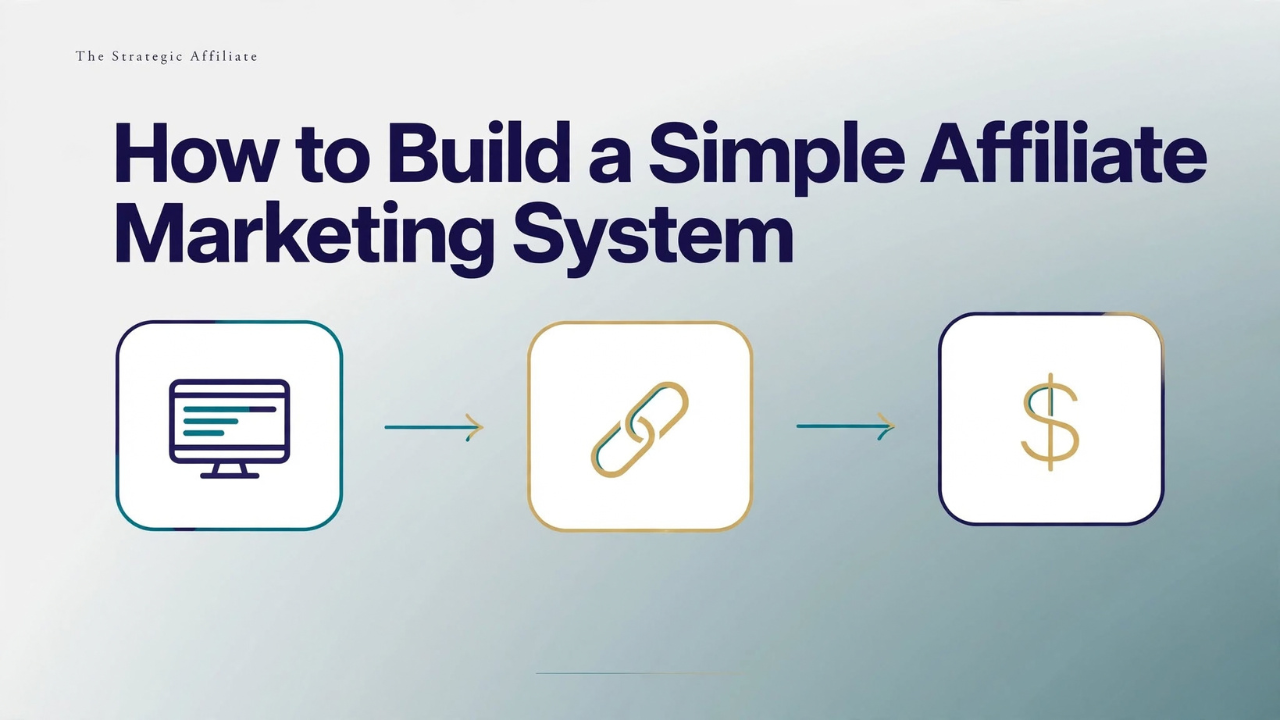
How to Build a Simple Affiliate Marketing System You Can Actually Stick To
You sit down to work on your affiliate business and spend the first half-hour deciding what to do.
Should you write a new post? Update an old one? Check your affiliate dashboard? Send an email? Research another product?
If that sounds familiar, you are not doing anything wrong. You have several jobs to manage, and they all seem important. Without a simple routine, though, the urgent or interesting task tends to win over the one that would make the biggest difference.
Here’s the truth: an affiliate marketing system does not need to be complicated. It is a repeatable way to choose what to work on, do the work, and check whether it helped. You can build one around the time you actually have, even if that is only a few hours a week.
Let’s put together a system you can use without buying more software or turning your week into a spreadsheet.
What Your System Needs to Do
When people hear “system”, they often picture automations running between a dozen tools. That can be useful later, but it is not where affiliate beginners need to start.
A simple affiliate marketing system should help you do five things:
- Find worthwhile questions your audience is asking.
- Publish content that answers those questions.
- Give readers a relevant next step.
- Keep your content and recommendations up to date.
- Review results so you know what to improve.
That is the whole job. Your system is the routine that keeps those five things moving.
Picture a UK creator building a site about starting a small home business. They might publish a guide to choosing an email marketing platform, offer a free checklist, and recommend a suitable tool through an affiliate link. A few weeks later, they check whether the guide is getting visitors, whether anyone downloads the checklist, and whether readers click through to the tool.
If the page gets no visitors, they work on its visibility. If it gets visitors but no clicks, they look at the content and recommendation. That is a system in action. It does not depend on a complicated dashboard; it depends on knowing what happens next.
A system is not a promise of income
It is worth being clear about this early. A routine cannot guarantee sales. You still need useful content, relevant offers, an audience, and time to learn what works.
What a routine can do is stop you from starting again every Monday. It gives you a way to keep making sensible decisions instead of relying on bursts of motivation.
“Predictable affiliate income” is a goal many people have. In practice, income can vary from month to month. The useful first step is to make your work more consistent: what you publish, what you maintain, and how you learn from the results.
Build Your System Around One Clear Path
Most beginners don’t realise how much harder the work becomes when they try to build several businesses at once.
They start a blog, open three social accounts, join ten affiliate programmes, set up an email platform, and plan a YouTube channel. Before any one of those channels has a clear purpose, they are struggling to keep up with all of them.
Start with one path a reader can follow.
For example:
Search question → helpful article → relevant next step → affiliate recommendation
The next step could be another guide, a product comparison, or an email checklist. You do not need every part in place on day one. You need to know who the content is for and what would genuinely help that person after they have read it.
Take a beginner who searches for help choosing WordPress hosting for a first affiliate site. They may need:
- A plain-English explanation of what hosting does.
- A shortlist that suits a modest budget.
- Help understanding renewal prices and useful features.
- A recommendation that explains both strengths and limitations.
- A clear link to check the current offer if they decide to buy.
That reader does not need to be pushed through an elaborate funnel. They need enough information to make a sensible choice.
Pick one audience and a manageable topic area
Write a short description of the person you want to help. Keep it specific enough to guide your decisions, but do not spend days inventing a detailed customer profile.
For example:
I help UK beginners build their first affiliate website alongside a job or other commitments.
That sentence gives you a useful test. Would a planned article help that reader? Is the recommended product suitable for their budget and experience? Have you explained anything a newcomer might not know?
Next, choose a small set of connected topics. For The Strategic Affiliate, these might include getting started, building systems, and understanding traffic and funnels. Each topic can contain several focused articles, with a pillar page helping readers find their way around.
Do not choose topics simply because an SEO tool shows a number beside them. Ask whether you can give readers a useful answer and whether the subject fits the site you are building.
Give every article one main job
A post is easier to plan and maintain when you know what it is meant to do.
Before writing, complete this sentence:
This article helps a beginner .
You might write:
This article helps a beginner set up a simple weekly affiliate marketing routine.
Or:
This article helps a beginner compare two email platforms without paying for features they do not need.
Then decide what the reader could do next. Sometimes that will be an affiliate click. Sometimes it will be another article or a free resource. If there is no suitable product to recommend, do not force one into the page.
That restraint helps readers trust you. It also keeps your content useful when an affiliate programme changes or an offer disappears.
Make the Work Repeatable
Once you have a clear reader and content path, build a small workflow around them. You are not trying to remove judgement from your work. You are trying to remove avoidable decisions.
Keep one place for content ideas
Choose a place you will actually open: a Google Sheet, a document, a notebook, or a board you already use. One reliable list is better than ideas scattered across browser bookmarks, phone notes, and emails.
For each idea, record only what you need to decide whether it is worth writing:
| Working title | Reader question | Purpose | Next step | Status |
|---|---|---|---|---|
| How to choose hosting for a first affiliate site | What do I need to pay for? | Help a beginner compare options | Hosting comparison guide | Idea |
| What to do each week on a new affiliate site | How should I use limited time? | Give the reader a routine | Systems pillar page | Drafting |
| How to write a useful product review | What belongs in a review? | Improve review quality | Review template | Published |
Your idea list is not a commitment to publish everything. It is a place to choose from when you are ready to plan the next piece.
If you already have ten Traffic and Funnels posts, you have a useful starting point. Look at the questions those posts raise but do not answer in detail. Some may suit your Systems pillar: how to plan a week, manage links, check old articles, or organise product research. Give each new post its own job rather than rewriting the same advice under a different headline.
Use a short brief before drafting
A content brief need not be a formal document. Five prompts are enough:
- Who is this for?
- What question are they trying to answer?
- What should they understand or be able to do by the end?
- What examples would make the answer clearer?
- Where should they go next, if anywhere?
This takes a little time at the start and saves far more time during the draft. It also helps you avoid a common problem: writing a long article that circles the topic without answering the reader’s question.
If you use AI to help outline or edit, keep your own judgement in charge. Check product claims, remove generic wording, and add examples that reflect what you know about the reader. A quick draft is only useful if the finished article earns its place on your site.
Create a publishing checklist
Publishing involves more than writing the last paragraph. A short checklist prevents small jobs from being forgotten:
- Check that the introduction answers the reader’s question.
- Read the article aloud, or at least read it once away from the draft screen.
- Check product names, prices, features, and claims.
- Add relevant internal links.
- Check affiliate links and disclosures.
- Write the page title and meta description.
- Preview the post on mobile.
- Record the publication date and where the article sits in your content plan.
You can adapt this list to your website. The point is to stop relying on memory for tasks you repeat every time.
Keep offers and links organised
As your site grows, an affiliate link can appear in several posts, emails, and resources. If the product changes its plans or you stop recommending it, you need to know where to look.
Keep a basic offer register with the product name, the audience it suits, your affiliate programme, the pages where you recommend it, and the last date you checked the offer. Include any important limitations you want to remember when updating content.
This does not need to be a large database. A spreadsheet will do.
It is especially useful for UK creators writing about software or services priced in another currency. If you mention a price, check what the reader will actually see and avoid making an old figure sound permanent. Clear, careful wording is usually better than a highly specific price you cannot keep current.
Put maintenance in the calendar
New posts are appealing because you can see the result of your work. Maintenance is less exciting, so it gets postponed.
Set aside regular time to check your most useful pages. Look for broken links, dated screenshots, changed product features, unclear recommendations, and places where a reader could benefit from a link to a newer guide.
You do not need to review every page every week. Start with the pages that receive visitors, recommend products, or act as entry points to your site. Keep a note of what you checked and when.
A system that only produces new content eventually leaves you with a growing list of pages you no longer feel confident sharing. Maintenance is part of publishing, not a separate job to tackle someday.
Choose a Routine You Can Keep
The best weekly routine is not the busiest one. It is the one that still works when client work runs late, family plans change, or you simply have less energy than expected.
Start with the time you can usually protect, not the time you hope to have in an ideal week.
If you have around four hours, your week might look like this:
| Time | Task | Outcome |
|---|---|---|
| 20 minutes | Review your task list and basic results | Choose one priority |
| 45 minutes | Research and outline | Prepare the next article |
| 2 hours | Draft or improve content | Make visible progress on one page |
| 35 minutes | Edit, link, publish, or maintain | Finish the work properly |
| 20 minutes | Note what happened and the next step | Make next week easier |
Treat this as an example, not a target. If you have two hours, reduce the amount of work. You might spend one week outlining and the next drafting. Publishing one genuinely useful article at a pace you can sustain is better than setting a schedule you abandon after a month.
Use a weekly decision rule
When everything feels important, choose the task that removes the clearest obstacle.
Ask yourself:
- Do I have a useful page ready to finish? Finish it.
- Is an important published page out of date? Fix it.
- Are readers reaching a page but struggling to find the next step? Improve it.
- Am I short of relevant content ideas? Research real beginner questions.
- Am I spending time on a task without knowing why? Pause and check its purpose.
This is more helpful than automatically deciding that every week must contain a new blog post. Sometimes your best work is updating a strong article or making the route between two existing guides clearer.
Review results without living in your dashboards
An affiliate income system needs feedback. Otherwise, you are repeating tasks without learning from them.
Once a week, take a brief look at what you published, what you updated, and whether anything needs attention. Once a month, look more closely at which pages attracted readers, which resources people used, which affiliate links drew interest, and what you earned.
Do not turn this into a daily judgement of your business. Small sites can have uneven results. A quiet few days may tell you very little.
Use your review to answer one practical question: What should I do next?
If a guide attracts relevant readers but has an unclear next step, improve that page. If a product recommendation gets clicks but no confirmed sales, check that the offer still fits the reader and that your information is current. If a post has barely been seen, you may need more related content and clearer links from elsewhere on your site.
Your Traffic and Funnels articles can help you investigate those stages in more detail. Your Systems routine is what makes sure you take the time to investigate them at all.
Allow for a minimum week
A routine becomes much easier to stick to when you decide in advance what a difficult week looks like.
Your minimum week might be:
- Check that your site and important links are working.
- Spend 30 minutes moving one article forward.
- Write down the next action before you stop.
That may not sound ambitious, but it protects momentum. You are not asking yourself to catch up on an imaginary perfect schedule. You are keeping the work alive until you have more time.
When a week goes badly, return to the routine. Do not create a punishing backlog to make up for it.
Avoid the Traps, Then Start Small
A simple system works best when you protect it from unnecessary complexity. These are the mistakes I see affiliate beginners make most often.
1. Building a workflow before choosing a direction
It is tempting to design dashboards, templates, and automations because they feel productive. But they cannot tell you who you help or what you should publish.
Avoid it: Write down your audience, your main topic area, and the purpose of your next three articles before you organise the tools.
2. Treating every idea as a priority
A long idea list can become its own source of pressure. You begin several drafts and finish none of them.
Avoid it: Keep an idea bank, but choose one primary piece of work for the week. Finish or deliberately pause it before starting another.
3. Publishing without a maintenance plan
An old comparison can keep attracting readers after its prices or features have changed. That is not helpful to them, and it leaves you with more work later.
Avoid it: Record where you recommend products and set time aside to review important pages. When you update one, note the date and what changed.
4. Choosing tools instead of fixing the process
A new app will not solve an unclear content plan. It may give you another place to check.
Avoid it: Run the process manually first. If a repeated task is taking too much time, then consider whether a tool would genuinely make it easier.
5. Making the schedule too demanding
A plan to write, publish, email, post on social media, and analyse results every day may look impressive. It is not useful if your available time cannot support it.
Avoid it: Plan around an ordinary week. Build in a minimum week, and increase your output only when your current routine feels comfortable.
Your first hour
You can put a basic version of this system together today.
- Write one sentence describing the beginner you help.
- Pick one topic you want your site to cover well.
- List three questions that person might ask about it.
- Choose one question for your next article.
- Write the article’s main job and its most helpful next step.
- Put a realistic work session in your calendar.
- Create one place to track the idea, its status, and any products or links it uses.
You do not need to complete an article in that hour. You need to make the next work session obvious.
Key takeaways
A system you can stick to is a small set of decisions you make once and use again:
- Know which reader you are helping.
- Give each article a clear purpose.
- Keep ideas, offers, and publishing tasks in places you can find them.
- Set a weekly routine based on your real availability.
- Maintain useful content instead of only adding new posts.
- Review results to choose your next improvement, not to judge every day.
Those habits give you a steadier foundation for an affiliate business. They also leave you room to change direction when your readers show you what they need.
If you want to build on this routine, explore the Systems Pillar Page on The Strategic Affiliate for guides on planning, workflows, and keeping your content organised. If you are still putting the basics in place, the How to Start Affiliate Marketing pillar page is a good place to begin.
Start with one reader, one useful article, and one repeatable week. You can make the system more capable when the work calls for it.