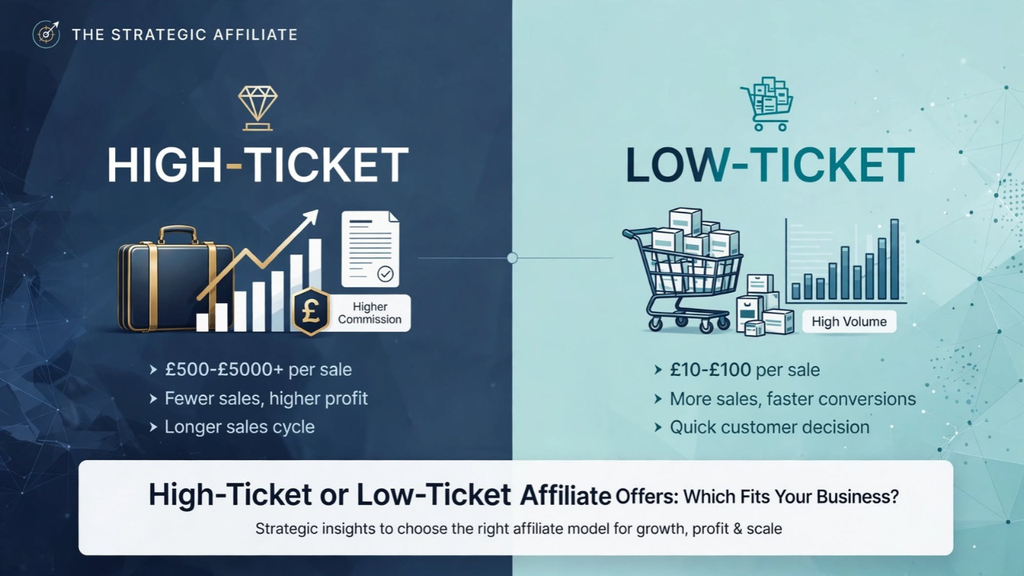
High-Ticket or Low-Ticket Affiliate Offers: Which Fits Your Business?
A £300 commission looks more attractive than a £3 commission. That part is easy.
What is harder to judge is how much work each sale needs, whether your audience wants the product, and how many commissions will actually be approved and paid.
If you are starting out, the advice can feel contradictory. One person tells you to promote expensive products because you need fewer sales. Someone else recommends cheaper products because they are easier for beginners to explain.
Neither approach gives you the whole picture.
The useful question is not simply, “Which pays more?” It is, “Which offer fits my audience, my content and the business I can realistically build?”
This guide compares high-ticket vs low-ticket affiliate offers using clearly labelled worked examples. You will see how the numbers change, what those numbers leave out, and how to choose a sensible starting point without treating hypothetical commissions as an earnings forecast.
What Are High-Ticket and Low-Ticket Affiliate Offers?
For this comparison, low-ticket offers are relatively inexpensive purchases, while high-ticket offers involve a larger financial commitment.
There is no fixed price boundary being used here. A £200 purchase might be a major decision for someone buying hobby equipment, but a modest expense for an established business choosing software.
Examples of lower-priced purchases might include:
- A beginner’s gardening book.
- A baking accessory.
- A downloadable planning template.
- A basic piece of home-office equipment.
Higher-priced purchases might include:
- A specialist training programme.
- A premium software subscription paid annually.
- An expensive camera or machine.
- A substantial business service package.
However, product price and affiliate commission are different things.
A £1,000 product paying 3% produces a £30 commission. A £200 product paying 30% produces a £60 commission, assuming the full stated price is commissionable.
The cheaper product pays the affiliate more in that example.
Before comparing offers, separate three figures:
- What the customer pays.
- What the programme treats as commissionable revenue.
- What you receive for an eligible, approved sale.
Real programme rules matter. For example, Amazon Associates UK publishes category-specific commission rates rather than one rate for every product. Its schedule also refers to qualifying revenue, so multiplying a shop’s headline price by a percentage is not always a reliable way to calculate your payment.
Start With the Buyer’s Problem, Not the Commission
Here’s the truth: a generous commission does not make an unsuitable recommendation useful.
Imagine you run a UK gardening website aimed at people growing vegetables in small rented gardens.
A practical guide to container growing might fit naturally. An expensive commercial greenhouse system probably would not, even if the commission were substantial.
Now imagine your readers operate market gardens. The more expensive equipment could become relevant because the audience, budget and purpose have changed.
The product did not become better. The fit became better.
Before choosing an offer, ask:
- What is the reader trying to achieve?
- What have they already tried?
- What can they reasonably afford?
- What information do they need before buying?
- Can I explain who should not buy this product?
That last question is particularly useful. If you cannot describe the wrong buyer, your recommendation may be too broad.
For affiliate beginners, choosing a clearly defined problem is a more useful starting point than collecting programmes with attractive commission headlines.
Worked Example 1: Comparing Offers With the Same Number of Affiliate Clicks
Let’s break this down using two fictional offers.
These are teaching assumptions, not market averages, programme recommendations or predictions. The commission amounts are assumed to be fixed payments per qualifying sale.
We will compare 1,000 outbound affiliate clicks for each offer. These are clicks through to the merchant, not visits to your website.
| Measure | Lower-ticket offer | Higher-ticket offer |
|---|---|---|
| Customer price | £40 | £1,000 |
| Assumed commission per qualifying sale | £4 | £200 |
| Outbound affiliate clicks | 1,000 | 1,000 |
| Assumed click-to-sale conversion rate | 5% | 0.2% |
| Resulting tracked sales | 50 | 2 |
| Commission before reversals and costs | £200 | £400 |
The calculations are:
- Lower-ticket: 1,000 clicks × 5% × £4 = £200.
- Higher-ticket: 1,000 clicks × 0.2% × £200 = £400.
Under these assumptions, the higher-ticket offer produces more commission despite generating far fewer sales.
But that conclusion belongs to this example. It does not prove that higher-ticket offers perform better generally.
Change the higher-ticket conversion rate to 0.1%, and the model produces one sale worth £200. Both offers now generate the same commission.
What this example tells you
The commission per sale is only one part of the calculation.
You also need to know how effectively relevant clicks become qualifying purchases. Without that information, “you only need a few sales” is incomplete advice.
There is another limitation: obtaining 1,000 suitable clicks for each offer might require very different content, effort and spending.
Equal click numbers do not mean equal work.
Worked Example 2: Following Readers From Content to Commission
The previous example began with affiliate clicks. Your business starts earlier, with people finding and reading your content.
For this second fictional example, we will compare two groups of pages receiving 2,000 visits each during a defined reporting period.
Assume the resulting sales have had enough time to be recorded and approved.
| Measure | Lower-ticket content | Higher-ticket content |
|---|---|---|
| Content visits | 2,000 | 2,000 |
| Assumed outbound click-through rate | 25% | 10% |
| Affiliate clicks | 500 | 200 |
| Assumed merchant conversion rate | 4% | 0.5% |
| Qualifying sales | 20 | 1 |
| Assumed commission per sale | £5 | £150 |
| Commission before costs | £100 | £150 |
The higher-ticket route produces £50 more commission in this scenario.
Now add illustrative production costs:
- Lower-ticket content: £30 in direct expenses and six hours of work.
- Higher-ticket content: £120 in direct expenses and 18 hours of work.
After those direct expenses, the figures become:
- Lower-ticket route: £70.
- Higher-ticket route: £30.
Neither figure includes tax, general business overheads or a wage for your time.
This is why commission totals alone do not tell you which approach fits your business.
Compare the work as well as the payment
A specialist software review might require a paid subscription, several test projects, screenshots and ongoing updates.
A lower-priced product comparison could also require substantial testing. Cheap products do not automatically mean cheap content.
Record the actual work involved rather than assuming one category will be easier.
Also remember that content can remain useful beyond its first reporting period. Comparing initial production costs against one period’s commission is a starting point, not a complete lifetime profitability assessment.
Worked Example 3: What Happens When a Commission Is Reversed?
A large tracked commission can make a dashboard look encouraging. It is still worth checking whether that commission is pending, approved or payable.
For this fictional example, assume:
- A lower-ticket offer generates 20 tracked sales at £5 each.
- A higher-ticket offer generates one tracked sale at £100.
- Both initially show £100 in commission.
Now suppose two lower-ticket orders are cancelled, while the single higher-ticket order is refunded.
| Measure | Lower-ticket offer | Higher-ticket offer |
|---|---|---|
| Initial tracked commission | £100 | £100 |
| Reversed commission | £10 | £100 |
| Remaining commission | £90 | £0 |
This does not mean expensive products have higher refund rates. We have assumed particular outcomes to show the effect of relying on fewer transactions.
When one sale accounts for most of a reporting period’s commission, losing that sale has a larger impact.
The reverse is also true: one additional approved sale can change the figures sharply.
That makes a small sample difficult to interpret. One strong month does not establish dependable performance, and one quiet month does not necessarily prove the offer is unsuitable.
For your own records, keep pending commission separate from approved commission and cash received.
Compare the Main Trade-Offs
The worked examples show the arithmetic. The next step is deciding what each approach asks of you.
Buyer commitment
A lower price reduces the amount the customer must spend, but it does not guarantee an easy decision.
Someone buying a £25 replacement part may need precise compatibility information. Someone buying a £1,500 business tool may already have a budget and a clear requirement.
Think about the buyer’s uncertainty, not just the price.
Ask what could stop a suitable customer from proceeding:
- Unclear compatibility.
- Doubts about quality.
- Uncertainty about ongoing costs.
- Difficulty understanding the product.
- Concern about support or cancellation terms.
Your content should resolve those questions honestly.
Content and expertise
Choose products you can assess properly.
For a cooking website, that might mean showing how an inexpensive tool performs in an ordinary kitchen. For a business software website, it might mean demonstrating a complete task rather than repeating the merchant’s feature list.
If a product requires specialist knowledge you do not have, a large commission does not fix that gap.
You can research, learn and test. What you should not do is imply first-hand experience you have not gained.
Traffic requirements
A small commission leaves less room to cover costs per sale. A large commission gives you more room mathematically, but only if suitable buyers convert and the commission is approved.
Neither category removes the need for relevant traffic.
For UK creators with limited publishing time, a useful planning question is:
Can I consistently create the content this buyer needs before making a decision?
That is more practical than choosing an offer because someone else says it needs “less traffic”.
Payment timing
Compare when money becomes payable, not simply when a sale appears.
For each programme, check the written terms for:
- Validation periods.
- Payment schedules.
- Minimum payout thresholds.
- Refunds and commission reversals.
- Currency and payment fees.
- Any conditions affecting eligibility.
A programme that looks attractive on paper may be awkward for your cash flow. Treat payment timing as part of the offer comparison, not an administrative detail to investigate later.
Do Recurring Commissions Change the Decision?
They can, but recurring does not mean guaranteed.
Consider a fictional software programme paying £12 for each qualifying month that a referred customer remains subscribed.
If five customers all remain eligible for six paid months:
5 customers × £12 × 6 months = £360.
Now assume three customers stay for six months and two leave after two months:
- Three customers: 3 × £12 × 6 = £216.
- Two customers: 2 × £12 × 2 = £48.
- Total commission: £264.
Both calculations follow the same commission arrangement. Customer retention changes the result.
Before comparing recurring commission with a one-off payment, establish:
- How long commissions can continue.
- Which plans qualify.
- What happens after cancellation or a refund.
- Whether upgrades and renewals qualify.
- What conditions can end your eligibility.
Avoid turning “£12 per month” into an assumed annual payment without evidence.
Recurring offers can belong in an affiliate income system, but the useful figure is the commission actually retained over time, not an optimistic lifetime estimate.
How Traffic and Funnels Affect the Choice
An offer does not sit separately from the content that introduces it.
Traffic and funnels should connect a reader’s question with a useful next step. A funnel is simply that sequence; it does not have to involve complicated software or a long email campaign.
Consider two illustrative paths.
A lower-ticket path for a baking website
A reader searches for help choosing a cake tin for a small oven.
They find a guide covering:
- How to measure the available space.
- Which dimensions matter.
- Differences between suitable tin materials.
- A comparison of relevant products.
- Clearly labelled links to retailers.
The purchase recommendation answers the original question.
A higher-ticket path for a freelance business website
A reader wants to replace several disconnected business tools.
They might need:
- A guide to identifying their requirements.
- A comparison of suitable platforms.
- A walkthrough of the main workflow.
- An explanation of costs and limitations.
- A trial or demonstration, where available.
The second path contains more stages because this hypothetical buyer has more questions. That does not mean every expensive offer needs a long funnel.
The aim is to provide enough information for a sensible decision, not to add steps until the reader buys.
You can see how this connects with repeatable publishing, tracking and review routines on The Strategic Affiliate Systems Page
Which Approach Fits Your Business?
Rather than looking for a universal winner, compare the offer with your current resources.
Consider lower-ticket offers when…
- Your audience has a specific, modestly priced problem.
- You can assess the products without stretching your budget.
- Your content naturally answers practical shopping questions.
- You want to practise creating useful comparisons and tracking clicks.
- The commission leaves a workable margin after your likely costs.
Do not choose lower-ticket offers merely because they sound beginner-friendly. Check whether the numbers and workload make sense.
Consider higher-ticket offers when…
- Your audience has a genuine need for the product.
- You understand the decision well enough to explain it accurately.
- You can investigate limitations, alternatives and ongoing costs.
- Your content reaches people with a relevant budget and purpose.
- You can tolerate uneven results without depending on one pending commission.
A small specialist audience may be worth investigating. However, being small and specialist does not itself prove that people will buy.
Consider a mixed approach when…
Different offers serve different needs within the same audience.
A photography website might cover inexpensive accessories, mid-priced editing software and premium cameras. The connection is the reader’s photography needs, not a plan to push everyone towards the most expensive purchase.
A mixed approach becomes confusing when the offers stop belonging together.
A budget gardening blog does not need an unrelated high-commission business course.
A Practical Offer-Comparison Process You Can Start Today
You do not need a complicated scoring system. A spreadsheet and a clear reader profile are enough to begin.
Step 1: Define one reader and one problem
Write a sentence such as:
“I help UK freelancers choose straightforward tools for managing client projects.”
This gives you a reference point when an attractive but irrelevant programme appears.
Step 2: Shortlist three relevant offers
Choose a manageable number to investigate.
They do not need to include every price category. Include only products that could reasonably solve the problem you identified.
Step 3: Record the commercial terms
Create columns for:
- Customer price and ongoing costs.
- Commission amount or rate.
- Commissionable revenue rules.
- Attribution window and tracking conditions.
- Validation and payment terms.
- Refund and reversal conditions.
- Permitted promotional methods.
- Your testing and production costs.
Record the date you checked the terms so you know when they may need reviewing.
Step 4: Assess the product separately from the programme
Ask two different questions:
- Would this product help the right reader?
- Does the affiliate arrangement make commercial sense?
A good product can have an unsuitable programme. An attractive programme can promote a product you would not recommend.
You need both sides to work.
Step 5: Build cautious scenarios
Use the structure from the worked examples:
Content visits → affiliate clicks → qualifying sales → retained commission → costs.
Create a weaker, middle and stronger scenario. Label every untested figure as an assumption.
If the offer only looks workable under your most optimistic assumptions, investigate further before investing heavily.
Step 6: Publish one useful content path
Start with a clear question, a relevant comparison or review, and an appropriate next step.
You do not need ten overlapping reviews before you have learned whether the first one helps readers.
Step 7: Review evidence before expanding
Track visits, outbound clicks, tracked sales, reversals and approved commission separately.
If people read but do not click, examine the match between the question and the recommendation.
If people click but do not buy, investigate price, merchant information, tracking and buyer suitability rather than automatically adding more traffic.
These are possible explanations to examine, not diagnoses you can make from one number alone.
Five Beginner Mistakes to Avoid
1. Choosing the biggest commission first
The payment attracts your attention, so you build content around a product your audience does not need.
Avoid it by writing down the reader’s problem before comparing programmes. Reject offers that do not fit, regardless of commission.
2. Treating a worked example as an income forecast
A spreadsheet shows £500, so that figure becomes an expectation.
Avoid it by marking assumptions clearly and replacing them with your own observed data when available. A calculation explains what would happen under stated conditions; it does not establish how likely those conditions are.
3. Ignoring your time and expenses
A campaign generates commission, but testing subscriptions, equipment and production costs go unrecorded.
Avoid it by keeping a simple cost and time log. Separate commission revenue from the amount left after expenses.
4. Recommending products you cannot assess honestly
You publish confident claims based only on the merchant’s sales page.
Avoid it by explaining what you tested, what you researched and what remains uncertain. Use evidence you can support, and include meaningful drawbacks.
5. Hiding the commercial relationship
You place affiliate links in content but leave readers to work out that you may be paid.
UK ASA guidance says affiliate advertising must be identifiable. Depending on the content, the whole piece or the relevant affiliate section may need clear labelling. Its guidance recommends prominent, upfront identification and warns that labels such as “aff” are not sufficient on their own.asa.org+1
Avoid treating a buried disclosure page as a substitute for clearly identifying the advertising readers are about to view.
What About Predictable Affiliate Income?
It is understandable to want predictable affiliate income. Planning a business is easier when you have some confidence about what may happen next.
But predictable should not be used as another word for guaranteed.
A more useful goal is to understand your business well enough to explain its performance:
- Which content attracts relevant readers?
- Which recommendations receive clicks?
- Which offers generate approved commissions?
- What does that content cost to create and maintain?
- How dependent are results on one merchant or a handful of sales?
As those records develop, you can make better-informed decisions. You still need to allow for uncertainty.
The affiliate income system worth building is a repeatable process for research, publishing, promotion and review—not a spreadsheet that assumes every month will improve.
Key Takeaways
When comparing high-ticket vs low-ticket affiliate offers, keep these points in mind:
- A higher product price does not automatically mean a higher affiliate payment.
- Commission per sale matters alongside conversion, approval, costs and workload.
- Fewer large commissions can make individual refunds more significant.
- Recurring payments need retention and eligibility assumptions.
- Audience fit should come before commission size.
- Worked examples help you understand trade-offs; they are not earnings promises.
Choose the offer you can explain honestly, support with useful content and assess commercially. That is a stronger starting point than choosing a price category and hoping the audience follows.
Put Your Comparison Into a Manageable Plan
If you are still building the foundations, work through How to Start Affiliate Marketing to put offer selection alongside your niche, content and wider business setup.
If you already have content or traffic, The Strategic Affiliate Systems Page brings together practical guidance on publishing, tracking, follow-up and improving your funnels.
And when you are ready to turn your shortlist into publishing tasks, The Affiliate Content Planning Workbook helps you organise article ideas, updates and priorities into a manageable four-week plan.
Start with one reader problem, compare a few suitable offers, and give your first piece of content a clear job. You do not need to settle your entire business model before taking that step.