SEO vs Social Media for Affiliate Traffic: Where Should Beginners Start?
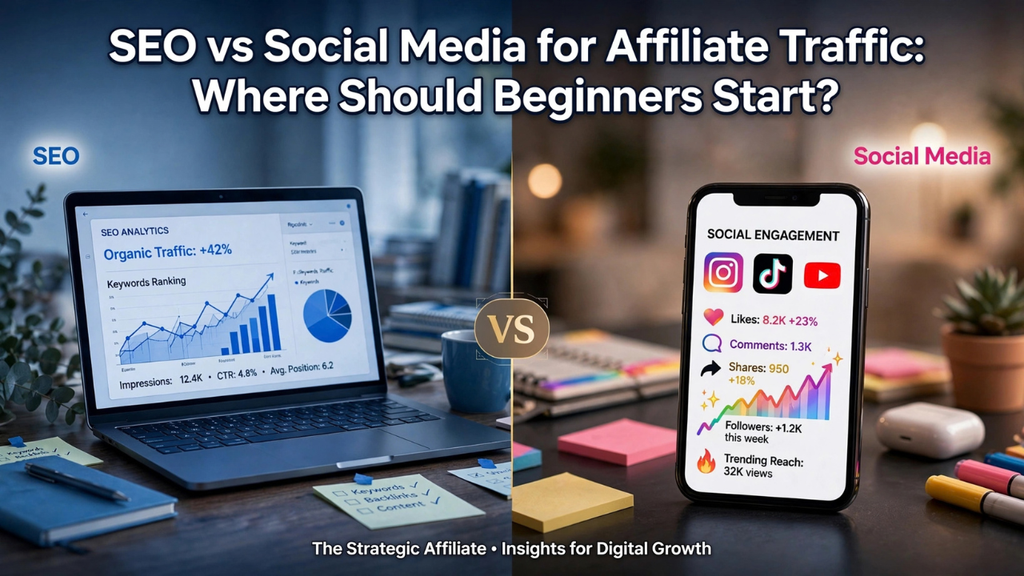
If you are new to affiliate marketing, start with one main traffic source, not five. For most affiliate beginners, social media is usually the fastest place to get feedback and early clicks, while SEO is the better long-term route to predictable affiliate income. The sensible approach is to use social media to learn what people respond to, then turn the best ideas into useful website content that can keep attracting visitors long after the post disappears.
You do not need to choose SEO or social media forever. You need to know what each one is good at, where its weaknesses are, and which should get most of your attention at your current stage.
Key takeaways
- Social media can help UK creators get visible quickly, test content ideas and start conversations.
- SEO takes longer, but useful articles can bring targeted traffic for months or years.
- If you have no audience and no website content, use social media for quick feedback while building a small SEO foundation.
- If you already have a website, focus on SEO first and use social media to distribute the content you publish.
- Avoid trying to be everywhere. Pick one platform, one audience and one clear topic.
- Build an affiliate income system around owned assets: a website, an email list and helpful content.
The question every beginner asks
Most people starting affiliate marketing want the same thing: traffic.
They have joined an affiliate programme, found a product they think people might buy, created a few links, and then hit the obvious problem: nobody knows the links exist.
At that point, beginners usually hear two conflicting pieces of advice.
One person says:
“Post on TikTok, Instagram, Facebook or YouTube every day. Social media is the fastest way to grow.”
Another says:
“Build a website. Write blog posts. Rank on Google. SEO is the only sustainable traffic source.”
Both are partly right.
The trouble is that neither answer explains the practical difference between the two. It also fails to account for the reality of being a beginner with limited time, limited confidence and probably no budget for ads.
Here is the truth: social media and SEO solve different traffic problems.
Social media helps you get noticed now. SEO helps you get found later.
Social content is useful for testing ideas, building familiarity and learning what questions people ask. SEO helps you create a library of answers that can attract visitors while you are working, sleeping or doing something else entirely.
The best choice depends on what you have available today:
- Your time.
- Your confidence on camera or in writing.
- Whether you already have a website.
- Whether you have an audience.
- The type of product you promote.
- How quickly you need feedback.
- Whether you want to build a long-term business asset.
Let’s break this down without pretending there is one magic answer for everyone.
What affiliate traffic actually means
Affiliate traffic is simply the flow of people who arrive at your content and may eventually click an affiliate link, join a mailing list, request more information or make a purchase.
But not all traffic is equal.
A viral post can send thousands of people to a link and produce very little income if the audience is not interested in the product. A small, focused article answering a buying question can bring fewer visitors but generate regular commissions because the people arriving are already looking for a solution.
For affiliate beginners, the goal is not “more traffic” in the abstract.
The goal is relevant traffic from people who have a real problem your content can help solve.
For example:
- Someone watching a short Instagram Reel about “three mistakes new Etsy sellers make” may be interested in a beginner Etsy course.
- Someone searching Google for “best bookkeeping software for UK sole traders” may be close to choosing a tool.
- Someone in a Facebook group asking how to start a newsletter may benefit from a beginner email-marketing guide.
- Someone reading a YouTube comment about poor sleep may be curious about a mattress review, but they may need more research before buying.
Each person is at a different stage. Your job is to create content that meets them where they are and guides them towards the next sensible step.
That might be:
- Reading a helpful guide.
- Joining your email list for a checklist.
- Watching a product tutorial.
- Comparing two options.
- Reading a transparent review.
- Clicking through to a product you genuinely recommend.
This is why traffic and funnels belong together. Traffic gets attention. A simple funnel gives that attention somewhere useful to go.
SEO: the long-term traffic asset
SEO, or search engine optimisation, is the process of helping your website appear in search results when people look for relevant information, products or services.
For affiliate marketing, SEO often means creating helpful articles around questions, problems, comparisons and buying decisions.
Examples include:
- “How to start affiliate marketing in the UK”
- “Best email marketing platform for beginners”
- “ConvertKit vs MailerLite for small creators”
- “How to build a simple affiliate marketing website”
- “Best tools for new Etsy sellers”
- “Do I need a website for affiliate marketing?”
- “How to create an affiliate email funnel”
These are not random article ideas. They reflect what real people search for when they are trying to understand a problem or make a decision.
Google’s guidance is clear that its systems are designed to prioritise helpful, reliable content made for people, rather than content made mainly to manipulate rankings. Google also provides an SEO Starter Guide covering crawlability, indexing, site structure and other fundamentals.
That is good news for beginners. You do not need to outspend a huge company to be useful.
You do need to be more specific.
A broad article called “The Best Affiliate Marketing Tips” may struggle because it tries to cover everything. A more focused article called “How to Choose Your First Affiliate Programme in the UK” has a clearer audience, clearer problem and clearer purpose.
Why SEO works well for affiliate marketing
SEO has several advantages for people building a long-term affiliate income system.
- Your content can keep attracting visitors after you publish it.
- Search visitors often arrive with a clear question or buying intention.
- You own your website and can update, improve and repurpose the content.
- Articles can lead naturally into affiliate reviews, comparisons, email sign-ups and tutorials.
- A well-structured site can build authority over time within a focused topic.
- You can measure clicks, impressions, queries and pages using Google Search Console.
- You are not entirely dependent on a social platform deciding whether to show your next post.
Google Search Console provides reports to measure Search traffic and performance, find issues and improve how your website appears in Google results.
That last point matters.
A social account can grow quickly, but you are still renting space on another company’s platform. Your reach may fall, your account may be restricted, a feature may change or your audience may simply move on.
A website is not immune to change, of course. Google updates its systems, competitors improve their pages and search behaviour evolves. But when you build useful content on your own domain, you are creating an asset you control.
The downside of SEO
SEO is not instant.
A brand-new site may take time to be crawled, indexed and trusted. An article might get a handful of impressions before it gets regular clicks. Competitive product terms can take months of consistent work before you see meaningful movement.
This is where many affiliate beginners give up too early.
They write three articles, check rankings after two weeks, see little happening, and conclude that SEO does not work.
Usually, the issue is not that SEO does not work. It is that the site does not yet have enough useful content, topical focus, internal links, credibility or time.
Think of SEO as planting an orchard, not buying a lottery ticket.
The early work can feel quiet. But each good article gives your website another chance to be found, linked to, shared and trusted.
Social media: the faster feedback channel
Social media can be useful because it gives you a quicker route to people.
You can publish a post today and know within hours whether anyone found the topic useful, relatable or worth discussing. That immediate feedback is valuable when you are still trying to understand your audience.
For UK creators and affiliate beginners, the most practical platforms will depend on where your audience already spends time.
You might choose:
- Facebook for groups, local communities, practical discussion and audiences who prefer longer posts.
- Instagram for visual demonstrations, short-form tips, Stories and Reels.
- TikTok for short, direct videos and rapid idea testing.
- YouTube for tutorials, reviews, demonstrations and search-friendly video content.
- LinkedIn for professional tools, B2B affiliate offers, career content and business education.
- Pinterest for evergreen visual ideas in niches such as home, crafts, food, travel, planning and design.
You do not need an account on all of them.
In fact, setting up on every platform is one of the quickest ways to exhaust yourself. You will spend your time resizing images, rewriting captions and checking notifications instead of learning what actually works.
Start with one platform where you can consistently create content in a format that suits you.
If you enjoy writing, Facebook, LinkedIn, Pinterest and text-based short posts may suit you better than daily video. If you are comfortable explaining things aloud, YouTube and short video can work well. If you can show a product, transformation or process visually, Instagram or TikTok may make more sense.
Why social media helps beginners
Social media gives you things SEO cannot give as quickly:
- Fast feedback on topics.
- Direct questions from real people.
- A chance to build familiarity and personality.
- A way to show how you think and teach.
- Opportunities to share useful content before you have significant Google traffic.
- A practical way to send people to a guide, lead magnet, video or email list.
- A way to test hooks, headlines and common objections.
For instance, imagine you are building an affiliate site around home-office tools for UK freelancers.
You could post a short LinkedIn or Instagram tip:
“Three things I would check before buying a desk chair for working from home: lumbar adjustment, seat depth and return terms.”
If people save it, comment with questions or ask for recommendations, you have learned something useful.
You can then turn the subject into a better article:
- “How to Choose an Ergonomic Office Chair for Home Working”
- “Best Budget Desk Chairs for UK Home Offices”
- “Ergonomic Chair Features Worth Paying For”
- “Standing Desk vs Ergonomic Chair: What Should You Buy First?”
Your social post becomes topic research. Your website becomes the place where the detailed answer lives.
That is a far better use of social media than dropping raw affiliate links into every post.
The downside of social media
Social media has a problem that is easy to ignore when you are excited by early reach: most posts have a short life.
A Reel, TikTok, Facebook post or LinkedIn update may get attention for hours or days. Occasionally it might travel further. But much of the content disappears quickly from view.
You are also dependent on platform rules and algorithms.
One month, your posts might reach 5,000 people. The next, they might reach 300. You can improve your content, but you do not fully control distribution.
There is also the pressure to keep producing.
If you stop posting, your traffic can stop almost immediately. That can make social media feel like a treadmill.
This does not make social media bad. It simply means you should use it with clear expectations.
Use it to build relationships, test ideas, share useful lessons and direct interested people towards places you own: your website and email list.
SEO vs social media: the practical comparison
| Factor | SEO | Social media |
|---|---|---|
| Speed of first feedback | Usually slower; often weeks or months | Often immediate; hours or days |
| Traffic lifespan | A useful article can attract traffic for months or years | Most posts have a short lifespan |
| Level of control | You own the website and content | You rent access to a platform and its audience |
| Best for | Search-led questions, product research, tutorials, comparisons and evergreen content | Awareness, conversation, personality, testing ideas and fast attention |
| Main effort | Research, writing, site structure, updating and technical basics | Consistent posting, creative formats, engagement and platform learning |
| Strongest visitor intent | Often high because the visitor searched for a specific answer | Varies widely; people may be browsing rather than buying |
| Measurement | Search Console, analytics, affiliate dashboards and conversion tracking | Platform insights, link clicks, views, saves, comments and direct messages |
| Risks | Slow progress, competition, technical issues and over-reliance on Google | Reach changes, account issues, algorithm shifts and content burnout |
| Long-term asset value | High when you build useful pages and an email list | Lower unless you move followers onto your own list or website |
| Best beginner use | Build a focused content library gradually | Learn audience language and validate content ideas quickly |
Most beginners do not realise that you can use the strengths of both without doubling your workload.
Create one useful idea. Share a short version on social media. Build the full version on your website. Link to it when appropriate. Collect an email address by offering an extra checklist, template or mini-guide.
That is a basic but effective traffic and funnels system.
So where should beginners start?
There are three common starting points. Pick the one that best matches your current position.
Start with SEO if you already have a website
If you already own a domain, have basic WordPress skills and prefer writing over being on camera, start with SEO.
Build a simple site around a clear topic. Do not begin with ten unrelated affiliate niches.
A focused site might cover:
- Email marketing for small UK creators.
- Home-office equipment for remote workers.
- Simple website tools for local businesses.
- Beginner gardening products.
- Budget travel tools for UK families.
- Digital courses and productivity tools for freelancers.
- Content-creation tools for small online businesses.
Then create a small set of pages:
- A clear homepage explaining who the site helps.
- An about page explaining your experience and approach.
- A contact page.
- A disclosure page.
- Three to five useful beginner guides.
- One or two honest product reviews or comparisons.
- A simple email sign-up offer.
Do not wait until the site looks perfect. Start publishing helpful material.
Start with social media if you have no website confidence
If the thought of building a website makes you freeze, social media can help you get moving.
Pick one platform and one subject. Post useful content that answers small questions. Do not make your first goal “go viral”. Make it “understand what my audience wants help with”.
For example, if you want to promote affiliate tools for aspiring online creators, you might post about:
- Common first-website mistakes.
- Simple ways to choose a niche.
- Beginner-friendly email-list ideas.
- Tools you use to plan content.
- The difference between clicks and commissions.
- How to avoid getting distracted by every new platform.
As people respond, take note of their wording. Their questions will become future articles, emails, videos and lead magnets.
But do not stay only on social media for too long. Build a basic website and email list as soon as you can. You want somewhere permanent to send people.
Start with both if you can commit to a modest system
For many beginners, this is the best middle ground:
- Publish one useful article every two weeks.
- Create three to five social posts from each article.
- Use each post to share one tip, mistake, question or example from the full guide.
- Link to the article when it adds genuine value.
- Offer a simple free checklist or resource related to the article.
- Email your list when you publish something useful.
This gives you short-term feedback from social media and long-term compounding value from SEO.
You do not need to create separate ideas for every platform. One solid article can become:
- A short video.
- A Facebook post.
- A LinkedIn post.
- An Instagram carousel.
- A Pinterest pin.
- A newsletter email.
- A simple checklist.
- A set of answers to common questions.
That is content repurposing with a purpose, not content for content’s sake.
A simple affiliate traffic system for beginners
A predictable affiliate income system does not need to be complicated.
Here is a beginner-friendly structure:
- Choose one audience and one problem area
For example: UK freelancers who need help choosing affordable business tools. - Create useful content around that problem
Publish guides, checklists, comparisons and tutorials that answer real questions. - Use social media to distribute the ideas
Share short lessons, examples, mistakes and personal observations from the content. - Send people to a helpful next step
This could be a full article, a video, a resource page or an email sign-up. - Build an email list
Offer something relevant, such as a beginner tool checklist, planning template or comparison worksheet. - Recommend suitable affiliate products honestly
Explain who the product is for, what it does well, where it falls short and what alternatives exist. - Measure what happens
Track content views, search impressions, link clicks, email sign-ups, affiliate clicks and commissions. - Improve the content that gets attention
Update successful pages, answer follow-up questions and create related content.
Here is a simple example.
A UK creator publishes an article called:
“How to Start an Email List for a Small Online Business”
They share a short Instagram Reel explaining three mistakes people make when setting up their first lead magnet.
The Reel points viewers to the full article. The article includes a free lead-magnet planning checklist. The checklist requires an email sign-up. The follow-up email sequence provides more advice and includes a transparent recommendation for an email-marketing platform.
Nothing about this is aggressive.
The social post helps someone discover the idea. The article answers the question properly. The checklist gives extra help. The email sequence continues the conversation. The affiliate link appears only where it is relevant.
That is how traffic and funnels work together.
How to choose between SEO and social media
Ask yourself these questions.
Do you prefer writing or creating short-form content?
If you enjoy research, writing and explaining ideas in depth, SEO may be your natural starting point.
If you enjoy sharing quick tips, talking to camera, creating visuals or joining conversations, social media may feel easier.
Choose the format you can keep doing without hating it.
Consistency matters more than choosing the platform someone else claims is best.
Does your niche involve urgent searches?
SEO is particularly useful when people actively search for solutions.
Examples include:
- Software comparisons.
- Product reviews.
- “How to” problems.
- Buying guides.
- Troubleshooting.
- Local services.
- Templates and resources.
- Course comparisons.
- Business tools.
If someone is likely to type a question into Google before buying, SEO deserves attention.
Does your niche depend on personality or visual demonstration?
Social media can be stronger where people want to see the creator, product or process.
Examples include:
- Beauty.
- Fitness.
- Home organisation.
- Crafts.
- Food.
- Fashion.
- Travel.
- Photography.
- Home improvement.
- Product demonstrations.
You can still use SEO in these niches. But short-form video and visual posts may help people trust you faster.
Can you afford to wait?
If you need quick feedback, social media can help. If you are building a business you want to own for years, SEO and email should remain part of the plan.
The answer is not “social media first forever” or “SEO only”.
The answer is to use quick feedback to improve long-term assets.
SEO basics affiliate beginners should not skip
If you decide to build search traffic, do not overcomplicate it. Start with the basics.
Choose clear topics
Write pages around real beginner questions and buying decisions.
Use sources such as:
- Google autocomplete suggestions.
- Google Search Console once you have data.
- Questions in Facebook groups.
- Reddit discussions.
- YouTube comments.
- Customer or subscriber emails.
- Product reviews.
- Competitor content, for ideas rather than copying.
Look for questions you can answer better, more clearly or more specifically.
Match the search intent
Before writing, search the phrase yourself.
Are the top results guides, reviews, category pages, videos or product pages?
If people search “best email marketing platform for beginners”, they likely want comparison information. A vague article about why email marketing matters will not fully match that intent.
Make the page genuinely useful
A strong affiliate page should include more than a list of links.
Include:
- Who the product suits.
- Who it does not suit.
- Key features.
- Pricing context.
- A comparison with alternatives.
- Your method for assessing the product.
- Advantages and limitations.
- Practical examples.
- A clear next step.
If you have used the product, say what your experience was. If you have not used it, be honest about how you researched it.
Link related pages together
If you write an article about starting an email list, link naturally to related content about lead magnets, email tools, welcome sequences and affiliate marketing.
This helps readers find more useful material. It also helps search engines understand how your content connects.
Update, do not only publish
A good article is not finished forever.
Return to useful pages and update:
- Pricing.
- Features.
- Screenshots.
- Product alternatives.
- Broken links.
- New questions.
- UK-specific rules or changes.
- Your own experience.
Over time, this is often more valuable than pumping out more weak content.
Social media basics affiliate beginners should not skip
Social media works best when you treat it as a place to help, not a place to throw links at strangers.
Create useful, small pieces of content
A post does not need to teach everything.
It can answer one small question:
- “Do you need a website before starting affiliate marketing?”
- “The first three pages I would add to an affiliate site.”
- “Why clicks do not always turn into commissions.”
- “How to choose one niche without overthinking it.”
- “A simple way to organise affiliate links.”
- “What I would do with one hour a day.”
Short, specific content often works better than broad motivation.
Use a clear content mix
A simple weekly mix might include:
- One beginner tip.
- One mistake to avoid.
- One useful tool or resource.
- One personal lesson or observation.
- One question to start a conversation.
You do not need to post all of these every week. The point is to avoid becoming a feed of nothing but promotions.
Give people a sensible next step
Every post does not need a call to action. But some should point people somewhere useful.
For example:
- “I have explained the full process in the guide on my site.”
- “Download the free checklist if you want the steps in one place.”
- “Read the comparison before choosing a platform.”
- “Join the email list if you want the templates.”
Avoid using every post to say “link in bio”. People tune that out quickly.
Stay transparent about affiliate links
If you publish affiliate content, disclose the commercial relationship clearly.
UK guidance from the ASA and CAP says affiliate marketing falls under the CAP Code, and marketing communications must be obviously identifiable as such. UK guidance for content creators also says commercial content should be clearly labelled, and posts based on incentives should reflect genuine experience.
In practical terms:
- Use clear wording such as “ad”, “affiliate link” or “I may earn a commission”.
- Put disclosures where people are likely to see them before engaging with the promotion.
- Do not make claims you cannot back up.
- Do not pretend a recommendation is independent if you earn from it.
- Do not hide commercial intent in a block of hashtags or tiny text.
Transparency does not reduce trust. Hidden incentives do.
Beginner mistakes to avoid
1. Trying to master every platform at once
A website, YouTube channel, TikTok account, Instagram page, Facebook group, Pinterest profile and LinkedIn account may look impressive on a planning sheet. It is usually unmanageable for one beginner.
Avoid it: choose one primary content platform and one owned asset, usually a website or email list.
2. Posting affiliate links without useful context
A raw link gives people no reason to click and no reason to trust you.
Avoid it: explain the problem, give useful information, show where the product fits and link only when it is relevant.
3. Chasing followers instead of the right audience
Ten thousand random followers are less valuable than 500 people who genuinely care about the problem you solve.
Avoid it: create content for a defined audience. Be specific about who you are helping.
4. Writing generic SEO articles
Many affiliate beginners publish articles that could have been written by anyone. They repeat basic definitions, add product links and offer no useful perspective.
Avoid it: use examples, experience, research, comparisons and clear opinions. Explain what a beginner should actually do next.
5. Expecting immediate SEO results
SEO is not a 30-day fix for a new site. It is a process of publishing, improving, earning trust and learning what searchers want.
Avoid it: set a 90-day plan, track impressions and clicks, and judge progress by trend rather than daily ranking fluctuations.
6. Building on rented land only
A social profile can be useful, but it is not a complete business.
Avoid it: use social media to bring people to your website and email list. Build assets you own.
7. Promoting products you would not recommend
Short-term commissions are not worth long-term distrust.
Avoid it: promote products that suit your audience. Mention limitations. Recommend alternatives where appropriate. Your reputation is more valuable than a single sale.
A practical 30-day starting plan
You do not need a complicated content calendar to get moving. Use this simple plan.
Week 1: Choose your focus
- Pick one audience.
- Pick one problem area or niche.
- Choose one main traffic channel: SEO or a social platform.
- Set up a basic website or landing page if you do not have one.
- Create an about page, contact page and affiliate disclosure.
Week 2: Create your first useful asset
- Write one detailed article that answers a real beginner question.
- Add a simple call to action, such as a related guide or email checklist.
- Create three short social posts based on the article.
- Publish the article and share it where appropriate.
Week 3: Listen and learn
- Track questions, comments, saves, shares and direct messages.
- Note the exact language people use.
- Update your article if people raise a useful question you missed.
- Create one related piece of content based on feedback.
Week 4: Build the next link in the chain
- Publish a second useful article or tutorial.
- Link it to the first article.
- Create more short social posts from the new topic.
- Add a simple email sign-up offer.
- Review which topics got the most attention and repeat what worked.
At the end of 30 days, you will not have a finished affiliate business. But you will have something far better than a blank plan: proof of what you can create, early audience feedback and the beginning of a repeatable system.
Key takeaways
SEO and social media are not enemies. They serve different purposes in an affiliate business.
- Use social media to get faster feedback, start conversations and test content ideas.
- Use SEO to create long-lasting content that attracts people searching for answers.
- Build a website and email list because those are assets you control.
- Focus on one niche, one audience and one main platform before expanding.
- Make every affiliate recommendation useful, honest and clearly disclosed.
- Turn social questions into articles, email ideas, tutorials and comparison pages.
- Build traffic and funnels around helping people solve problems, not around pushing links.
For most affiliate beginners, the strongest long-term approach is simple: create useful website content, share the ideas on one social platform, collect email subscribers with a relevant free resource, and recommend products only when they genuinely fit the reader’s next step.
That is how you move from random clicks towards predictable affiliate income.
Keep building the right way
If you want more help with beginner-friendly traffic strategies, practical funnel ideas and content that supports a real affiliate income system, explore the Traffic and Funnels pillar page on The Strategic Affiliate. You may also find the How to Start Affiliate Marketing pillar page useful if you are still putting the basic pieces in place.
Take it one step at a time. You do not need a huge audience, daily viral posts or a complicated website. You need a useful message, a repeatable system and enough patience to keep improving.